“Healthcare organizations are under constant pressure to reduce costs, improve compliance, and scale workforce training without compromising quality. That is why a learning content management system is becoming a strategic investment, not just a training tool. When learning is managed across disconnected spreadsheets, legacy LMS platforms, email threads, and department-specific repositories, inefficiency becomes expensive. Centralization helps healthcare leaders create a single, reliable system for training content, compliance oversight, and operational consistency.” – Stephen Handisides
Introduction: The Cost of Fragmentation in Healthcare Learning
In many healthcare systems, training is still fragmented across departments, facilities, and software tools. HR may use one platform for onboarding, clinical teams another for certifications, and compliance officers a separate tracker for audits. This decentralized approach creates duplicated work, inconsistent training delivery, and rising administrative costs.
More importantly, fragmentation introduces risk. If training records are incomplete or policies vary by location, organizations become vulnerable to compliance gaps, accreditation issues, and avoidable legal exposure. For healthcare leaders, centralization is no longer just an efficiency play. It is an operational necessity. A Learning Content Management System, or LCMS, offers a practical path to unify learning content, automate oversight, and reduce waste.
Understanding Centralization in Healthcare Learning
Centralization in healthcare learning means bringing content, tracking, delivery, and reporting into one governed ecosystem. Instead of each department building and storing training materials independently, the organization manages learning through a shared framework and a single source of truth.
This matters because an LMS and an LCMS are not the same. A traditional LMS primarily delivers and tracks courses. An LCMS goes further by enabling teams to create, update, store, reuse, and distribute content at scale. For healthcare organizations with frequent policy changes, recurring compliance requirements, and multi-site operations, that distinction is significant.
A centralized learning ecosystem impacts finance, operations, IT, clinical leadership, and procurement alike. Everyone benefits when learning becomes standardized, visible, and easier to manage.
What is a Learning Content Management System (LCMS)?
A Learning Content Management System is a platform designed to support the full learning content lifecycle. It allows organizations to create training materials, organize them in a central repository, distribute them to the right learners, and track completion and compliance.
In healthcare, this functionality is especially valuable. Clinical protocols, onboarding modules, safety procedures, and regulatory training can all be maintained in one controlled environment. Updates can be made once and pushed organization-wide, reducing version confusion and eliminating manual redistribution.
Modern learning content management system software can also integrate with HR systems, identity management tools, and other healthcare IT infrastructure. That makes it easier to connect workforce data, automate enrollments, and scale training without adding administrative headcount.
The Business Case for Centralization
The case for centralization starts with financial pressure. Healthcare systems are expected to do more with less while maintaining quality, safety, and compliance. Yet siloed training programs often hide major inefficiencies.
Teams recreate similar content in multiple departments. Managers spend hours tracking completions manually. Instructors repeat the same sessions across sites. Vendors charge for overlapping functionality across disconnected systems. All of this increases cost without increasing value.
At the same time, healthcare organizations face growing demand for standardized education and stronger compliance documentation. Centralization answers both needs by creating consistency and reducing duplication.
Key Cost Drivers in Decentralized Learning Models
Decentralized learning models create unnecessary spending in several ways:
Redundant content development across business units
- Inconsistent training delivery that requires rework
- High administrative overhead for reporting and follow-up
- Compliance risks and penalties tied to poor visibility
- Technology duplication costs from multiple niche tools
These issues may seem manageable in isolation, but together they create a significant financial drain. For CFOs and procurement leaders, this is where centralization starts to look less like a software expense and more like a cost-containment strategy.
How LCMS Centralization Reduces Costs
An LCMS reduces costs by converting operational efficiency into measurable savings. First, it eliminates redundant content creation. Instead of five departments building five versions of the same training, one approved module can be reused across the organization.
Second, it streamlines administration. Automated enrollment, expiration alerts, version control, and reporting reduce manual tasks that consume valuable staff time. Operations teams can focus less on chasing records and more on improving performance.
Third, it improves resource allocation. Clinical educators and subject matter experts spend less time repeating basic instruction and more time on high-value activities.
Fourth, centralization can reduce instructor-led training expenses by shifting appropriate programs to digital, reusable formats.
Finally, automated compliance tracking lowers the risk of missed certifications, failed audits, and costly penalties. For healthcare organizations, that risk reduction alone can justify the investment.
ROI Framework for LCMS Implementation
ROI in healthcare learning should be measured through both tangible and intangible returns. Tangible returns include lower software spend, reduced labor hours, faster onboarding, fewer duplicated resources, and fewer compliance-related costs. Intangible returns include better staff confidence, stronger standardization, and improved organizational agility.
In the short term, organizations often see savings through consolidation and workflow automation. In the long term, the payoff grows through scalability, stronger governance, and better workforce readiness.
Useful KPIs include:
- Training administration time
- Time to onboard new hires
- Course completion rates
- Compliance audit readiness
- Number of duplicate tools retired
- Training cost per employee
- Scalability and Growth Enablement
One of the strongest benefits of centralization is scalability. A healthcare organization can add locations, departments, or workforce segments without increasing training complexity at the same rate. That means expansion does not require a linear increase in administrative effort or software costs.
An LCMS supports rapid onboarding, standardized clinical education, and easier adaptation to staffing changes. An ai powered lms can further improve this by helping personalize learning paths, recommend content, and surface gaps before they become operational problems. As growth continues, centralized infrastructure becomes a long-term advantage.
Strategies for Successful Implementation
Successful implementation starts with a needs assessment. Leaders should map current systems, identify duplication, and define the compliance and operational requirements that matter most.
From there, selecting the right platform is critical. The ideal solution should support integration, content reuse, reporting, security, and scale. A phased rollout often works best, starting with high-impact use cases such as onboarding or compliance training. Stakeholder engagement is equally important, especially across finance, operations, IT, and clinical leadership.
Future Trends and Strategic Recommendations
Healthcare learning is moving toward AI-driven personalization, mobile-first delivery, predictive analytics, and stronger links between training and patient outcomes. Compared with decentralized models, centralized systems are more cost-efficient, easier to govern, less risky, and more sustainable over time.
Healthcare leaders should align learning strategy with enterprise goals, invest in scalable technology, and use training data to support better decision-making. A centralized model is not just better for administration. It is better for resilience, quality, and long-term performance.
Conclusion: The Strategic Advantage of Centralized Learning
The ROI of centralization is clear: lower costs, less duplication, stronger compliance, and scalable growth. A centralized LCMS helps healthcare organizations turn fragmented training into a strategic asset. For leaders responsible for financial discipline and operational excellence, investing in learning content management system software is a smart step toward sustainable transformation.
Frequently Asked Questions (FAQs)
- What is the difference between an LMS and an LCMS?
- An LMS focuses on delivering and tracking learning, while an LCMS also manages content creation, storage, reuse, and updates.
- How long does it take to see ROI from an LCMS?
- Many organizations begin seeing early savings within months, especially through consolidation and administrative automation.
- Is centralization suitable for small healthcare providers?
- Yes. Even smaller providers benefit from reduced duplication, better compliance tracking, and easier scaling.
- What are the biggest risks of not centralizing training?
- Higher costs, inconsistent training quality, compliance gaps, and poor audit readiness.
- How does LCMS improve compliance in healthcare?
- It automates tracking, standardizes training delivery, and provides more reliable reporting.
- What costs are typically reduced through centralization?
- Software overlap, manual administration, duplicate content creation, instructor time, and compliance-related costs.
- Can LCMS integrate with existing healthcare systems?
- Yes. Most modern platforms are designed to integrate with HR, identity, and enterprise systems.
- What metrics should be used to measure ROI?
- Track training cost per employee, completion rates, onboarding time, admin hours, and compliance performance.
- How does centralization impact patient care quality?
- It helps ensure staff follow consistent protocols, which supports safer and more reliable care.
- What are the first steps to implementing an LCMS?
- Start with a needs assessment, identify duplication, define success metrics, and choose a scalable platform.
Why V-Unite is the Solution for your LCMS Healthcare Needs
V-Unite provides a state-of-the-art learning content management system specifically designed for the complexities of the medical field. Our platform combines the power of an ai powered lms with robust content management tools to ensure your organization is lean, compliant, and ready for the future. Whether you are a regional clinic or a multi-national hospital network, V-Unite scales with you, turning your educational content into a measurable financial asset.
Ready to see the ROI for yourself? Contact V-Unite today for a tailored consultation.
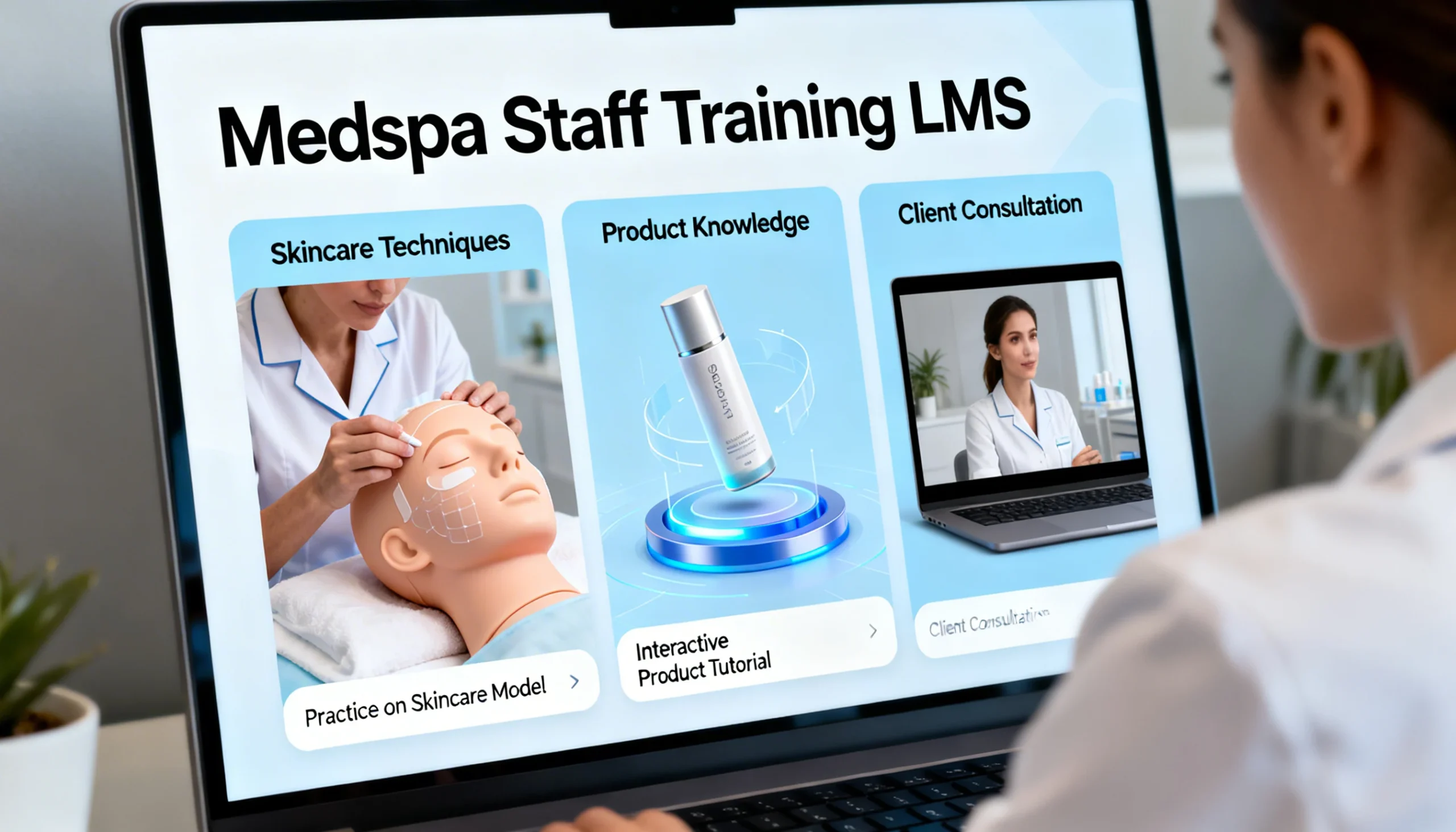
The #1 LCMS Solution for Medspas, Beauty and Wellness Groups
Enterprise medspa, beauty, and wellness groups face growing complexity as they scale including inconsistent training, uneven service quality, compliance risk, brand dilution, and slower employee ramp times across locations.
V-Unite provides a centralized, scalable platform designed to standardize training, upskill employees, and accelerate performance across every clinic, spa, and wellness location.
Book your exclusive demo today. Experience effortless growth.