“Medspa compliance is no longer a back-office issue reserved for lawyers and auditors. In 2026, it sits at the center of safe growth, patient trust, and operational stability for every aesthetic practice. Whether you are a medspa owner, medical director, practice manager, or compliance consultant, understanding the rules that shape daily operations is essential. A strong Medspa Checklist does more than organize tasks. It helps reduce liability, protect licenses, and align your business with evolving Medspa legal requirements.” – Stephen Handisides
Introduction to Medspa Compliance in 2026
Compliance matters more than ever because the medspa industry continues to grow while attracting tighter scrutiny from regulators, insurers, and patients. What used to be seen as a beauty-focused service is now firmly recognized as a healthcare-adjacent setting with medical, privacy, employment, and safety obligations. That shift means regulators are paying closer attention to who owns the practice, who performs procedures, how treatments are documented, and whether patients are adequately informed before care begins.
The risks of non-compliance are significant. A medspa can face fines, patient complaints, refund disputes, insurance issues, license discipline, or even litigation if its structure and procedures do not meet current standards. In some cases, a single violation, such as improper delegation of injectable procedures or a HIPAA breach involving patient photos, can trigger a much larger investigation into the entire operation.
At the same time, compliance is not just about avoiding penalties. It is also a business advantage. Patients are more likely to trust a medspa that demonstrates strong clinical oversight, transparent consent practices, secure communication, and consistent safety protocols. In a competitive market, a compliant medspa sends a clear message: this is a professional, reliable, and patient-centered brand.
Understanding the 2026 Medspa Regulatory Landscape
One of the biggest challenges in medspa compliance is the fact that the regulatory landscape is layered. Federal rules apply broadly in areas such as patient privacy, workplace safety, and device oversight. State law, however, often determines who can own a medspa, who can perform certain procedures, and how physician supervision must be structured. For that reason, a generic compliance approach is rarely enough. A useful Medspa Checklist must address both federal standards and state-specific obligations.
Federal agencies shape core compliance areas. HIPAA governs protected health information and how patient records, communications, and photos are stored, shared, and secured. OSHA regulates employee safety, infection control, hazard communication, and exposure prevention in the workplace. The FDA influences medspa operations through its oversight of devices, injectables, labeling, product storage, and adverse event reporting. These rules affect day-to-day clinic workflows much more than many operators realize.
State medical boards and licensing agencies add another layer of responsibility. They often define which procedures are considered medical, who may delegate them, and what level of supervision is required. A treatment that is routine in one state may require direct physician oversight in another. Ownership models can also vary significantly depending on how a state interprets the Corporate Practice of Medicine doctrine.
For medspas, this means compliance in 2026 must be dynamic, not static. It is not enough to create policies once and assume they will remain valid. Leaders need a process for reviewing updates, checking board guidance, training staff, and adjusting operations before small issues become major liabilities.
Building a Legally Compliant Medspa Structure
Before a medspa can market treatments or hire staff, it needs a legally sound structure. This is where many businesses make costly mistakes. A beautiful brand and strong revenue model cannot protect a clinic that is built on the wrong ownership or management framework. Understanding Medspa legal requirements at the entity level is critical from day one.
Choosing the right business entity depends on state law, the services offered, and who will be clinically responsible for care. In many states, ownership of a medical spa is restricted or heavily influenced by the Corporate Practice of Medicine doctrine. This doctrine generally limits non-physicians from owning or controlling medical decision-making. For medspa owners and entrepreneurs, especially non-medical investors, this creates an urgent need to structure the business properly from the start.
Medical director requirements are equally important. In some states, the medical director must actively supervise protocols, review charts, train staff, and maintain meaningful involvement in clinical operations. In others, rules may define how often the physician must be on-site or available for consultation. A nominal medical director who only lends their name to the practice can create substantial legal exposure.
Delegation is another high-risk area. Not every provider can legally perform every treatment, and not every physician can delegate the same procedures in the same way. Injectables, laser treatments, IV therapy, and other advanced services often fall under detailed scope-of-practice and supervision rules. A reliable Medspa Checklist should clearly identify which roles can perform which services, under what level of oversight, and with what documentation.
Employment classification also matters. Misclassifying clinical staff as independent contractors when they function like employees can create tax, wage, and liability issues. In a regulated healthcare setting, HR decisions and compliance decisions are often deeply connected.
Licensing and Credentialing Essentials
Licensing and credentialing are the foundation of a compliant medspa workforce. No matter how strong the brand or how advanced the equipment, a practice cannot operate safely or legally if its professionals are not properly licensed, verified, and monitored. This is one of the most practical areas where medspas can turn compliance into a repeatable system.
Every medspa should identify the licenses required for each role involved in patient care and operations. That includes physicians, nurse practitioners, physician assistants, registered nurses, licensed vocational or practical nurses where applicable, aestheticians, laser technicians, and any other professionals whose credentials affect treatment delivery. The exact rules vary by state, which is why credential verification should never be based on assumptions or prior experience in another market.
Best practices include primary source verification, documented onboarding reviews, and scheduled re-checks of active licenses and disciplinary history. Continuing education should also be tracked carefully, especially when certain procedures or technologies require specific certifications or training updates. Clinics that rely on expired credentials or incomplete onboarding documentation expose themselves to preventable regulatory problems.
Tracking license expiration dates efficiently is essential in 2026, particularly for growing medspas operating across multiple locations or states. Practice managers should use a centralized compliance tracker to monitor renewals, training deadlines, and documentation status. This turns licensing into an active process rather than a last-minute scramble.
Multi-state expansion adds complexity. A provider qualified in one state may not be authorized to perform the same services elsewhere, and telehealth-related workflows can create additional licensing questions depending on how consultations are conducted. For owners and consultants alike, licensing is not just an HR function. It is a core part of medspa compliance and one of the clearest indicators of whether a business is truly built for long-term growth.
Patient Consent and Documentation Compliance
Patient consent and documentation are two of the most important pillars of medspa compliance in 2026. If a treatment is performed without clear, legally sound consent or without complete charting, the medspa increases its exposure to disputes, board complaints, and liability claims. This is why every strong Medspa Checklist should begin with intake, consent, and recordkeeping protocols that are standardized across the clinic.
Consent forms should be procedure-specific, easy to understand, and updated regularly to reflect current risks, alternatives, expected outcomes, and post-care instructions. A generic form is rarely enough for injectables, laser services, IV therapy, or body contouring. Patients should have enough information to make informed decisions, and the medspa should be able to prove that discussion took place before treatment.
Documentation must also be consistent and defensible. Best practice includes recording the patient’s history, assessment, treatment plan, product or device details, lot numbers where applicable, settings used, provider name, adverse reactions, and follow-up instructions. Incomplete records are one of the fastest ways to weaken legal defenses and create operational confusion.
Digital recordkeeping standards matter just as much as the content itself. Records should be organized, time-stamped, access-controlled, and easy to retrieve during audits or patient requests. Photography consent deserves special attention as well. Before-and-after images are valuable for education and marketing, but they require specific patient authorization, especially when images may be shared publicly. Retention policies should also be defined clearly so the medspa knows how long records, photos, and signed forms must be stored under applicable Medspa legal requirements.
HIPAA Compliance Checklist for Medspas
HIPAA remains one of the most visible and misunderstood areas of medspa compliance. Many clinics assume privacy compliance only applies to large medical practices or hospitals, but medspas routinely handle protected health information through consultation forms, treatment records, photographs, billing systems, emails, and text messages. That makes HIPAA a daily operational issue, not just a policy manual topic.
A practical Medspa Checklist for HIPAA should include secure storage of electronic health records, role-based access controls, password protection, device security, and clear policies for who can view, edit, or transmit patient information. If front-desk staff, providers, remote team members, and vendors all interact with patient data, those access points must be monitored closely.
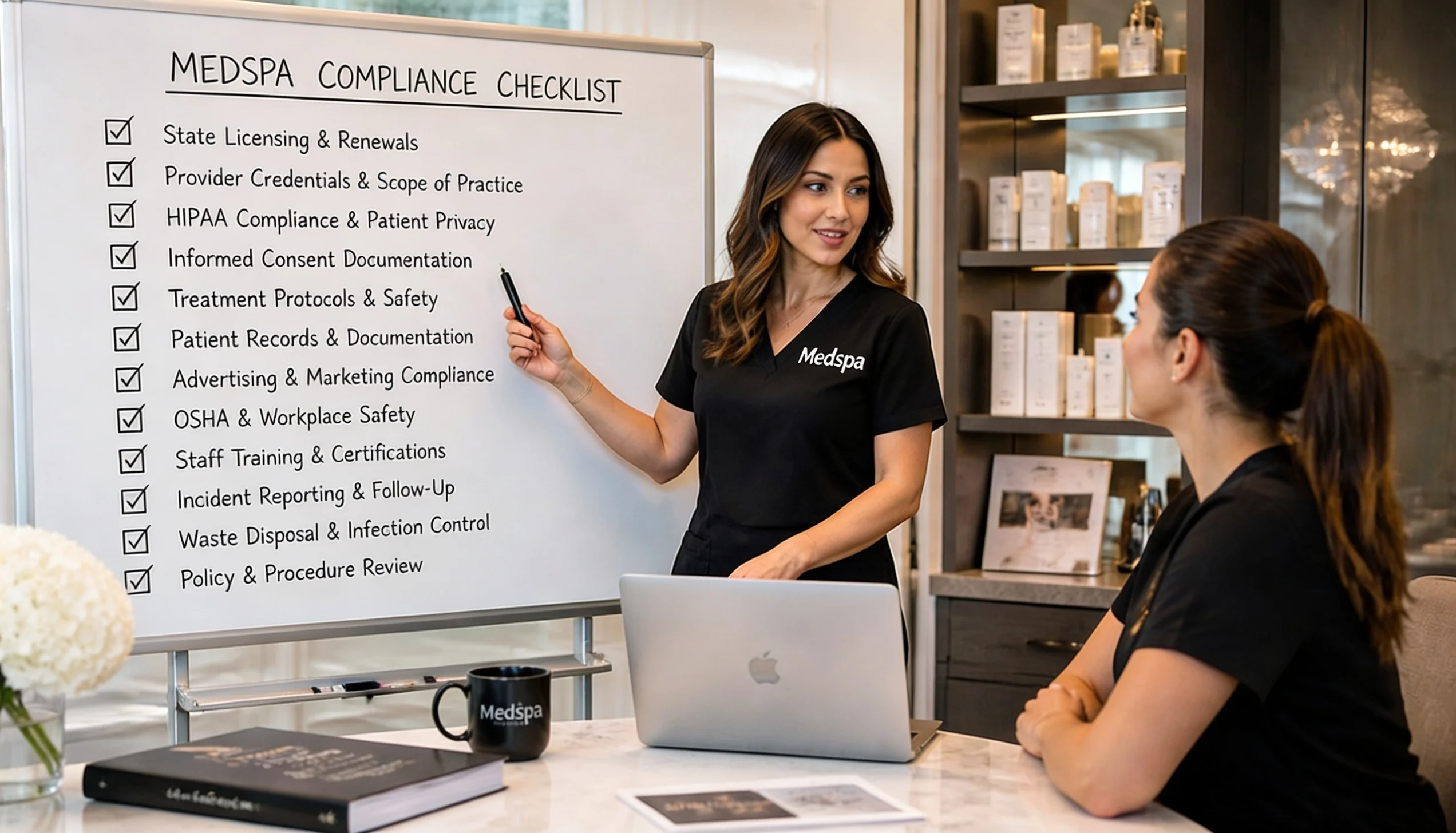
Here is the breakdown of the checklist:
Business structure
- Confirm ownership model complies with CPOM and state law
- Verify business entity, zoning, and local permits
- Review medical director agreement and supervisory duties
Licensing and credentialing
- Verify all provider licenses are active
- Track renewals, CE requirements, and certifications
- Document scope of practice for each role
- Patient consent and records
Use updated procedure-specific consent forms
- Maintain complete treatment notes and aftercare instructions
- Obtain written photo and marketing consent
- Follow record retention policies
- HIPAA compliance
Secure EHR access with passwords and role permissions
- Train staff on privacy and secure communication
- Protect patient photos, emails, and text messages
- Maintain breach response procedures
- OSHA and workplace safety
Keep bloodborne pathogen training current
- Maintain infection control and room sanitization protocols
- Store chemicals properly and keep Safety Data Sheets accessible
- Dispose of sharps and biohazard waste correctly
- Treatment compliance
Confirm who can perform each procedure legally
- Document supervision requirements for injectables, lasers, and IV therapy
- Maintain emergency protocols and adverse event procedures
- Standardize treatment workflows and charting
- FDA and product/device controls
Source products from authorized suppliers
- Monitor expiration dates and storage conditions
- Keep device maintenance and calibration logs
- Report adverse events when required
- Marketing and AI compliance
Avoid misleading claims and unsubstantiated results
- Review before-and-after usage permissions
- Monitor chatbot and automation tools for privacy and accuracy
- Ensure AI tools do not replace licensed clinical judgment
Audit routine
- Daily: consent, sanitation, chart completion
- Weekly: spot-check records and inventory
- Monthly: review documentation and training logs
- Quarterly: risk assessment and policy updates
- Annually: full compliance audit and legal review
Employee training is another core requirement. Staff should understand how to verify identity before sharing information, how to avoid discussing patient details in public areas, and how to handle emails, text messages, and photo sharing in a compliant way. Training should happen during onboarding and continue through regular refreshers, especially as communication tools evolve.
Cybersecurity has become one of the biggest HIPAA pressure points in 2026. Phishing attacks, weak passwords, unsecured tablets, and poorly configured cloud systems can expose sensitive patient data fast. A medspa does not need to be a massive organization to be targeted. Small and mid-sized clinics are often more vulnerable because they rely on convenience tools without proper safeguards.
Penalties for HIPAA violations can be costly financially and reputationally. Even when a breach seems minor, the resulting investigation can uncover broader compliance gaps. For medspas, privacy compliance is about more than avoiding fines. It protects patient trust, brand credibility, and the clinic’s long-term ability to grow responsibly.
OSHA and Workplace Safety Requirements
OSHA compliance is where patient care and employee protection meet. In a medspa environment, safety rules are not optional housekeeping details. They directly affect infection control, staff readiness, inspection outcomes, and the overall professionalism of the practice. A medspa that overlooks workplace safety often reveals broader weaknesses in operations.
Bloodborne pathogen standards are especially important in clinics offering injectables, microneedling, PRP, and other procedures involving exposure risks. Staff must know how to prevent contact, respond to incidents, and use personal protective equipment correctly. Written exposure control plans, training logs, and accessible protocols should all be part of the clinic’s routine compliance system.
Infection control procedures should be documented and followed consistently across treatment rooms, shared equipment, and common areas. That includes cleaning schedules, hand hygiene protocols, sterilization workflows, and clear separation between clean and contaminated items. A polished interior means very little if the underlying clinical habits are inconsistent.
Hazard communication and chemical safety also matter. Medspas frequently use disinfectants, topical agents, and treatment-related products that require proper labeling, storage, and staff awareness. Safety Data Sheets should be current and easy to access. Employees should know what they are handling and what to do if exposure occurs.
Sharps disposal and biohazard waste management must be handled with precision. Overfilled sharps containers, poor disposal habits, or unclear responsibilities create avoidable risk. Employee safety training should be structured, documented, and repeated regularly. For practice managers, OSHA is not separate from business performance. It is part of the foundation of safe, efficient, and inspection-ready operations.
Treatment and Procedure Compliance Standards
Treatment compliance is where many medspas face the greatest scrutiny because this is where business growth, clinical judgment, and regulatory limits collide. In 2026, medspas need to be especially careful about who performs procedures, under what authority, and with what documentation. This area cannot run on assumptions, habits, or verbal agreements.
Injectable services require clear clinical protocols, proper licensure, appropriate supervision, and thorough charting. The same applies to laser and energy-based device treatments, which often involve state-specific rules on training, delegation, and physician oversight. A provider may be technically skilled and still be operating outside the law if the supervisory structure is not valid.
IV therapy has become another important compliance focus. Depending on the state and treatment model, rules may affect patient evaluation, prescribing, administration, emergency preparedness, and supervision. Body contouring and wellness services also need careful review because the regulatory classification of these treatments may differ based on the device, the claims made in marketing, and the person delivering the service.
Proper supervision is the thread that connects all advanced procedures. Medical directors and practice owners should be able to answer simple but critical questions: Who is allowed to perform each service? What training is required? What level of physician involvement is mandated? How is competency documented? If those answers are vague, the clinic likely has a compliance gap.
This is why a strong Medspa Checklist should include procedure-specific rules, supervision standards, training records, emergency response protocols, and documentation requirements for every major service line. Strong treatment compliance does not slow down growth. It makes growth safer, more scalable, and more defensible.
How Medical Virtual Assistants Can Support Compliance
Medical virtual assistants can play a valuable role in strengthening medspa compliance in 2026, especially as clinics handle more patients, more communication channels, and more documentation demands with lean internal teams. While they do not replace licensed providers, compliance officers, or legal counsel, they can support the systems that keep a medspa organized, consistent, and audit-ready. For many growing practices, this support can be the difference between reactive compliance and structured compliance.
One of the biggest benefits is improved appointment documentation and record accuracy. Virtual assistants can help confirm that intake forms are complete, patient information is updated, charts are routed properly, and missing documents are flagged before the day’s schedule moves forward. That kind of administrative precision helps reduce preventable gaps that often create compliance risk later.
They can also support HIPAA-compliant patient communication when workflows and permissions are set correctly. This may include sending appointment reminders, following approved scripts, organizing secure messages, and escalating sensitive issues to in-house staff. The key is to ensure virtual assistants work within defined access controls, privacy protocols, and communication boundaries.
Consent and intake form management is another area where medical virtual assistants can add value. They can help track unsigned forms, organize documentation before appointments, and make sure required records are easy to retrieve. This directly supports a better Medspa Checklist process because it reduces administrative inconsistency.
Virtual assistants may also assist with audit preparation by helping organize training logs, compliance files, policy acknowledgments, equipment records, and documentation reports. Most importantly, they help reduce administrative compliance errors, which are often small, repetitive mistakes that build into larger problems. In a modern medspa, smart support systems are not just convenient. They are part of sustainable compliance operations.
Conclusion
Medspa compliance in 2026 is no longer something practices can afford to treat as occasional maintenance. It is a core business function that affects clinical safety, legal protection, operational efficiency, and long-term brand trust. From ownership structure and licensing to patient privacy, OSHA standards, FDA oversight, and AI governance, the modern medspa operates inside a far more demanding regulatory environment than even a few years ago.
The key takeaway is simple: compliance works best when it is proactive. Clinics that review their structure, clarify supervision, standardize documentation, train staff consistently, and use a practical Medspa Checklist are far better positioned to avoid disruption. More importantly, they create a stronger patient experience built on trust, safety, and professionalism.
Proactive compliance also supports growth. It helps medspas expand with more confidence, onboard teams more effectively, prepare for audits with less stress, and reduce the costly setbacks that come from preventable mistakes. In that sense, compliance is not just protection. It is infrastructure.
For medspa owners, medical directors, practice managers, and industry consultants, the goal in 2026 should not be perfection. It should be consistency, accountability, and continuous improvement. That is what builds a safe, trusted, and resilient medspa brand in a competitive market.
Frequently Asked Questions (FAQs)
What licenses are required to operate a medspa in 2026?
The answer depends on the state, services offered, and who performs them. Most medspas need licensed medical oversight plus properly credentialed clinical providers for regulated treatments.
Can non-physicians own a medical spa?
In some states, yes, but ownership may be limited by Corporate Practice of Medicine rules. This is one of the most important Medspa legal requirements to review before launching or restructuring a practice.
How often should a medspa conduct compliance audits?
A strong approach includes daily checks, monthly documentation reviews, quarterly risk assessments, and annual full compliance evaluations.
What are the biggest HIPAA risks for medspas?
Common risks include unsecured patient photos, weak passwords, improper texting, poor access controls, and staff sharing information without authorization.
Are AI tools allowed in medspa patient communication?
They can be used carefully, but they should not replace licensed judgment or create misleading medical guidance. Oversight and privacy controls are essential.
What happens if a medspa fails a compliance inspection?
The result may range from corrective action requirements to fines, licensing issues, or deeper regulatory review depending on the severity of the findings.
Do medspas need OSHA training for all employees?
Employees exposed to workplace hazards or clinical risks generally need appropriate OSHA-related training based on their role and responsibilities.
How can medspas stay updated on changing regulations?
They should monitor state board guidance, review federal standards, update policies regularly, and conduct routine internal compliance reviews.
What insurance policies are essential for medspas?
Most practices should review professional liability, general liability, cyber liability, employment-related coverage, and property or equipment protection.
How can technology improve medspa compliance management?
Technology can centralize records, track licenses, organize audits, secure communications, and automate reminders for recurring compliance tasks.
Why can V-Unite help you with Medspa Compliance this 2026?
V-Unite can support medspas in 2026 by helping reduce the administrative burden that often causes compliance breakdowns. When clinics struggle with incomplete documentation, inconsistent patient communication, missing intake forms, and disorganized back-office processes, risk starts to grow quietly. V-Unite helps bring structure to those workflows.
With the right support model, V-Unite can assist practices in maintaining documentation accuracy, managing patient communication with greater consistency, tracking required forms, and supporting audit readiness. That makes it easier for owners, medical directors, and practice managers to focus on higher-level oversight while reducing avoidable administrative errors.
In a market where compliance expectations are rising, operational support is no longer just about saving time. It is about protecting the business. If your medspa wants stronger systems, cleaner processes, and better day-to-day execution, V-Unite can be a practical partner in helping you build a more compliant and scalable operation.