
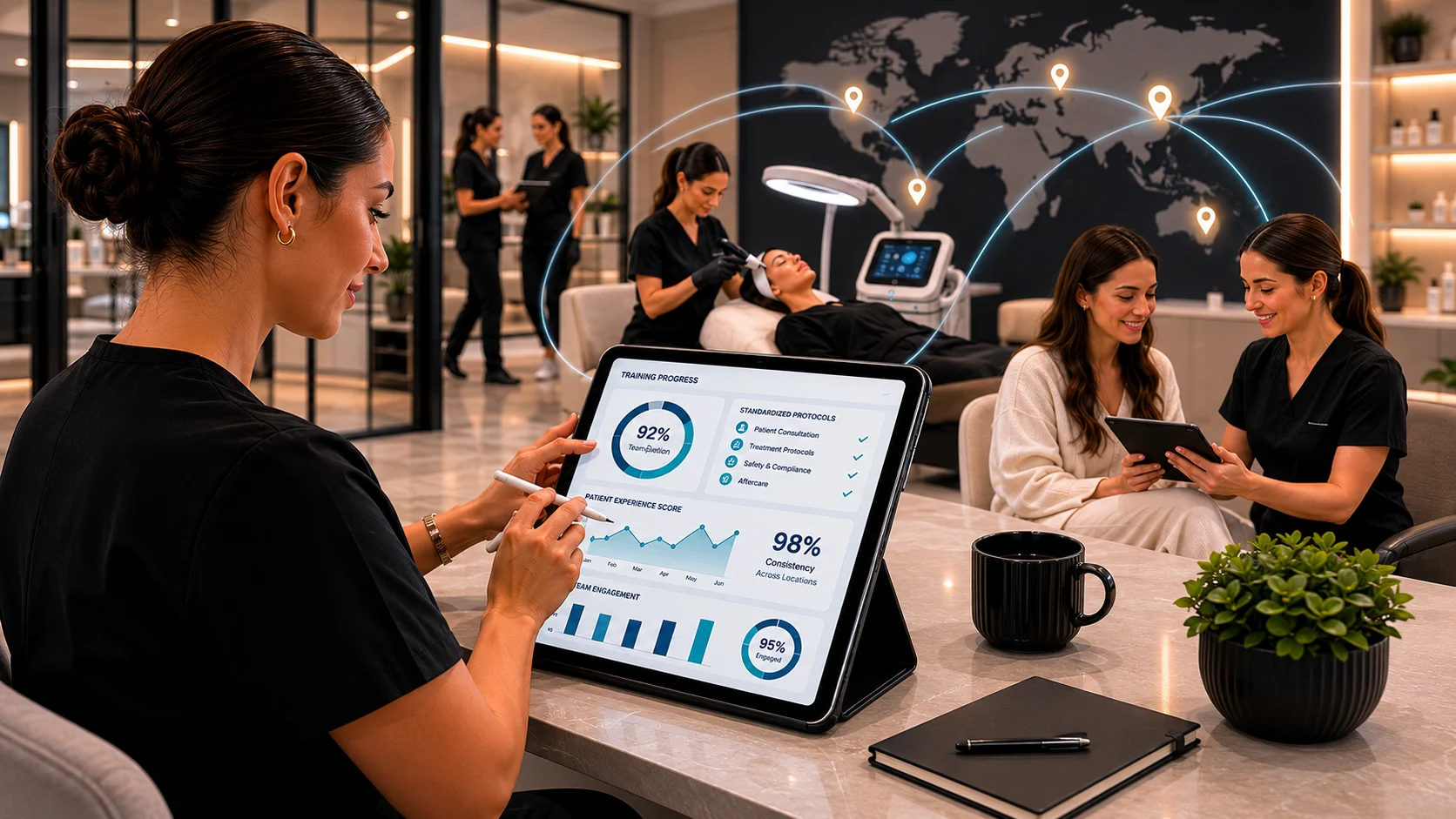
“The medspa industry is evolving rapidly, with brands expanding from single-location practices into multi-location enterprises. As growth accelerates, maintaining a consistent patient experience becomes one of the biggest operational challenges. This is where a strong Medspa LMS can play a critical role. By centralizing training, standardizing protocols, and improving communication across teams, medspa owners can scale operations without compromising the quality of care that patients expect.” – Stephen Handisides
Introduction
The rise of multi-location medspa brands has created exciting opportunities for expansion, profitability, and market authority. However, scaling too quickly without operational alignment often leads to inconsistent service delivery. One location may provide exceptional consultations and patient care, while another may struggle with communication, treatment protocols, or customer service standards. These inconsistencies can damage brand reputation and reduce patient trust.
In aesthetic medicine, consistency is not optional. Patients expect the same level of professionalism, safety, and results no matter which branch they visit. Whether they are booking Botox treatments, laser procedures, or skincare consultations, patients associate every interaction with the overall brand identity. A poor experience at just one location can influence online reviews, referrals, and long-term loyalty.
The hidden costs of inconsistency are significant. Medspas dealing with uneven patient experiences often encounter higher staff turnover, declining retention rates, operational inefficiencies, and reduced revenue growth. Without structured systems in place, scaling becomes increasingly difficult and chaotic.
Modern medspa patients are also more informed and selective than ever before. They expect personalized care, seamless scheduling, transparent communication, and consistent treatment outcomes. Brands that fail to deliver a unified experience across locations risk losing patients to competitors who prioritize operational excellence and standardized service delivery.
For growing medspa brands, the solution lies in creating scalable systems that align staff training, workflows, technology, and patient engagement strategies across every clinic.
Understanding the Patient Experience in the Medspa Industry
The patient experience in aesthetic medicine extends far beyond the treatment room. It includes every interaction a patient has with the brand, from the initial online inquiry to post-treatment follow-ups. For multi-location medspas, ensuring consistency throughout this journey is essential for building trust and long-term loyalty.
A typical patient journey begins with digital engagement. Patients may discover a medspa through social media, online reviews, or referrals before booking an appointment. Their first impression is often shaped by how responsive and professional the brand appears online. Once they visit a location, every touchpoint—including front desk interactions, consultations, treatment procedures, and aftercare communication—contributes to their overall perception.
Patient satisfaction in the medspa industry is influenced by three major components: emotional, clinical, and operational experiences.
Emotionally, patients want to feel heard, respected, and confident in their provider’s expertise. Aesthetic treatments are deeply personal, and trust plays a central role in the decision-making process. Clinically, patients expect safe procedures, skilled practitioners, and consistent outcomes. Operationally, they value convenience, efficiency, and smooth communication.
When multiple locations operate without standardized systems, these elements can vary significantly. One clinic may excel in consultation quality, while another may provide inconsistent follow-up care. Over time, these differences weaken the brand experience.
Brand perception is especially important in the aesthetic industry because patients often associate quality with consistency. A medspa that delivers reliable service across every branch is more likely to generate positive reviews, referrals, and repeat appointments. This is why many growing organizations invest heavily in Medspa staff training and centralized operational systems.
Trust is another defining factor in patient retention. Patients need confidence that every provider within the organization follows the same clinical standards and delivers the same level of care. Inconsistent experiences can quickly erode that trust, particularly in treatments involving injectables, lasers, or advanced skincare procedures.
To build a scalable and trustworthy brand, medspas must focus on creating repeatable patient experiences that feel seamless regardless of location.
Common Causes of Inconsistent Patient Experiences
As medspa brands expand into multiple locations, operational gaps often become more noticeable. Without standardized systems and clear processes, maintaining a consistent patient experience becomes increasingly difficult.
One of the most common causes of inconsistency is variation in staff training and expertise. Different clinics may onboard employees differently, resulting in uneven skill levels, consultation styles, and treatment approaches. Without structured lms training, employees may rely on personal habits instead of brand-approved procedures.
Inconsistent consultation processes also contribute to patient dissatisfaction. Some providers may take a highly educational and personalized approach, while others may rush appointments or overlook patient concerns. This creates confusion and damages the overall brand experience.
Another major issue is the lack of standardized treatment protocols. When providers across locations use different techniques, documentation methods, or safety procedures, treatment outcomes can vary significantly. In the aesthetic industry, even small inconsistencies can impact patient confidence and satisfaction.
Customer service inconsistencies are equally problematic. Patients expect the same level of professionalism and hospitality regardless of which location they visit. However, differences in communication styles, scheduling procedures, and front desk operations often create frustration.
Communication gaps between locations can further complicate operations. Without centralized systems, clinics may struggle to share updates, policy changes, or training materials effectively. This often leads to confusion among staff and inconsistent implementation of company standards.
Technology disparities also create operational friction. Some clinics may use outdated scheduling systems or disconnected patient management tools, making it difficult to maintain continuity across locations. When systems are not integrated, patient information, appointment histories, and follow-up communications may become inconsistent.
A scalable training system for medspas can help solve many of these issues by ensuring every employee receives the same onboarding, compliance education, and operational guidance. Standardized digital training platforms also make it easier to update procedures and maintain alignment across all clinics.
Without centralized training and operational consistency, even the strongest medspa brands can struggle to protect their reputation during expansion.
The Business Impact of Poor Experience Standardization
Inconsistent patient experiences can have long-term consequences for growing medspa brands. While operational issues may seem minor at first, they often compound as more locations are added.
One of the most immediate impacts is negative online reviews. Patients who encounter inconsistent service, communication issues, or disappointing treatment outcomes are more likely to leave public feedback. In today’s digital landscape, online reputation directly influences patient acquisition and trust.
Poor experience standardization also contributes to declining patient retention rates. Patients expect reliability from established brands. If one location provides exceptional service while another fails to meet expectations, patients may choose to seek treatment elsewhere.
Cross-location referrals can also decrease. Ideally, patients should feel comfortable visiting any branch within the same organization. However, inconsistent experiences create uncertainty and reduce confidence in the brand as a whole.
Operational inefficiencies are another major concern. Without standardized workflows, clinics often duplicate efforts, struggle with onboarding, and spend more time correcting errors. These inefficiencies increase labor costs and slow down growth initiatives.
For medspa leaders focused on expansion, inconsistency creates one of the biggest barriers to scalability. Rapid growth without operational alignment can overwhelm teams and weaken brand identity. This is why successful multi-location medspa organizations prioritize structured systems, centralized communication, and standardized staff education from the beginning.
A strong operational foundation allows medspas to scale confidently while maintaining the signature patient experience that drives loyalty and revenue growth.
Standardizing Clinical Procedures Across Locations
For multi-location medspa brands, standardization is one of the most important foundations for sustainable growth. Without clearly defined clinical procedures, patient experiences can vary dramatically between locations, leading to confusion, inconsistent treatment outcomes, and reputational risks.
Developing comprehensive Standard Operating Procedures (SOPs) helps medspas create repeatable systems that every clinic can follow. SOPs should cover consultations, treatment preparation, injection protocols, sanitation procedures, aftercare instructions, documentation standards, and emergency response workflows. When every provider follows the same structured process, patients receive a more consistent and trustworthy experience regardless of location.
Uniform safety and compliance protocols are equally critical. Since aesthetic medicine involves medical procedures, maintaining consistent compliance standards across all clinics protects both patients and the business itself. Medspa leaders should ensure every employee understands regulatory requirements, patient consent procedures, and treatment safety guidelines.
Consistency in treatment outcomes also depends heavily on process alignment. Even highly skilled practitioners may produce different results if protocols are not standardized. By implementing clear treatment frameworks, brands can reduce variability while maintaining high-quality patient care.
Quality assurance measures help reinforce these standards over time. Regular audits, peer reviews, patient feedback evaluations, and performance assessments allow leadership teams to identify gaps before they become larger operational problems. Successful medspa organizations continuously monitor clinic performance instead of assuming every location operates at the same level.
A centralized Medspa LMS can significantly improve this process by ensuring that updated protocols, compliance training, and procedural changes are instantly distributed across every branch. This creates operational consistency while reducing administrative burdens on management teams.
Training and Onboarding Strategies for Multi-Location Teams
As medspa brands expand, employee onboarding and education become increasingly complex. Without a centralized training structure, each location may develop its own workflows, service styles, and operational habits. Over time, these inconsistencies can weaken the patient experience and create brand fragmentation.
Designing a centralized Medspa staff training program helps organizations maintain alignment across all clinics. Every employee, regardless of location, should receive the same onboarding experience, operational guidance, and brand education. This ensures that company expectations remain consistent from day one.
Role-based learning paths are especially valuable in multi-location operations. Front desk coordinators, patient care specialists, injectors, aestheticians, regional managers, and medical directors all require different training modules tailored to their responsibilities. Structured learning paths improve efficiency while ensuring each team member develops the necessary skills for their role.
Ongoing education is equally important. Aesthetic medicine evolves rapidly, with new technologies, products, and treatment techniques constantly entering the market. Conducting regular skills assessments allows medspas to identify knowledge gaps and reinforce training where needed. Continuous learning also helps employees stay confident and engaged in their work.
Training should extend beyond technical procedures. Reinforcing brand culture through education helps employees understand the organization’s mission, patient care philosophy, and communication standards. Patients notice when staff members consistently demonstrate professionalism, empathy, and confidence across every location.
Digital learning platforms have become essential for scaling training efficiently. A modern training system for medspas enables organizations to deliver standardized onboarding, compliance education, certifications, and operational updates from one centralized platform. This approach reduces training inconsistencies while improving accountability and scalability.
Additionally, digital lms training allows leadership teams to monitor employee progress, track certifications, and ensure compliance requirements are completed on time. For fast-growing medspa brands, centralized learning technology creates a more organized and scalable operational structure.
The Role of Technology in Experience Consistency
Technology plays a major role in creating a seamless and standardized patient experience across multiple medspa locations. Without integrated systems, clinics often struggle with communication gaps, inconsistent scheduling practices, and fragmented patient records.
Centralized CRM and patient management systems help unify operations by storing patient histories, treatment plans, consent forms, and communication records in one accessible platform. This ensures continuity of care, especially when patients visit different branches within the same organization.
Appointment scheduling standardization is another critical factor. Inconsistent booking procedures can create confusion, double bookings, long wait times, or poor patient communication. A unified scheduling process improves operational efficiency while delivering a smoother patient experience.
Automating patient communications also enhances consistency. Appointment confirmations, reminders, follow-up messages, aftercare instructions, and promotional campaigns should reflect the same brand voice across every location. Automation helps reduce human error while improving patient engagement.
Patient feedback tools provide valuable insights into operational performance. Surveys, review monitoring systems, and post-appointment feedback forms allow medspa leaders to identify recurring issues and address service inconsistencies quickly. Monitoring feedback across locations helps organizations maintain higher service standards over time.
Analytics platforms further support decision-making by revealing operational trends, patient retention rates, staff performance metrics, and satisfaction levels. Data-driven insights allow leadership teams to proactively improve service delivery before problems impact the broader brand.
When integrated with a Medspa LMS, these technologies create a more connected operational ecosystem. Training, communication, compliance tracking, and patient management become aligned under one scalable framework, helping medspa brands maintain consistency during expansion.
Leadership’s Role in Scaling Medspa Operations
Strong leadership is essential for maintaining consistency across multiple medspa locations. Even with advanced technology and standardized systems in place, operational success ultimately depends on how effectively leadership teams reinforce accountability, communication, and culture.
Creating accountability across teams helps ensure that operational standards are consistently followed. Leaders should establish measurable performance benchmarks for patient satisfaction, treatment quality, compliance, and staff development. Clear expectations help employees understand their role in protecting the brand experience.
Empowering location managers is equally important. Branch leaders act as the operational bridge between corporate leadership and frontline staff. Providing managers with proper training, resources, and decision-making authority allows them to address challenges quickly while maintaining alignment with company standards.
Cross-location collaboration can also strengthen operational consistency. Encouraging communication between clinics allows teams to share best practices, solve problems collectively, and maintain stronger organizational alignment. This collaborative culture reduces silos and improves overall efficiency.
Building a patient-centric company culture should remain a top priority during expansion. As organizations grow, there is often a risk of focusing too heavily on operational metrics while overlooking patient relationships. Successful medspa brands balance scalability with personalized care by ensuring every employee understands the importance of patient trust and satisfaction.
Leadership teams that invest in structured systems, continuous education, and operational transparency position their organizations for long-term growth. By combining strong leadership practices with scalable tools like lms training platforms and standardized operational frameworks, medspa brands can expand confidently without sacrificing the patient experience that defines their success.
Overcoming Challenges in Multi-Location Scaling
Scaling a medspa brand across multiple locations is rarely a linear process. Even with strong systems in place, growth introduces operational strain, cultural drift, and quality inconsistencies that can quietly erode the patient experience over time. The challenge is not just expansion—it’s controlled expansion.
Managing rapid growth without sacrificing quality is one of the most pressing concerns for medspa founders and COOs. When new clinics open quickly, leadership teams often struggle to maintain oversight of daily operations. This is where standardized workflows, structured onboarding, and a reliable training system for medspas become essential. Without them, each location begins to operate like an independent business rather than part of a unified brand.
Staff turnover adds another layer of complexity. The aesthetic industry is highly talent-driven, and replacing skilled providers or front desk staff can disrupt consistency. When new hires are onboarded through informal or location-specific methods, gaps in knowledge quickly emerge. A centralized Medspa staff training approach helps solve this by ensuring every employee—new or existing—follows the same learning path, regardless of when or where they join.
Local market differences also present a real operational challenge. Patient expectations in one city may differ significantly from another in terms of pricing sensitivity, treatment preferences, or communication style. While adaptation is necessary, it must not come at the expense of core brand standards. The goal is to localize experience, not dilute quality. Clear SOPs and consistent brand training help maintain this balance.
Perhaps the most delicate challenge is balancing standardization with flexibility. Too much rigidity can make staff feel constrained, while too much flexibility leads to inconsistency. Successful medspa brands define non-negotiable standards—such as safety protocols, consultation structure, and patient communication tone—while allowing flexibility in areas like personalization and patient rapport.
A well-structured Medspa LMS plays a critical role in managing these challenges. It ensures that training, updates, certifications, and compliance requirements are delivered consistently across all locations, even as the organization scales rapidly. This reduces dependency on manual oversight and helps leadership maintain control without micromanaging every clinic.
Future Trends in Medspa Experience Management
The future of medspa operations is being shaped by automation, personalization, and data-driven decision-making. As competition increases, brands that adopt technology early will have a significant advantage in delivering consistent, high-quality patient experiences at scale.
Artificial intelligence and automation are already transforming patient engagement. From AI-powered chat systems to automated booking and follow-up workflows, medspas are increasingly relying on technology to streamline communication. These tools reduce administrative workload while ensuring patients receive timely, consistent responses across all locations.
Hyper-personalized aesthetic experiences are also becoming the new standard. Patients no longer respond to generic treatment plans—they expect customized recommendations based on their skin type, goals, and history. When combined with centralized data systems, personalization can be delivered consistently across all branches, strengthening both trust and loyalty.
Teleconsultations and hybrid care models are expanding access to medspa services. Virtual consultations allow patients to connect with providers before visiting a clinic, improving convenience and conversion rates. However, without standardized consultation frameworks, virtual experiences can become inconsistent. Structured training and digital protocols ensure that every consultation—online or in-person—reflects the same brand quality.
Data-driven decision-making is another major trend shaping multi-location medspa brands. Leaders now have access to detailed analytics on patient retention, treatment performance, revenue trends, and staff productivity. This data allows organizations to identify gaps, optimize workflows, and improve overall service delivery across locations.
When paired with structured lms training and centralized operational systems, these technologies create a powerful ecosystem for scalable growth. Medspas can maintain consistency while continuously improving performance based on real-time insights.
Conclusion
Consistency is the foundation of sustainable growth for any multi-location medspa brand. Without it, expansion can quickly lead to operational fragmentation, inconsistent patient experiences, and weakened brand trust.
The long-term benefits of operational standardization are significant. From improved patient retention and stronger online reputation to more efficient staff training and streamlined workflows, consistency directly impacts profitability and scalability. When every location delivers the same level of care, patients gain confidence in the brand as a whole.
Ultimately, scaling a medspa successfully requires more than just opening new locations—it requires building systems that ensure every patient experience feels intentional, professional, and aligned with the brand promise. Organizations that invest in structured training, centralized technology, and leadership alignment are far better positioned for long-term success.
With the right combination of SOPs, leadership structure, and a powerful training system for medspas, brands can scale without losing what made them successful in the first place: trust, quality, and patient satisfaction.
FAQs
Why do patient experiences vary between medspa locations?
Patient experiences vary mainly due to inconsistent staff training, differing operational workflows, and a lack of standardized clinical and customer service protocols. Without a unified system in place, each location may develop its own approach to consultations, treatments, and communication, leading to uneven service quality.
How can medspa brands standardize services across clinics?
Standardization begins with clearly defined SOPs, centralized onboarding, and consistent clinical guidelines. Many growing brands also implement a training system for medspas to ensure every employee follows the same procedures regardless of location. This helps align both clinical outcomes and patient experience.
What technologies help improve consistency in multi-location medspas?
Centralized CRM systems, automated scheduling tools, patient communication platforms, and performance analytics dashboards are key technologies. When paired with structured lms training, these systems ensure that both operational processes and staff education remain consistent across all branches.
How often should medspa staff receive training?
Staff should receive continuous training, not just during onboarding. Quarterly refresher courses, monthly updates on new treatments or protocols, and ongoing lms training modules help ensure skills remain current and aligned with brand standards.
What metrics should medspa owners track to measure patient satisfaction?
Key metrics include patient retention rate, Net Promoter Score (NPS), online reviews, treatment rebooking rates, and consultation-to-conversion ratios. Tracking these metrics across all locations helps identify inconsistencies in the patient experience.
How can medspas personalize care while maintaining brand consistency?
Personalization should occur within a standardized framework. While treatment recommendations can be tailored to individual patients, the consultation process, communication style, and clinical protocols should remain consistent. This balance is achieved through structured Medspa staff training and clear SOPs.
What are the biggest challenges when scaling a medspa brand?
The biggest challenges include maintaining service quality across locations, managing staff turnover, ensuring consistent training, and preventing operational drift. Without a centralized training system for medspas, these challenges often become more pronounced as the brand expands.
Why is patient experience critical for medspa growth?
Patient experience directly impacts retention, referrals, online reputation, and revenue growth. In aesthetic medicine, trust and consistency are key drivers of long-term success, making experience management a core growth strategy rather than a secondary concern.
How can V-Unite help you with your multi-location inconsistent patient experiences?
As medspa brands scale, maintaining consistency becomes increasingly complex. V-Unite helps solve this challenge by providing a centralized platform designed to streamline onboarding, standardize procedures, and unify training across all locations.
By integrating structured lms training, automated workflows, and performance tracking, V-Unite enables medspa organizations to ensure every employee follows the same operational and clinical standards—no matter where they work.
This creates a more consistent patient journey, reduces operational inefficiencies, and strengthens brand reputation across every clinic location.
Why V-Unite?
If your medspa brand is expanding and struggling with inconsistent patient experiences across locations, it may be time to rethink your training and operational systems.
V-Unite provides a scalable solution designed specifically for multi-location medspa growth. From centralized onboarding to continuous Medspa staff training, it helps your teams stay aligned, compliant, and performance-ready at every stage of expansion.
Build consistency. Protect your brand. Scale with confidence.