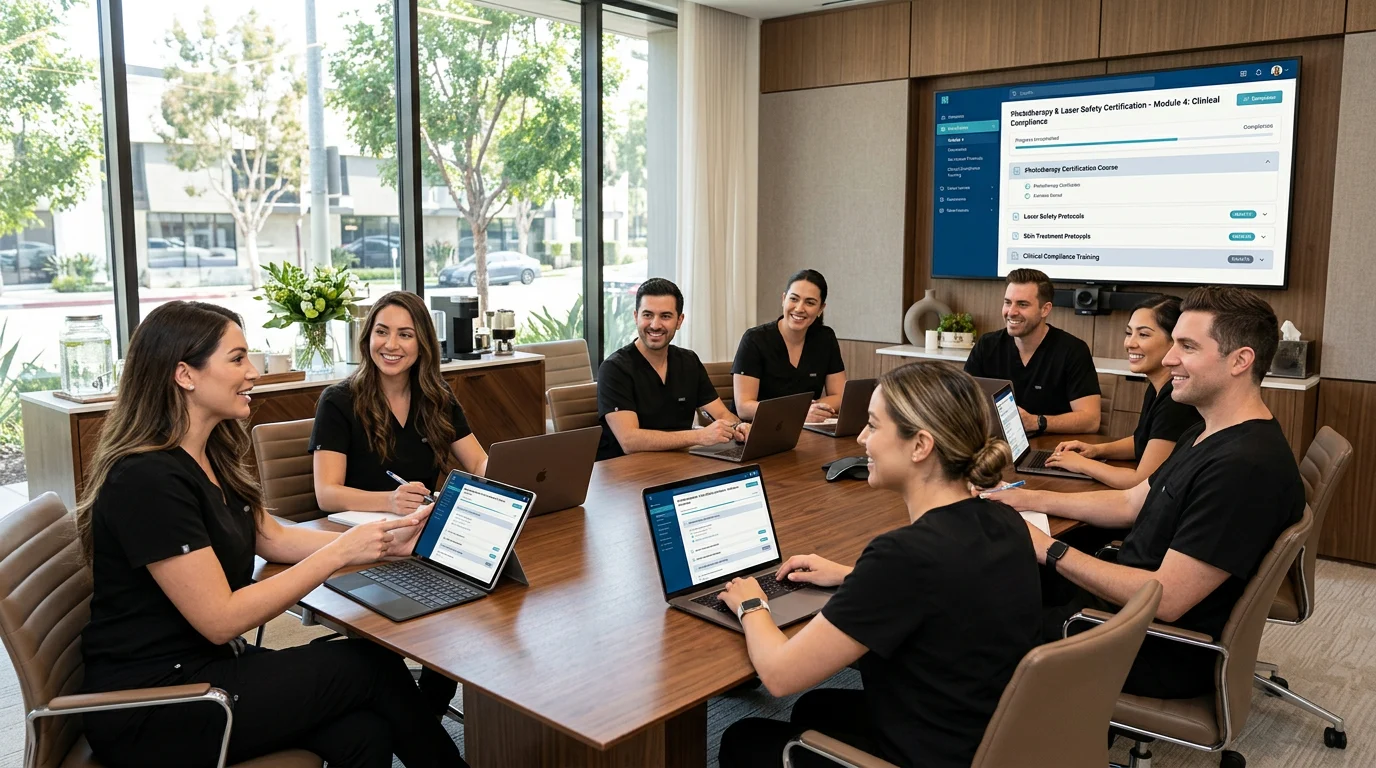
“For today’s medspa owners and medical directors, staying compliant is no longer a simple administrative task. As regulations continue to evolve and treatment offerings expand, maintaining accurate records, certifications, and policies has become increasingly complex. Effective Medspa compliance training is now a critical component of protecting your business from costly penalties, operational disruptions, and legal liabilities.” – Stephen Handisides
Whether you operate a single location or oversee multiple clinics, compliance management touches nearly every aspect of your organization. From staff credential verification and patient documentation to HIPAA requirements and training records, every detail matters. Missing a single deadline or overlooking an expired certification can expose your practice to significant risk.
Why Compliance Management Is Becoming More Complex for Medspas
The modern medspa industry has experienced tremendous growth over the past decade. Services such as injectables, laser treatments, body contouring, IV therapy, and advanced skincare procedures have expanded the scope of practice for many providers. Alongside this growth comes increased regulatory oversight from state medical boards, health agencies, and privacy regulators.
Many medspas must now manage compliance requirements across multiple providers, treatment categories, and locations. As teams grow, maintaining visibility into employee certifications, policy acknowledgments, and required training becomes increasingly difficult using traditional methods.
Adding to the challenge is employee turnover. New hires must quickly complete onboarding requirements while existing staff must stay current with ongoing compliance obligations. Without a structured system, important tasks can easily fall through the cracks.
The Hidden Costs of Manual Compliance Tracking
Many medspas still rely on spreadsheets, paper files, shared folders, and manual reminders to manage compliance activities. While these methods may appear cost-effective initially, they often create hidden operational expenses.
Practice managers frequently spend hours every week tracking certification expiration dates, collecting signed documents, updating training records, and preparing for audits. These repetitive administrative tasks divert valuable time away from patient care, staff development, and business growth.
Manual systems also increase the likelihood of errors. Duplicate records, missing documentation, inconsistent filing practices, and overlooked deadlines can quickly become serious compliance issues. What starts as a minor administrative oversight can escalate into fines, legal disputes, or reputational damage.
How Automation Reduces Regulatory Risk and Administrative Burden
Automation helps medspas transform compliance management from a reactive process into a proactive one. Instead of relying on memory, spreadsheets, or paper checklists, automated systems centralize compliance data and continuously monitor critical requirements.
Automated compliance tracking can generate alerts for upcoming license renewals, identify missing documentation, assign required training, and maintain audit-ready records. By reducing manual intervention, medspas can significantly lower the risk of human error while improving operational efficiency.
Perhaps most importantly, automation provides leadership teams with confidence that compliance obligations are being monitored consistently across the organization.
What Readers Will Learn in This Guide
In this guide, you’ll discover the key compliance areas every medspa must monitor, the risks associated with manual tracking systems, and the practical steps required to automate compliance management successfully. You’ll also learn how modern technology can help reduce administrative workload, improve accountability, and create a more reliable compliance infrastructure for long-term growth.
Understanding Medspa Compliance Requirements
What Compliance Means in the Modern Medspa Industry
Compliance in a medspa environment extends far beyond simply following regulations. It involves creating systems that consistently ensure patient safety, staff competency, documentation accuracy, and operational accountability.
A compliant medspa demonstrates that every treatment is performed by properly trained professionals, supported by accurate documentation, and aligned with applicable state and federal regulations. Maintaining this standard requires ongoing monitoring and continuous process improvement.
Key Regulatory Areas Every Medspa Must Monitor
Successful compliance management requires visibility across several critical operational areas.
Licensing and Credential Verification
Every provider performing medical or aesthetic treatments must maintain current licenses, certifications, and credentials as required by state regulations. Monitoring expiration dates and renewal requirements is essential to avoid interruptions in service or regulatory violations.
Patient Consent Documentation
Proper informed consent is a cornerstone of risk management. Medspas must maintain accurate and accessible records demonstrating that patients understood treatment risks, benefits, and alternatives before procedures were performed.
Medical Record Management
Comprehensive medical records provide documentation of patient care and support clinical decision-making. Incomplete, inaccurate, or missing records can create significant legal and operational challenges during audits or investigations.
HIPAA and Data Privacy Requirements
Protecting patient information remains a top compliance priority. Medspas must implement safeguards to ensure that protected health information is stored, accessed, and shared appropriately while meeting all applicable privacy requirements.
Staff Training and Certification Compliance
Ongoing education is critical for maintaining treatment quality and regulatory compliance. Organizations must document completed training, monitor certification requirements, and ensure employees remain qualified to perform assigned procedures.
Common Compliance Challenges Faced by Growing Medspas
As medspas expand, compliance management becomes increasingly difficult to coordinate. Multiple providers, diverse treatment offerings, and growing staff numbers create more opportunities for documentation gaps and oversight failures.
Without standardized systems, leadership teams often struggle to maintain visibility into employee qualifications, policy acknowledgments, and compliance status across the organization. These challenges frequently increase as businesses scale.
The Risks of Relying on Manual Compliance Processes
Why Spreadsheets and Paper-Based Systems Fall Short
Manual compliance processes often depend on individual employees to update records, monitor deadlines, and maintain documentation. While this approach may work for smaller practices, it becomes increasingly unreliable as operations grow.
Spreadsheets are prone to version-control issues, while paper records can be misplaced, damaged, or difficult to access during audits. As compliance requirements become more complex, manual systems struggle to provide the consistency and accountability modern medspas require.
Common Human Errors That Lead to Compliance Failures
Missed Renewal Deadlines
Licenses, certifications, and training requirements often have strict renewal schedules. Manual tracking systems make it easy for critical deadlines to be overlooked, potentially exposing the organization to regulatory action.
Incomplete Documentation
Missing consent forms, unsigned policies, or incomplete training records can create significant compliance gaps. These issues frequently surface during inspections or audits when documentation is most critical.
Inconsistent Record Keeping
When different departments or managers follow varying documentation practices, records become fragmented and difficult to verify. This inconsistency increases the likelihood of compliance violations and operational inefficiencies.
Financial, Legal, and Reputational Consequences of Non-Compliance
The consequences of compliance failures can be severe. Regulatory fines, legal disputes, corrective action plans, and operational disruptions can create significant financial burdens for medspa owners.
Beyond direct costs, compliance issues can damage patient trust and negatively impact brand reputation. In an industry built on credibility and safety, even a single compliance failure can influence future growth and profitability.
For medspa leaders, proactive compliance management is not simply a regulatory requirement—it is a business necessity that protects both patients and the long-term success of the organization.
Step 1: Audit Your Current Compliance Processes
Before implementing any automation strategy, medspa leaders must first understand the current state of their compliance operations. Automating inefficient or incomplete processes simply accelerates existing problems. A thorough compliance audit creates the foundation for a successful automation initiative and helps identify the areas where the greatest improvements can be achieved.
Conducting a Comprehensive Compliance Assessment
Begin by reviewing every compliance-related activity performed throughout the organization. This includes training management, credential verification, policy acknowledgments, patient documentation, incident reporting, and regulatory recordkeeping.
The goal is to identify where compliance information currently resides, who is responsible for managing it, and how consistently processes are being followed. Many medspas discover that critical compliance data is spread across spreadsheets, email inboxes, paper files, and disconnected software platforms.
Identifying Compliance Tasks Suitable for Automation
Not every process requires manual oversight. Many repetitive compliance activities can be automated to reduce administrative workload and improve accuracy.
Common opportunities for automation include:
Recurring Documentation Requirements
Routine document collection, policy sign-offs, consent form tracking, and annual compliance acknowledgments can all be automated through digital workflows.
Credential Tracking
Monitoring provider licenses, certifications, continuing education requirements, and expiration dates becomes significantly easier when automated systems continuously track renewal timelines.
Policy Acknowledgment Monitoring
Automation ensures employees receive updated policies, complete acknowledgments on time, and generate documented proof of compliance for audit purposes.
Mapping Compliance Workflows Across Departments
Compliance responsibilities often extend across multiple departments, including clinical teams, human resources, operations, and leadership. Mapping these workflows provides visibility into how information moves throughout the organization.
Understanding these interdependencies helps identify process bottlenecks, duplicate efforts, and areas where automation can create greater efficiency.
Establishing Baseline Compliance Metrics
Before implementing automation, establish measurable benchmarks. Metrics such as overdue certifications, training completion rates, documentation accuracy, audit preparation time, and administrative hours spent on compliance tasks provide valuable performance indicators.
These baseline measurements allow leadership teams to clearly quantify the return on investment after automation is introduced.
Step 2: Centralize Compliance Data in a Digital System
Automation becomes significantly more effective when all compliance-related information is stored in a centralized platform. Without centralization, organizations continue to struggle with fragmented records, inconsistent reporting, and limited visibility into compliance status.
Why Centralization Is the Foundation of Compliance Automation
A centralized compliance system creates a unified environment where all records, documentation, and compliance activities can be managed from a single location.
Instead of searching through multiple databases, spreadsheets, and filing cabinets, authorized personnel can access critical information instantly. This not only improves operational efficiency but also strengthens accountability across the organization.
Creating a Single Source of Truth for Compliance Records
A centralized platform should serve as the authoritative source for all compliance-related information.
Employee Credentials and Certifications
Provider licenses, training certificates, continuing education records, and competency validations should be maintained within one secure system. This enables managers to quickly verify compliance status and identify upcoming renewal requirements.
Patient Documentation
Consent forms, treatment records, medical histories, and compliance-related patient documentation should be organized in a structured and easily accessible format.
Regulatory Policies and Procedures
Current policies, standard operating procedures, compliance manuals, and regulatory updates should be maintained within a centralized repository to ensure staff always access the latest approved versions.
Eliminating Data Silos Between Teams
One of the most common compliance challenges in growing medspas is the existence of departmental data silos. Human resources may track employee training, operations may manage policy compliance, and clinical teams may oversee credential verification.
Centralization eliminates these disconnected systems and provides leadership with a comprehensive view of organizational compliance performance.
Improving Accessibility and Audit Readiness
When compliance records are centralized, audits become significantly less stressful. Instead of scrambling to gather documentation from multiple sources, organizations can quickly generate required records and demonstrate compliance with confidence.
This level of preparedness not only reduces audit-related stress but also strengthens organizational credibility with regulators and accrediting bodies.
Step 3: Automate Monitoring, Alerts, and Reminders
Once compliance data has been centralized, the next step is implementing automated monitoring systems that continuously track compliance requirements and proactively notify stakeholders when action is required.
Building Automated Compliance Workflows
Automated workflows remove the need for manual follow-up and significantly reduce the likelihood of missed deadlines. Tasks are automatically assigned, monitored, and escalated when necessary.
This proactive approach helps organizations address compliance issues before they become regulatory violations.
Setting Up Expiration and Renewal Notifications
One of the most valuable automation features is the ability to monitor expiration dates and generate timely reminders.
Professional Licenses
Automated systems can track physician, nurse practitioner, physician assistant, registered nurse, and esthetician licenses while providing advance notifications before renewals become due.
Training Certifications
Organizations can automatically monitor certification requirements associated with treatments, equipment operation, safety procedures, and Clinical compliance training programs.
Insurance and Vendor Documentation
Business insurance policies, malpractice coverage, vendor agreements, and service certifications can also be monitored through automated tracking systems.
Using Real-Time Alerts to Prevent Compliance Gaps
Real-time alerts provide immediate visibility when compliance issues arise. Whether a license expires, a required training module remains incomplete, or documentation is missing, managers can take corrective action quickly.
This proactive visibility helps reduce regulatory risk and strengthens overall compliance oversight.
Reducing Administrative Work Through Automation
Manual reminder systems often require substantial administrative effort. Automated notifications eliminate repetitive tracking tasks and allow managers to focus on higher-value operational priorities.
Over time, these efficiencies can save dozens of administrative hours each month while improving compliance consistency throughout the organization.
Step 4: Implement Automated Documentation and Reporting
Documentation is often one of the most time-consuming aspects of compliance management. Automating recordkeeping and reporting processes helps ensure consistency while reducing administrative burden.
Streamlining Compliance Recordkeeping
Automated documentation systems capture compliance activities as they occur, creating an accurate and continuously updated record of organizational compliance performance.
This eliminates many of the errors commonly associated with manual data entry and fragmented recordkeeping practices.
Automating Employee Training Documentation
As teams grow and turnover increases, maintaining accurate training records becomes increasingly difficult. Automated systems simplify this process by recording employee participation and completion data automatically.
Many organizations utilize Medspa onboarding software to manage both new-hire compliance requirements and ongoing training obligations from a single platform.
Course Completion Tracking
Automated tracking allows managers to instantly verify which employees have completed required courses and identify individuals who still need additional training.
Certification Verification
Training certifications can be automatically stored, verified, and linked to employee profiles, creating a complete compliance history that is easily accessible during audits.
Generating Audit-Ready Compliance Reports
One of the most significant advantages of automation is the ability to generate comprehensive compliance reports on demand.
Rather than spending days collecting records before an inspection, leadership teams can quickly produce reports showing training completion rates, certification status, policy acknowledgments, and documentation compliance.
Ensuring Accurate Documentation Across All Locations
For multi-location medspa organizations, maintaining consistency can be particularly challenging. Automated systems standardize documentation practices across every clinic, ensuring compliance requirements are applied uniformly regardless of location.
This consistency strengthens governance, reduces organizational risk, and supports sustainable business growth as operations continue to expand.
Step 5: Continuously Monitor, Improve, and Scale Compliance Efforts
Implementing automation is not the final step in building a successful compliance program. Regulatory requirements, business operations, and staffing needs continue to evolve over time. To maintain long-term compliance and minimize risk, medspa leaders must establish a process of continuous monitoring and improvement.
The most effective compliance programs are not static systems. They are dynamic frameworks that adapt alongside organizational growth, regulatory changes, and emerging industry challenges.
Establishing Ongoing Compliance Oversight
Even with advanced automation in place, leadership involvement remains essential. Compliance oversight should include regular reviews of key performance indicators, training completion rates, documentation accuracy, and regulatory readiness.
By establishing a structured governance process, medspa owners and directors can ensure accountability remains embedded throughout the organization. Consistent oversight helps prevent minor compliance issues from developing into larger operational or legal problems.
Using Compliance Dashboards for Real-Time Visibility
Modern compliance platforms provide centralized dashboards that offer immediate visibility into organizational performance. These dashboards allow managers to monitor critical compliance activities without manually reviewing spreadsheets or reports.
Real-time visibility can help organizations track:
- Expiring licenses and certifications
- Outstanding training requirements
- Missing documentation
- Policy acknowledgment completion rates
- Audit readiness status
- Compliance performance across multiple locations
This level of transparency enables leadership teams to make informed decisions and address risks before they impact operations.
Conducting Automated Internal Audits
Traditional internal audits can be labor-intensive and disruptive. Automated compliance systems simplify this process by continuously reviewing records, identifying gaps, and generating audit reports.
Instead of preparing for audits only when inspections occur, organizations can maintain ongoing audit readiness throughout the year. Automated auditing creates a more proactive compliance culture while reducing administrative burden.
Identifying Risk Trends
One of the most valuable benefits of compliance automation is the ability to identify patterns that may indicate emerging risks.
For example, recurring documentation errors, repeated training delays, or frequent credential expirations may reveal process weaknesses that require attention. Early identification allows leadership teams to implement corrective actions before regulatory agencies discover the issues.
Correcting Issues Before Regulatory Reviews
Regulatory inspections often expose problems that have existed for months without detection. Automated monitoring systems help eliminate this vulnerability by providing early warnings whenever compliance gaps emerge.
This proactive approach enables organizations to resolve issues quickly, strengthen internal controls, and maintain greater confidence during audits and inspections.
Scaling Compliance Systems as the Medspa Grows
Growth often introduces additional compliance complexity. New locations, expanded service offerings, and larger teams create more documentation, training requirements, and regulatory obligations.
Scalable compliance automation platforms allow organizations to expand without significantly increasing administrative workload. As the business grows, compliance processes remain consistent, standardized, and easier to manage across the entire organization.
Choosing the Right Compliance Automation Technology
The success of any compliance automation strategy depends heavily on selecting the right technology platform. Not all compliance management systems are designed specifically for healthcare or medspa environments, making careful evaluation essential.
Choosing a solution that aligns with operational needs can significantly improve compliance performance while maximizing long-term return on investment.
Essential Features to Look for in Compliance Management Software
A comprehensive compliance management solution should support automation, visibility, reporting, and secure recordkeeping. The goal is to reduce manual work while strengthening compliance accountability throughout the organization.
When evaluating potential solutions, medspa leaders should prioritize platforms that provide the following capabilities.
Automated Alerts and Notifications
Automated reminders are critical for preventing missed deadlines and expired credentials. The platform should generate notifications for licenses, certifications, training requirements, policy acknowledgments, and other time-sensitive compliance obligations.
Reliable alert systems help ensure that compliance activities are completed before deadlines become violations.
Workflow Automation
Workflow automation streamlines repetitive compliance tasks by automatically assigning responsibilities, tracking progress, and escalating unresolved issues when necessary.
This capability significantly reduces administrative effort while improving process consistency and accountability.
Secure Document Storage
Compliance documentation often contains sensitive employee and patient information. Secure storage capabilities are essential for protecting records while ensuring authorized users can access information when needed.
Centralized document management also supports faster audits and more efficient compliance reviews.
Reporting and Analytics Capabilities
Strong reporting functionality enables leadership teams to evaluate compliance performance across departments, providers, and locations.
Analytics can reveal trends, highlight risk areas, and support data-driven decision-making. These insights become increasingly valuable as organizations grow and compliance requirements become more complex.
Integration Considerations for Existing Medspa Systems
Technology should enhance existing workflows rather than create additional complexity. Before selecting a compliance platform, organizations should evaluate how well it integrates with current business systems.
This may include employee management platforms, scheduling software, learning management systems, document repositories, and other operational tools. Effective integrations improve efficiency while reducing duplicate data entry.
Evaluating Vendor Reliability and Security Standards
Compliance software providers become trusted custodians of critical organizational information. As a result, vendor evaluation should extend beyond features alone.
Medspa leaders should assess factors such as:
- Data security standards
- System reliability and uptime
- Customer support responsiveness
- Regulatory expertise
- Product scalability
- Ongoing software updates
Choosing a reputable technology partner helps ensure the long-term success of compliance automation initiatives.
The Future of Automated Compliance Management in Medspas
Compliance management technology continues to evolve rapidly. As regulations become more complex and healthcare organizations generate increasing amounts of data, automation will play an even greater role in reducing risk and improving operational performance.
Forward-thinking medspa leaders are already adopting advanced technologies that provide deeper visibility and more proactive compliance management capabilities.
Emerging Trends in Compliance Technology
The next generation of compliance platforms is moving beyond basic recordkeeping and reminders. Modern systems increasingly leverage advanced analytics, automation, and intelligent workflows to provide greater operational insight.
Organizations can expect future compliance solutions to become more predictive, interconnected, and capable of identifying risks before they affect business performance.
Artificial Intelligence and Predictive Risk Monitoring
Artificial intelligence is beginning to transform compliance management by analyzing large volumes of operational data and identifying patterns that humans may overlook.
Predictive risk monitoring can help organizations:
- Detect emerging compliance vulnerabilities
- Identify high-risk operational behaviors
- Forecast potential audit issues
- Recommend corrective actions
- Improve compliance decision-making
As these technologies mature, medspas will gain access to more sophisticated tools for protecting their organizations against regulatory exposure.
Preparing for Evolving Healthcare Regulations
Healthcare regulations will continue to change as technology, patient expectations, and treatment modalities evolve. Organizations that rely heavily on manual compliance processes may struggle to keep pace with these changes.
Automated compliance infrastructure provides the flexibility needed to adapt quickly to new requirements while maintaining operational efficiency. By investing in scalable systems today, medspa leaders can position their organizations for sustained compliance success in the years ahead.
Ultimately, the future of compliance management is not simply about meeting regulatory requirements. It is about creating resilient, data-driven systems that support growth, protect patients, and provide business leaders with confidence that their organizations remain prepared for whatever regulatory challenges lie ahead.
Conclusion
How Automation Transforms Compliance from a Burden into a Competitive Advantage
For many medspa owners, compliance management often feels like a never-ending administrative burden. Between monitoring licenses, maintaining documentation, managing staff certifications, and preparing for audits, compliance tasks can consume valuable time and resources that could otherwise be invested in patient care and business growth.
However, when supported by the right technology and processes, compliance can become a strategic advantage rather than an operational challenge.
Automation enables organizations to shift from reactive compliance management to proactive risk prevention. Instead of scrambling to address expired credentials, missing documents, or audit requests, medspa leaders gain continuous visibility into compliance performance and the confidence that critical requirements are being monitored consistently.
Improve Accuracy and Consistency
Automated systems reduce the human errors commonly associated with spreadsheets, paper files, and manual tracking methods. By centralizing records and standardizing workflows, medspas can ensure that documentation, certifications, and training records remain accurate and up to date.
This consistency helps strengthen compliance performance while creating a more reliable operational environment for both employees and leadership teams.
Reduce Regulatory Risk
Missed deadlines, incomplete records, and outdated certifications are among the most common causes of compliance violations. Automation minimizes these vulnerabilities by continuously monitoring requirements and generating alerts before issues become regulatory concerns.
With proactive oversight and real-time visibility, organizations can significantly reduce their exposure to fines, legal disputes, and reputational damage.
Increase Operational Efficiency
Compliance automation eliminates many of the repetitive administrative tasks that consume staff time. Automated reminders, digital documentation, reporting tools, and workflow management systems allow managers to focus on higher-value responsibilities instead of manual recordkeeping.
The result is improved productivity, reduced administrative costs, and a more efficient organization overall.
Build a Scalable Compliance Framework
As medspas grow, compliance requirements become increasingly complex. A scalable automation strategy ensures that compliance processes can expand alongside the business without creating additional administrative strain.
Whether adding new providers, introducing advanced treatments, or opening additional locations, automated systems provide the infrastructure needed to maintain compliance consistency across the organization.
Ultimately, investing in compliance automation is an investment in long-term business stability. Organizations that embrace modern compliance management tools are better positioned to protect patients, support employees, and confidently navigate an increasingly regulated healthcare environment.
Frequently Asked Questions (FAQs)
What is compliance automation in a medspa setting?
Compliance automation refers to the use of digital systems and automated workflows to manage regulatory requirements, documentation, certifications, training records, policy acknowledgments, and audit preparation activities. The goal is to reduce manual effort while improving compliance accuracy and consistency.
Why is manual compliance tracking risky for medspa businesses?
Manual tracking methods often rely on spreadsheets, paper files, and individual oversight. These systems are vulnerable to missed deadlines, incomplete records, duplicate data, and human error. As a result, medspas may face increased regulatory risk, operational disruptions, and costly compliance violations.
Which compliance processes should be automated first?
Most medspas benefit from first automating:
- License and credential tracking
- Employee training management
- Policy acknowledgment monitoring
- Documentation collection
- Certification renewals
- Audit reporting
These processes typically generate the highest administrative burden and present the greatest compliance risk when managed manually.
How can automation help prepare for regulatory audits?
Automation centralizes compliance records, continuously tracks documentation requirements, and generates audit-ready reports. This allows organizations to quickly provide evidence of compliance without spending significant time gathering information from multiple sources.
What features should medspa compliance software include?
A robust compliance platform should include:
- Automated alerts and reminders
- Workflow automation
- Secure document storage
- Reporting and analytics tools
- Credential tracking
- Training management capabilities
- Audit reporting functionality
- Integration with existing business systems
These features help streamline compliance management while improving visibility and accountability.
Can compliance automation help multi-location medspa businesses?
Yes. Compliance automation is particularly valuable for multi-location organizations because it standardizes processes across all facilities. Leadership teams can monitor compliance performance from a centralized dashboard while ensuring consistent policies, training requirements, and documentation practices across every location.
How often should compliance systems be reviewed and updated?
Compliance systems should be reviewed regularly, ideally on a quarterly basis, with more comprehensive evaluations conducted annually. Organizations should also update compliance processes whenever regulatory requirements, treatment offerings, staffing structures, or operational workflows change.
What are the biggest benefits of automating compliance tracking in a medspa?
The most significant benefits include:
- Reduced regulatory risk
- Improved documentation accuracy
- Greater audit readiness
- Lower administrative workload
- Increased operational efficiency
- Better visibility into compliance performance
- Stronger staff accountability
- Improved scalability for business growth
These advantages help medspas create a more resilient and efficient compliance program.
How can V-Unite help in compliance automation in a medspa setting?
V-Unite helps medspas modernize compliance management by providing solutions that support employee training, documentation management, workflow standardization, and operational oversight. Through streamlined onboarding, automated tracking, and centralized record management, V-Unite can help organizations strengthen compliance processes while reducing administrative workload.
By supporting initiatives such as Medspa compliance training, Clinical compliance training, and digital workforce management, V-Unite enables medspa owners and leadership teams to build a more scalable, audit-ready, and efficient compliance infrastructure that supports long-term growth and regulatory confidence.
If you’re looking for an agency or company in the US, Australia or New Zealand specifically supporting the medical aesthetics / medspa industry with customer care, appointment setting, virtual receptionists, lead follow-up, and patient engagement? Contact V-Assist!
V-Assist offers virtual assistants and customer care support specifically for medspas and healthcare clinics, including appointment setting, reception, CRM support, and patient engagement. Strong fit if you want industry-trained offshore or hybrid support.