
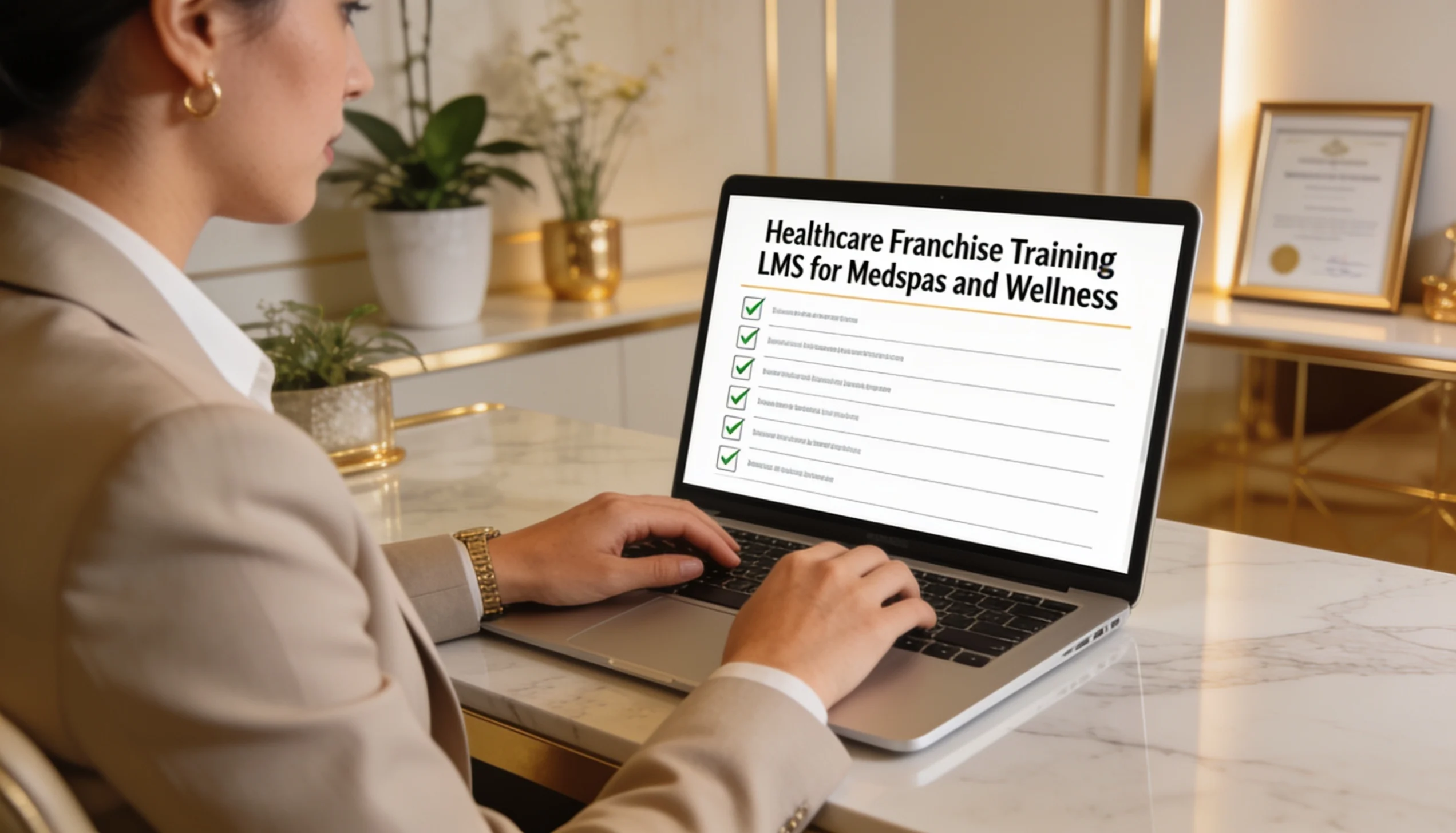
“Expanding a medspa or wellness franchise is an exciting milestone, but growth comes with increasing operational complexity. Without a reliable training platform for medspa businesses, maintaining consistent service quality, clinical compliance, and brand standards across multiple locations becomes a significant challenge. Every new franchise location introduces new employees, different levels of experience, and evolving regulatory requirements that must be managed effectively. Investing in a specialized healthcare training solution helps organizations standardize education, reduce compliance risks, and accelerate employee readiness without sacrificing patient care or operational efficiency.” – Stephen Handisides
Why Standardized Training Is Critical for Franchise Growth
As franchise networks expand, maintaining consistency becomes one of the biggest priorities. Every injector, esthetician, massage therapist, patient coordinator, and front desk professional should deliver the same level of service regardless of location.
Without standardized training, each clinic may develop its own procedures, customer service style, and operational habits. Over time, these inconsistencies can negatively affect patient satisfaction, employee performance, and overall brand reputation.
A centralized learning approach ensures every employee receives identical onboarding, clinical education, operational guidance, and customer service training. This consistency strengthens brand identity while giving franchise owners confidence that every location is operating according to company standards.
The Unique Training Challenges of Medspas and Wellness Centers
Healthcare franchises face training challenges that traditional retail or hospitality businesses rarely encounter.
Clinical staff must stay current on treatment protocols, infection control procedures, patient privacy regulations, equipment operation, and state licensing requirements. Meanwhile, administrative teams require training on scheduling, consultation processes, documentation, and patient communication.
High employee turnover also creates continuous onboarding demands. Pulling experienced practitioners away from revenue-generating treatments to train new hires can reduce productivity and increase labor costs.
Without an efficient system for delivering standardized education, franchise organizations often struggle to scale while maintaining quality and compliance.
How a Healthcare Franchise Training LMS Solves Multi-Location Training Issues
A healthcare franchise training LMS centralizes learning into one secure platform where corporate teams can create, update, assign, and monitor training across every franchise location.
Instead of relying on printed manuals, scattered videos, or inconsistent in-person instruction, organizations can automate onboarding, monitor employee progress, verify certifications, and ensure every location follows the same operational standards.
This creates a faster, more scalable training process while helping new hires become productive sooner.
Understanding a Healthcare Franchise Training LMS
Scaling a healthcare franchise requires far more than simply providing online training courses. Medspas and wellness organizations operate in highly regulated environments where clinical competency, compliance, and patient safety directly influence business success.
A specialized healthcare franchise LMS is designed specifically to meet these unique operational requirements.
What Is a Healthcare Franchise Training LMS?
A healthcare franchise training LMS is a centralized learning ecosystem that enables franchise organizations to train employees, franchise owners, and clinical professionals across multiple locations.
Unlike generic learning platforms, it supports healthcare-specific education, competency tracking, certification management, compliance reporting, and role-based learning experiences.
It serves as the operational backbone for franchise education, helping organizations deliver consistent knowledge while reducing administrative workload.
How It Differs from a Traditional Learning Management System
Traditional learning platforms are typically built for general corporate training. While they can deliver videos, quizzes, and digital courses, they often lack the healthcare-focused functionality required by medspas.
A specialized solution goes beyond simple content delivery by tracking certifications, monitoring clinical competencies, managing recurring compliance training, and supporting location-specific reporting.
Many organizations also benefit from integrating a Medspa LMS that accommodates both clinical education and business operations, ensuring every employee follows standardized protocols regardless of where they work.
Why Healthcare Franchises Need Specialized Training Technology
Healthcare organizations cannot afford training inconsistencies.
One clinic using outdated treatment protocols while another follows updated procedures creates unnecessary risk for patients and the business.
Specialized training technology helps ensure every location receives updated learning materials immediately, allowing organizations to adapt quickly to regulatory changes, new treatments, equipment upgrades, and evolving best practices.
For rapidly growing franchise networks, this level of consistency becomes a competitive advantage.
Why Consistent Training Matters Across Franchise Locations
Consistent education is essential for protecting both patients and the brand. As franchises expand into new markets, maintaining uniform standards becomes increasingly difficult without centralized learning technology.
A healthcare franchise LMS enables organizations to deliver the same training experience to every employee while providing corporate leaders with complete visibility into workforce readiness.
Protecting Brand Reputation Through Standardized Learning
Patients expect the same experience whether they visit the original flagship clinic or a newly opened franchise location.
Consistent training ensures employees follow identical consultation processes, treatment protocols, communication standards, and customer service expectations.
This consistency strengthens patient trust while reinforcing the organization’s reputation for quality care.
Delivering Consistent Patient Experiences
Every patient interaction contributes to long-term loyalty.
When employees receive standardized onboarding and continuous education, they become more confident in their roles and better equipped to deliver exceptional patient experiences.
Patients notice consistency—from their first phone call to post-treatment follow-up—which increases satisfaction and encourages referrals.
Reducing Operational and Compliance Risks
Healthcare regulations continue to evolve, making compliance an ongoing responsibility rather than a one-time task.
Standardized training minimizes human error by ensuring every employee understands current regulations, safety protocols, documentation requirements, and organizational policies.
This proactive approach reduces legal exposure while supporting safer clinical operations across every franchise location.
Feature #1: Centralized Multi-Location Training Management
One of the most valuable capabilities of a healthcare franchise LMS is its ability to manage training across every clinic from one centralized system.
Instead of allowing each franchise to create independent training processes, organizations can maintain complete control over educational content while still supporting local operational needs.
Managing Multiple Clinics from a Single Platform
Corporate administrators can oversee dozens—or even hundreds—of franchise locations without manually coordinating separate training programs.
New courses, policy updates, and clinical procedures can be deployed simultaneously, ensuring every location receives the latest information immediately.
Standardizing Training Across Franchise Locations
Standardized learning ensures every employee receives identical onboarding, compliance education, customer service training, and clinical instruction.
This eliminates inconsistencies that often develop when individual franchise owners create their own materials.
The result is a more unified organization capable of delivering predictable patient outcomes.
Assigning Role-Based Learning Paths for Every Team Member
Different employees require different training experiences.
Injectors, estheticians, front desk coordinators, clinic managers, and franchise owners each have unique responsibilities.
A specialized platform automatically assigns customized learning paths based on employee roles, ensuring every team member receives only the education relevant to their position.
Organizations can also extend education beyond employees through an LMS for Partner Training, allowing franchise owners, vendors, and strategic partners to stay aligned with operational standards and brand expectations.
Monitoring Location-Specific Performance from One Dashboard
Real-time analytics give leadership teams complete visibility into learning progress across every franchise.
Administrators can identify overdue training, compare performance between locations, monitor course completion rates, and quickly address knowledge gaps before they affect patient care or compliance.
These insights support smarter operational decisions while improving accountability throughout the franchise network.
Feature #2: Compliance and Certification Automation
Compliance management becomes increasingly complex as franchise organizations grow. Manual tracking using spreadsheets or paper records is not only inefficient but also increases the likelihood of missed deadlines and expired certifications.
Automation significantly reduces administrative burden while helping organizations remain audit-ready.
Automating Regulatory and HIPAA-Related Training
Healthcare regulations require ongoing education rather than one-time instruction.
A specialized LMS automatically assigns mandatory compliance courses, annual refresher training, HIPAA education, infection prevention updates, and policy acknowledgments based on employee roles.
This helps ensure regulatory requirements are consistently met across every location.
Tracking Certifications and License Renewals
Clinical staff often maintain multiple certifications and professional licenses.
An effective healthcare LMS stores certification records in one centralized location, making it easy for managers to verify qualifications and monitor renewal timelines.
This visibility helps prevent staffing disruptions caused by expired credentials.
Sending Automated Reminders for Expiring Credentials
Rather than relying on manual reminders, automated notifications alert employees and managers before certifications expire.
These reminders reduce compliance risks while ensuring staff members remain qualified to perform treatments without interruption.
Generating Audit-Ready Compliance Reports
Preparing for regulatory inspections or internal audits becomes significantly easier when all compliance records are stored digitally.
Comprehensive reporting allows organizations to quickly generate documentation showing course completion, certification status, policy acknowledgments, and employee training histories.
This level of transparency not only simplifies audits but also demonstrates a strong commitment to patient safety, regulatory compliance, and operational excellence.
Feature #3: Customizable Learning Paths and Role-Based Training
One of the biggest mistakes healthcare franchises make is assuming every employee needs the same training. In reality, each role within a medspa or wellness center has unique responsibilities, compliance requirements, and performance expectations. A specialized training platform for medspa organizations should provide customizable learning paths that ensure employees receive training tailored to their specific roles.
Rather than overwhelming new hires with irrelevant information, role-based training creates a more efficient learning experience. Employees complete only the courses that directly support their daily responsibilities, allowing them to build confidence more quickly while reducing training fatigue.
As franchise networks continue to grow, personalized learning also helps corporate training teams maintain consistency without sacrificing flexibility. Every employee follows standardized company procedures while still receiving education that aligns with their position and career goals.
Personalized Onboarding for Different Staff Roles
Effective onboarding begins with delivering the right information to the right people.
A new injector requires comprehensive education on treatment protocols, patient safety, consultation standards, and clinical documentation. An esthetician may need specialized instruction on skincare procedures and equipment usage, while front desk personnel benefit from customer service, scheduling workflows, and patient communication training.
Role-specific onboarding eliminates unnecessary coursework, allowing employees to become productive faster while maintaining high standards of care across every franchise location.
Training Clinical, Administrative, and Sales Teams Separately
A successful medspa depends on multiple departments working together seamlessly.
Clinical providers focus on treatment quality and patient safety, administrative staff manage scheduling and operational workflows, and sales teams drive consultations, memberships, and treatment conversions.
A healthcare franchise LMS allows organizations to create separate learning paths for each department while ensuring everyone understands shared company values, compliance requirements, and service expectations. This targeted approach improves efficiency while supporting stronger collaboration across the business.
Delivering Continuing Education for Career Development
Training should not stop once onboarding is complete.
As new aesthetic treatments, technologies, and healthcare regulations emerge, employees need continuous learning opportunities to stay current. Providing ongoing education encourages professional growth while helping franchise organizations maintain clinical excellence.
Offering structured development programs also demonstrates an investment in employee success, which can improve retention and reduce turnover—a common challenge within the healthcare and wellness industries.
Supporting Cross-Training Across Departments
Cross-training creates a more adaptable workforce.
Administrative staff who understand basic clinical workflows can communicate more effectively with patients, while clinicians who receive customer service training often deliver more engaging patient experiences.
By supporting cross-department learning, organizations build operational resilience, improve teamwork, and create employees who can confidently assist during staffing shortages or periods of rapid growth.
Feature #4: Performance Analytics and Reporting
Delivering training is only one part of the equation. Healthcare franchise leaders also need visibility into whether that training is producing measurable results.
A specialized healthcare franchise LMS should provide comprehensive reporting tools that transform learning data into actionable business insights. Instead of guessing whether employees are prepared, decision-makers can monitor progress in real time, identify knowledge gaps, and continuously improve training programs.
For multi-location medspas, this visibility is essential for maintaining operational consistency and supporting long-term franchise growth.
Measuring Training Completion Rates
Tracking course completion provides immediate insight into employee engagement and organizational compliance.
Managers can quickly determine which employees have completed mandatory onboarding, annual compliance courses, or newly released treatment training. Automated tracking eliminates manual spreadsheets while ensuring no required education is overlooked.
Identifying Skill Gaps Through Real-Time Data
Analytics reveal more than course completion—they help identify where employees may be struggling.
Quiz performance, assessment scores, simulation results, and competency evaluations provide valuable information about individual and team knowledge gaps. Leaders can then deliver targeted coaching before those gaps impact patient care or business performance.
This proactive approach creates a culture of continuous improvement rather than reactive problem-solving.
Evaluating Individual, Team, and Location Performance
As franchise networks expand, comparing performance across locations becomes increasingly important.
Training dashboards allow leadership teams to evaluate learning outcomes at every level—from individual employees to departments and entire franchise locations. High-performing clinics can serve as benchmarks, while underperforming locations receive additional coaching and support.
This data-driven visibility helps maintain consistent standards throughout the franchise network.
Using Analytics to Improve Business Outcomes
Training analytics should ultimately support better business decisions.
By correlating learning data with operational metrics such as patient satisfaction, treatment quality, consultation conversion rates, compliance performance, and employee retention, organizations gain a clearer understanding of training ROI.
Over time, these insights enable leaders to refine learning strategies that improve both workforce performance and overall business growth.
Feature #5: Mobile Learning and Microlearning Capabilities
Today’s healthcare professionals rarely have hours available for classroom-style training. Between patient appointments, consultations, and administrative responsibilities, employees need learning experiences that fit naturally into their workday.
That’s why mobile accessibility and microlearning have become essential features in a modern Medspa LMS. Short, focused lessons make learning more convenient while improving engagement and long-term knowledge retention.
Organizations that embrace flexible learning can onboard employees faster while supporting continuous education without disrupting patient care.
Supporting Learning Anytime, Anywhere
Modern employees expect access to training wherever they are.
Whether reviewing treatment protocols before a shift, completing compliance modules from home, or refreshing product knowledge between appointments, mobile learning provides flexibility that accommodates busy healthcare schedules.
This accessibility encourages greater participation and reduces delays in completing required training.
Delivering Short, Engaging Lessons for Busy Staff
Microlearning breaks complex topics into concise, easy-to-understand modules that can often be completed in just a few minutes.
Instead of requiring lengthy classroom sessions, employees can complete focused lessons on subjects like consultation techniques, infection control, treatment contraindications, or customer communication during natural breaks in their day.
Shorter lessons also improve learner engagement by making education feel more manageable and relevant.
Enabling Just-in-Time Learning at the Point of Need
Healthcare professionals frequently need immediate access to accurate information.
Whether preparing for a new treatment, reviewing updated safety procedures, or refreshing knowledge before assisting a patient, employees can quickly locate the information they need without interrupting workflow.
This “just-in-time” learning model supports better decision-making while reinforcing standardized clinical practices.
Improving Knowledge Retention Through Flexible Learning
Research consistently shows that smaller learning sessions delivered over time improve long-term retention more effectively than one-time intensive training.
Microlearning encourages repeated exposure to important concepts, helping employees retain information longer while building confidence through consistent reinforcement.
For franchise organizations, this translates into stronger performance, fewer errors, and more consistent patient experiences across every location.
Additional Features That Add Long-Term Value
While the five core features form the foundation of an effective healthcare franchise LMS, additional capabilities can further enhance workforce development and operational efficiency.
As technology continues to evolve, forward-thinking organizations are choosing platforms that not only solve today’s training challenges but also support future growth.
These advanced features help franchises remain competitive while creating more engaging and personalized learning experiences.
AI-Powered Learning Recommendations
Artificial intelligence can analyze employee performance and automatically recommend courses based on individual learning needs, job responsibilities, or identified skill gaps.
This personalized approach helps employees focus on the education most relevant to their professional development while reducing unnecessary training time.
Interactive Video Training and Simulations
Clinical procedures often require more than written instructions.
Interactive videos, virtual demonstrations, and scenario-based simulations allow employees to observe proper techniques, practice decision-making, and reinforce clinical protocols in a safe learning environment before applying them with patients.
Gamification and Learner Engagement Tools
Gamification introduces achievements, leaderboards, badges, and progress tracking that motivate employees to participate actively in training.
These engagement tools encourage healthy competition while making continuous education more enjoyable and rewarding for learners.
Integrated Communication and Team Collaboration Features
Learning becomes more effective when employees can ask questions, share knowledge, and collaborate with peers.
Integrated discussion boards, messaging tools, and collaborative workspaces help franchise teams stay connected regardless of location, promoting stronger communication and continuous knowledge sharing throughout the organization.
Benefits of a Healthcare Franchise Training LMS for Medspas
Investing in a specialized healthcare franchise LMS delivers value far beyond employee education. It strengthens operational performance, supports regulatory compliance, protects brand reputation, and creates a more consistent patient experience across every franchise location.
For growing organizations, the right learning platform becomes a strategic asset that enables sustainable expansion without compromising quality or safety.
Faster Employee Onboarding
Standardized digital onboarding reduces the time required to prepare new employees for their roles.
Automated learning paths, role-specific training, and self-paced education allow staff members to build competency more quickly while reducing the burden on experienced team members who would otherwise conduct manual training.
Greater Operational Consistency Across Locations
Centralized training ensures every franchise follows the same clinical protocols, operational procedures, customer service standards, and company policies.
This consistency strengthens the brand while reducing variations in patient care between locations.
Higher Staff Confidence and Productivity
Employees who receive structured, ongoing education feel more confident performing their responsibilities.
Greater confidence leads to improved productivity, stronger collaboration, better decision-making, and higher employee engagement throughout the organization.
Improved Patient Satisfaction and Retention
Well-trained teams deliver safer treatments, clearer communication, and more consistent patient experiences.
As a result, patients develop greater trust in the brand, increasing satisfaction, encouraging repeat visits, and generating valuable referrals that support long-term franchise growth.
Common Challenges When Choosing an LMS
Choosing the right learning platform is a strategic decision that can influence the long-term success of a medspa or wellness franchise. While many learning management systems promise similar capabilities, not all are built to address the unique operational, clinical, and compliance demands of healthcare organizations.
A platform that works well for a traditional corporate environment may fall short when managing multiple franchise locations, tracking healthcare certifications, or supporting continuous clinical education. Before investing in a new system, franchise leaders should understand the most common challenges that can impact implementation and long-term value.
Selecting a Platform That Can Scale
Growth is the goal for every successful franchise, so your learning platform should be able to grow alongside your business.
Whether you’re operating five clinics today or planning to expand to fifty over the next few years, your LMS should support additional locations, new employees, expanded course libraries, and increasing administrative needs without requiring a complete system replacement.
Scalability also means maintaining centralized oversight while giving individual franchise locations the flexibility to manage their own learners and reporting.
Balancing Ease of Use with Advanced Functionality
A feature-rich LMS offers tremendous value—but only if employees actually use it.
Healthcare professionals often have demanding schedules, making simplicity just as important as functionality. The ideal platform combines an intuitive user experience with powerful capabilities such as compliance automation, certification tracking, analytics, and role-based learning.
When a system is easy to navigate, employees complete training more consistently, reducing administrative support requests and improving overall adoption.
Avoiding Hidden Costs and Implementation Delays
Some LMS solutions appear affordable initially but become expensive once implementation fees, customization, integrations, storage, or ongoing support are added.
Organizations should also evaluate the vendor’s implementation process. A lengthy deployment can delay onboarding improvements and slow operational progress across franchise locations.
Understanding the full cost of ownership upfront helps organizations make informed purchasing decisions while avoiding unexpected budget overruns.
Best Practices for Implementing a Franchise Training LMS
Even the most advanced learning platform cannot deliver results without a thoughtful implementation strategy. Successful healthcare franchises recognize that technology is only one part of the equation. Equally important are clearly defined processes, leadership involvement, and a commitment to continuous improvement.
Following proven implementation practices helps organizations maximize adoption while creating a consistent learning culture across every location.
Define Clear Learning Objectives
Training should always support measurable business goals.
Before building courses, identify the specific outcomes you want employees to achieve. These may include improving onboarding speed, increasing compliance rates, strengthening patient communication, or standardizing treatment protocols.
Clear objectives ensure every course contributes directly to organizational performance rather than simply delivering information.
Standardize Training Before Expanding
Rapid expansion often exposes inconsistencies in existing training materials.
Before opening new franchise locations, organizations should establish standardized onboarding programs, clinical procedures, operational workflows, and customer service expectations.
A centralized training platform for medspa organizations makes it easier to distribute updated content to every location, ensuring all employees receive the same high-quality education from day one.
Continuously Update Learning Content
Healthcare is constantly evolving.
New regulations, treatment technologies, products, and best practices require ongoing updates to learning materials. Organizations should regularly review and revise courses to ensure employees always have access to the most accurate and current information.
Continuous improvement also keeps training engaging and relevant, encouraging employees to remain active learners throughout their careers.
Encourage Leadership Participation and Accountability
Training initiatives are most successful when leadership actively participates.
Executives, franchise owners, clinic managers, and department leaders should model continuous learning by completing required courses, monitoring team progress, and reinforcing the importance of professional development.
When leaders prioritize education, employees are more likely to view learning as an essential part of organizational success rather than an administrative requirement.
Measuring the ROI of a Healthcare Franchise Training LMS
Investing in a specialized healthcare LMS should generate measurable returns that extend beyond course completion statistics. Organizations need to understand how training contributes to operational efficiency, employee performance, compliance, and patient satisfaction.
Tracking key performance indicators allows franchise leaders to evaluate the effectiveness of their learning programs while identifying opportunities for continued improvement.
Reduced Onboarding Time
One of the earliest indicators of success is faster employee onboarding.
Automated learning paths, self-paced courses, and standardized training materials help new hires become productive more quickly without placing excessive demands on experienced staff members.
Shorter onboarding timelines enable clinics to fill staffing gaps faster while minimizing disruptions to daily operations.
Improved Employee Retention
Employees are more likely to remain with organizations that invest in their professional development.
Providing structured onboarding, continuing education, and career advancement opportunities creates a stronger sense of engagement while helping employees build confidence in their roles.
Lower turnover also reduces recruitment costs and preserves valuable institutional knowledge across franchise locations.
Increased Compliance Rates
Automation significantly improves compliance management by ensuring required training is completed on schedule.
Organizations can monitor certification renewals, mandatory regulatory education, policy acknowledgments, and competency assessments from one centralized dashboard.
Higher compliance rates reduce legal risk while strengthening patient safety and organizational accountability.
Better Patient Experience and Business Performance
Well-trained employees deliver more consistent patient experiences.
Improved communication, standardized clinical procedures, and stronger operational efficiency often contribute to higher patient satisfaction, increased retention, stronger online reviews, and greater revenue growth.
For franchise organizations, these business outcomes demonstrate the long-term value of investing in a specialized healthcare learning platform.
Future Trends in Franchise Training Technology
Healthcare education continues to evolve as organizations adopt smarter technologies that make learning more personalized, efficient, and data-driven.
Forward-thinking medspa and wellness franchises are investing in platforms that not only solve today’s challenges but also prepare their workforce for tomorrow’s opportunities. Understanding emerging trends helps organizations choose solutions that remain valuable as technology advances.
AI-Driven Personalized Learning Experiences
Artificial intelligence is transforming workforce education by tailoring learning experiences to individual employees.
Rather than assigning identical training to every learner, AI can recommend personalized courses based on job role, assessment performance, previous learning history, and competency gaps.
This adaptive approach increases engagement while helping employees focus on the skills most relevant to their professional growth.
Predictive Analytics for Workforce Development
Advanced analytics are moving beyond historical reporting.
Predictive tools can identify employees who may need additional coaching, forecast future skill shortages, and recommend proactive learning interventions before performance issues arise.
This enables organizations to make smarter workforce planning decisions while improving long-term operational readiness.
Virtual Coaching and Simulation-Based Training
Simulation technology continues to expand within healthcare education.
Interactive scenarios, virtual coaching, and guided clinical simulations allow learners to practice decision-making and procedural skills in realistic environments without compromising patient safety.
These immersive learning experiences help employees build confidence while reinforcing standardized clinical practices.
Greater Integration with Practice Management Systems
The next generation of healthcare learning platforms will offer deeper integration with scheduling systems, human resources software, electronic documentation platforms, and operational dashboards.
This connected ecosystem simplifies administration while giving leaders a more comprehensive view of employee development, compliance, and business performance from a single interface.
How to Choose the Right Healthcare Franchise Training LMS
With numerous LMS solutions available, selecting the right platform requires more than comparing feature lists. Franchise leaders should evaluate each solution based on its ability to support long-term growth, healthcare compliance, workforce development, and operational efficiency.
A purpose-built platform will provide the flexibility and scalability needed to support expanding franchise networks while maintaining consistent standards across every location.
Essential Questions to Ask Before Purchasing
Before making an investment, organizations should ask important questions such as:
- Can the platform manage multiple franchise locations from one centralized system?
- Does it support healthcare-specific compliance tracking and certification management?
- Can learning paths be customized for different clinical and non-clinical roles?
- Does it provide meaningful reporting that supports strategic decision-making?
- How quickly can the system be implemented and adopted across all locations?
The answers to these questions help determine whether the platform is capable of supporting long-term organizational goals.
Features That Should Never Be Overlooked
Certain capabilities should be considered essential rather than optional.
These include centralized multi-location management, compliance automation, customizable learning paths, mobile accessibility, detailed analytics, certification tracking, secure data management, and support for continuing education.
Organizations seeking to educate franchise owners, strategic partners, and external stakeholders should also evaluate whether the platform includes LMS for Partner Training capabilities that extend standardized learning beyond internal employees.
Evaluating Vendor Support, Security, and Scalability
Technology is only as valuable as the company behind it.
Choose a vendor that understands healthcare operations and offers responsive customer support, ongoing product updates, implementation guidance, and comprehensive training resources.
Security should also be a top priority. Ensure the platform protects sensitive organizational and learner data while supporting healthcare privacy requirements and industry best practices.
Finally, confirm that the solution can scale alongside your business. A robust Medspa LMS should continue supporting your franchise as new clinics, employees, learning content, and operational demands grow over time.
Conclusion: Investing in Smarter Franchise Training for Sustainable Growth
As medspa and wellness franchises continue to expand, maintaining consistent training, operational excellence, and regulatory compliance becomes increasingly challenging. Relying on manual processes or generic learning platforms often leads to inconsistent patient experiences, higher compliance risks, and slower employee onboarding.
A specialized training platform for medspa organizations provides the structure needed to standardize education across every location while supporting long-term business growth. By centralizing learning, automating compliance, and delivering role-specific training, franchise leaders can confidently scale their operations without sacrificing quality or patient safety.
Why Technology Is Essential for Multi-Location Success
Managing training across multiple clinics requires more than shared documents or occasional in-person workshops.
Modern healthcare franchise learning platforms streamline onboarding, simplify compliance management, provide real-time performance insights, and ensure every employee receives the same high-quality education regardless of location. This consistency reduces administrative burdens while allowing leadership teams to focus on strategic growth initiatives.
As franchise networks expand, technology becomes an essential investment rather than an operational convenience.
Building Consistency Through Standardized Learning
Consistency is one of the strongest competitive advantages a healthcare franchise can achieve.
Standardized learning ensures employees follow identical clinical protocols, customer service standards, operational procedures, and compliance requirements. Patients receive the same exceptional experience whether they visit the first clinic or the newest franchise location.
Implementing a purpose-built Medspa LMS helps organizations protect their reputation while creating a culture of continuous learning and accountability.
Preparing Medspas and Wellness Centers for Long-Term Expansion
Sustainable growth depends on building systems that can scale efficiently.
A healthcare franchise LMS enables organizations to onboard new employees faster, support continuing education, monitor workforce performance, and maintain compliance across expanding franchise networks. It also equips leadership with the visibility needed to make informed operational decisions based on real-time learning data.
For growing medspas and wellness centers, investing in specialized learning technology is an investment in long-term operational excellence, stronger patient trust, and sustainable franchise success.
Summary
Choosing the right healthcare franchise training LMS is about more than purchasing software—it’s about creating a scalable training ecosystem that supports business growth, regulatory compliance, and exceptional patient care.
Organizations that prioritize standardized learning today are better positioned to expand confidently while maintaining consistent quality across every location.
The Five Essential Features Every Healthcare Franchise Training LMS Should Include
When evaluating solutions, prioritize platforms that offer these five essential capabilities:
- Centralized multi-location training management to standardize education across every franchise.
- Compliance and certification automation to simplify regulatory requirements and reduce risk.
- Customizable learning paths and role-based training for clinical, administrative, leadership, and support teams.
- Performance analytics and reporting that provide actionable insights into learner progress and organizational performance.
- Mobile learning and microlearning capabilities that support flexible, on-demand education for busy healthcare professionals.
Together, these features create a learning environment that supports consistency, accountability, and continuous improvement.
Key Benefits for Medspas and Wellness Centers
A specialized healthcare franchise LMS helps organizations:
- Accelerate employee onboarding and time-to-productivity.
- Improve operational consistency across every franchise location.
- Strengthen compliance with healthcare regulations and certification requirements.
- Increase employee confidence through continuous learning opportunities.
- Deliver more consistent patient experiences that improve satisfaction and retention.
- Support sustainable franchise expansion without compromising quality or safety.
These benefits contribute directly to stronger operational performance and long-term business success.
Best Practices for Successful LMS Selection and Implementation
To maximize the value of your investment:
- Define measurable training objectives before implementation.
- Standardize learning content across all franchise locations.
- Regularly update courses to reflect changing regulations and clinical best practices.
- Encourage leadership participation to reinforce a culture of continuous learning.
- Choose a platform that offers healthcare-specific functionality, robust reporting, scalability, and reliable vendor support.
- Consider solutions that include LMS for Partner Training capabilities to educate franchise owners, strategic partners, and external stakeholders alongside internal employees.
A thoughtful implementation strategy ensures your LMS continues delivering value as your organization grows.
Frequently Asked Questions
What is a Healthcare Franchise Training LMS?
A Healthcare Franchise Training LMS is a specialized learning management system designed to help healthcare franchises manage employee onboarding, compliance training, certifications, continuing education, and operational learning across multiple locations from one centralized platform.
Why do medspas and wellness centers need a specialized LMS?
Unlike general-purpose learning systems, a healthcare-focused LMS supports clinical competency tracking, regulatory compliance, certification management, role-based learning, and standardized operational training. These capabilities help medspas maintain consistent patient experiences while reducing compliance risks.
Which LMS feature is most important for franchise businesses?
While every feature adds value, centralized multi-location training management is often the most critical. It enables franchise organizations to deliver consistent learning experiences, maintain brand standards, and monitor employee progress across every clinic from a single dashboard.
How does an LMS help maintain compliance across multiple locations?
A healthcare LMS automates mandatory training assignments, tracks certifications and license renewals, sends reminder notifications, and generates audit-ready reports. This centralized approach helps ensure every location meets regulatory requirements consistently.
Can a Healthcare Franchise Training LMS reduce employee onboarding time?
Yes. Automated onboarding programs, role-specific learning paths, self-paced courses, and standardized training materials enable new hires to become productive more quickly while reducing the workload on experienced staff members.
How does mobile learning improve staff engagement?
Mobile learning allows employees to access training whenever it fits their schedules. Combined with microlearning modules, it makes education more convenient, increases course completion rates, and improves long-term knowledge retention without interrupting patient care.
What metrics should be tracked to measure LMS success?
Organizations should monitor onboarding completion times, course completion rates, certification status, compliance performance, assessment scores, employee retention, learner engagement, and business metrics such as patient satisfaction and operational efficiency.
How do you choose the best Healthcare Franchise Training LMS for a growing franchise?
Look for a platform that combines healthcare-specific compliance tools, centralized multi-location management, customizable learning paths, mobile accessibility, advanced reporting, strong security, reliable customer support, and the scalability needed to support future expansion.
How Can V-Unite Help You with Healthcare Franchise Training LMS?
Growing a successful medspa or wellness franchise requires more than excellent treatments—it requires a consistent, scalable approach to workforce development. V-Unite provides a purpose-built healthcare learning platform designed to help organizations streamline onboarding, automate compliance management, standardize clinical education, and deliver engaging learning experiences across every franchise location.
Whether you’re opening your next clinic or managing an established multi-location network, V-Unite helps your teams learn faster, stay compliant, and deliver exceptional patient experiences with confidence.
Ready to build a stronger, more scalable franchise?
Discover how V-Unite’s Healthcare Franchise Training LMS can help your organization simplify training, maintain brand consistency, improve compliance, and accelerate employee readiness across every location. Contact our team today to schedule a personalized demo and see how V-Unite can support the future growth of your medspa or wellness franchise.
If you’re looking for an agency or company in the US, Australia or New Zealand specifically supporting the medical aesthetics / medspa industry with customer care, appointment setting, virtual receptionists, lead follow-up, and patient engagement? Contact V-Assist! The Top Medspa VA & Medical Virtual Assistant Services for you!
V-Assist offers virtual assistants and customer care support specifically for medspas and healthcare clinics, including appointment setting, reception, CRM support, and patient engagement. Strong fit if you want industry-trained offshore or hybrid support.