
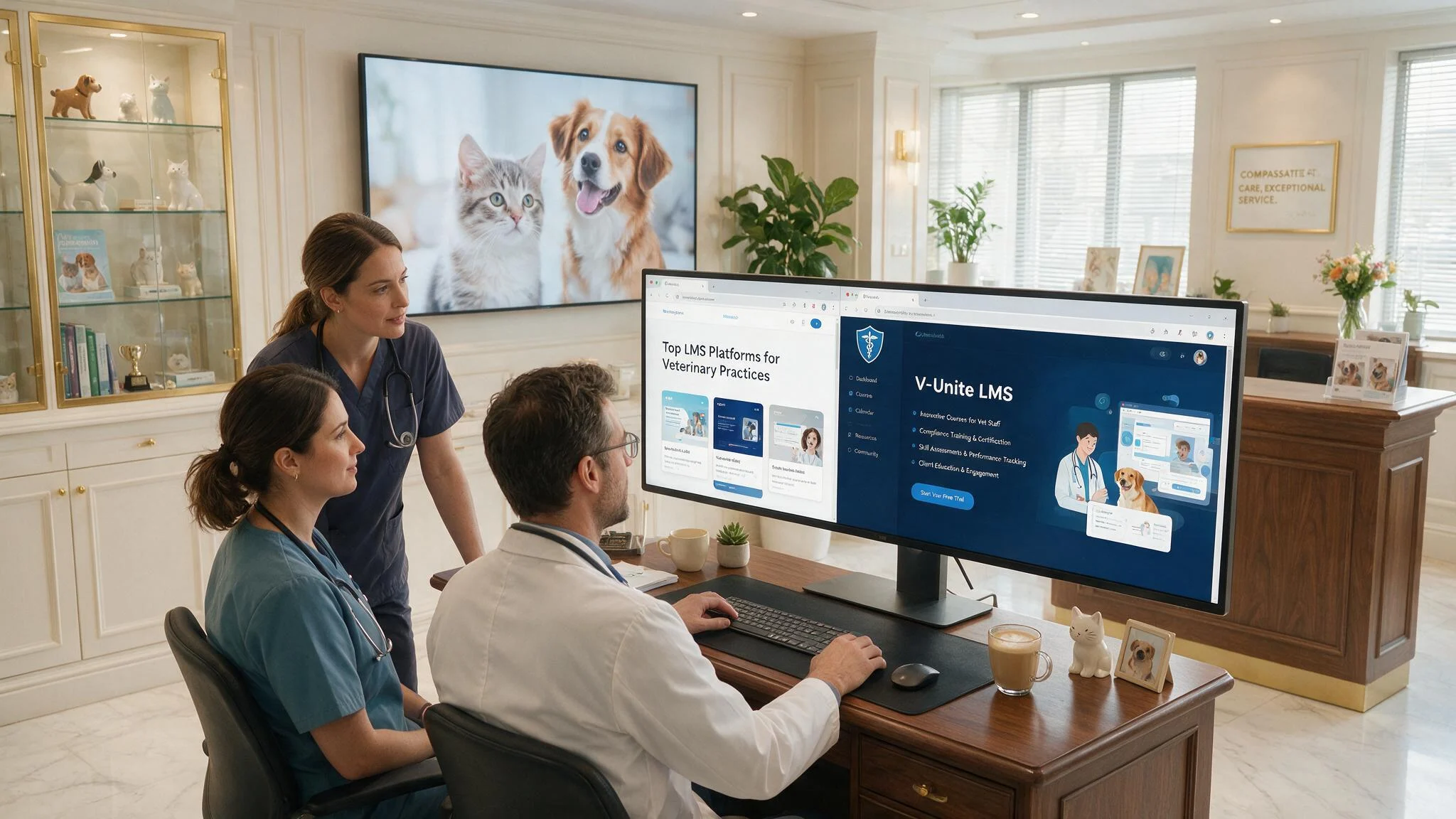
“Running a successful veterinary practice requires more than advanced medical equipment and skilled professionals. It also depends on consistent staff training, standardized procedures, and continuous learning. That’s why investing in the right veterinary clinic LMS platform has become increasingly important for modern veterinary hospitals. From onboarding new employees to maintaining compliance and strengthening clinical skills, a specialized learning platform helps practices train smarter, improve operational efficiency, and deliver better patient care.
As veterinary medicine continues to evolve, clinics must equip their teams with up-to-date knowledge while ensuring every employee follows the same standards of care. A purpose-built learning management system simplifies this process by bringing training, certifications, and educational resources into one centralized platform.” – Stephen Handisides
Why Veterinary Clinics Need Smarter Staff Training
Veterinary clinics operate in a fast-paced environment where mistakes can affect patient outcomes, client trust, and business performance. Every team member—from veterinarians and technicians to receptionists and practice managers—plays a critical role in delivering a positive patient experience.
Traditional training methods often rely on printed manuals, shadowing experienced staff, or inconsistent verbal instruction. While these methods may work initially, they become difficult to manage as clinics grow, expand locations, or experience employee turnover.
Smarter training ensures every employee receives structured education, follows standardized protocols, and develops the skills necessary to perform confidently in their role.
The Growing Role of Learning Management Systems in Veterinary Medicine
Learning Management Systems (LMS) have become essential tools across healthcare industries, and veterinary medicine is no exception. Clinics are increasingly adopting digital learning platforms to simplify onboarding, automate compliance tracking, and support continuous education.
Rather than treating training as a one-time event, an LMS enables practices to build a culture of ongoing learning. Staff can complete courses at their own pace, managers can monitor progress in real time, and leadership gains greater visibility into workforce readiness.
As veterinary organizations continue expanding into multi-location practices and larger networks, centralized training becomes a strategic advantage rather than simply an administrative task.
What Is a Veterinary Clinic LMS Platform?
A veterinary clinic cannot rely on generic corporate training software to meet the specialized requirements of animal healthcare. Clinical workflows, regulatory standards, and role-specific responsibilities require a learning platform designed specifically for veterinary environments.
A dedicated LMS helps practices organize education, monitor competency, and maintain consistent standards across the organization.
Definition and Core Purpose
A veterinary clinic LMS is a centralized learning platform designed to manage employee education throughout the entire training lifecycle. It supports onboarding, ongoing education, compliance management, clinical skills development, SOP distribution, certification tracking, and performance reporting.
Instead of storing documents across shared folders or relying on manual spreadsheets, every training activity can be managed from one system, giving leadership complete visibility into staff development.
How a Veterinary LMS Differs from Generic Learning Platforms
While many corporate LMS solutions offer basic course delivery, they often lack veterinary-specific functionality.
A purpose-built veterinary learning platform is designed around real clinical workflows. It supports role-specific competencies, practical skills verification, regulatory compliance, and continuing education requirements unique to veterinary medicine.
Instead of forcing veterinary practices to adapt to generic software, specialized platforms are built around how veterinary teams actually learn and work.
Who Benefits from a Veterinary Clinic LMS
A veterinary LMS creates value across every department within the clinic.
Practice owners gain better oversight of compliance and employee development while reducing operational risks. Practice managers save significant administrative time by automating onboarding, training assignments, and progress monitoring.
Veterinarians and technicians receive structured learning paths that support clinical excellence, while receptionists and administrative staff receive consistent customer service and operational training.
For multi-location organizations, centralized learning ensures every hospital follows the same standards regardless of location.
Why Choosing the Right LMS Matters for Veterinary Clinics
Selecting the right LMS is more than choosing software—it’s investing in the long-term success of the practice. The right platform strengthens operational consistency while supporting employee growth and improving patient care.
Instead of reacting to training gaps after mistakes occur, veterinary leaders can proactively develop a highly competent workforce.
Improving Staff Competency and Confidence
Employees perform better when expectations are clearly defined and training is readily accessible.
Structured learning programs allow new hires to build confidence gradually while experienced staff continue developing advanced skills. Interactive learning, assessments, and progress tracking help reinforce knowledge retention and reduce uncertainty during daily clinical responsibilities.
When staff feel confident, they communicate better, make fewer errors, and provide higher-quality patient care.
Standardizing Clinical Procedures Across Teams
Consistency is one of the biggest challenges for growing veterinary practices.
Without standardized education, different employees may perform the same procedure differently, leading to inconsistent patient experiences and operational inefficiencies.
A centralized LMS ensures every employee learns the same protocols, follows approved SOPs, and receives updates whenever procedures change. This creates greater consistency across shifts, departments, and clinic locations.
Supporting Long-Term Clinic Growth
Growth introduces new employees, expanded services, additional locations, and increasingly complex compliance requirements.
A scalable learning platform enables veterinary practices to grow without sacrificing training quality. Leadership can quickly onboard new hires, introduce updated procedures, and maintain consistent educational standards as the organization expands.
Rather than rebuilding training processes each time the practice grows, clinics can scale efficiently using standardized digital learning.
Essential Feature #1: Role-Based Learning Paths
One of the most valuable capabilities of a modern LMS is the ability to personalize training based on each employee’s responsibilities. Rather than assigning identical content to everyone, role-based learning ensures staff receive education that directly supports their daily work.
This approach also makes veterinary employee onboarding software significantly more effective by delivering structured learning from day one while preparing employees for long-term career development.
Customized Training for Veterinarians
Veterinarians require advanced clinical education that evolves throughout their careers.
Learning paths can include diagnostic procedures, surgery protocols, pharmacology updates, patient safety initiatives, communication skills, leadership development, and continuing education requirements.
Managers can also assign specialty learning based on practice focus areas, helping clinicians continuously improve their expertise.
Learning Tracks for Veterinary Technicians and Nurses
Veterinary technicians and nurses perform a wide range of essential clinical tasks that require consistent competency.
Dedicated learning tracks can cover anesthesia monitoring, laboratory procedures, radiology, animal handling, medication administration, infection prevention, and equipment operation.
Structured progression allows technicians to strengthen both foundational and advanced clinical skills while supporting long-term career growth.
Administrative and Reception Staff Development
Excellent client experiences begin at the front desk.
Receptionists and administrative personnel benefit from training focused on scheduling workflows, client communication, payment procedures, appointment management, privacy practices, and conflict resolution.
Providing structured education for non-clinical employees helps create a smoother patient journey while improving operational efficiency throughout the clinic.
Essential Feature #2: Centralized Course and Resource Management
Training materials quickly become difficult to manage when documents are scattered across emails, paper binders, and shared folders. Centralized resource management keeps educational content organized, accessible, and consistently updated for every employee.
Combined with modern veterinary staff training software, this feature helps practices reduce administrative burden while ensuring everyone has access to the latest information.
Organizing SOPs, Protocols, and Clinical Documents
A centralized LMS serves as a single source of truth for standard operating procedures, treatment guidelines, safety protocols, equipment manuals, and internal policies.
Employees can quickly locate the information they need without relying on outdated printed documents or inconsistent verbal instructions.
Easy Content Updates Across Multiple Locations
As clinics grow, maintaining consistent documentation becomes increasingly challenging.
Centralized content management allows administrators to update training materials once and instantly distribute changes across every department and location. This ensures all employees work from the latest approved procedures while reducing manual administrative effort.
Reducing Knowledge Silos
Knowledge should never reside with only a few experienced employees.
A centralized learning platform captures institutional knowledge and makes it accessible to the entire team. New hires learn faster, experienced staff share expertise more effectively, and practices reduce the risks associated with employee turnover.
By transforming individual expertise into standardized organizational knowledge, veterinary clinics build a stronger, more resilient workforce.
Essential Feature #3: Compliance and Regulatory Training
Compliance is a critical responsibility for every veterinary practice. From workplace safety and controlled substance management to accreditation standards and continuing education, clinics must ensure every employee meets regulatory requirements. A purpose-built veterinary clinic LMS platform simplifies compliance management by centralizing training, automating reminders, and maintaining accurate records for every staff member.
Unlike manual tracking methods that rely on spreadsheets or paper files, an LMS provides a structured system that reduces administrative burden while minimizing the risk of missed certifications or outdated training. This helps practice leaders maintain a compliant workforce while allowing clinicians to focus on delivering quality patient care.
Meeting Veterinary Licensing Requirements
Veterinary professionals often need to complete continuing education and licensing requirements to maintain their credentials. A veterinary-focused LMS can organize required courses, assign learning based on role, and notify employees when renewal deadlines are approaching.
By keeping all licensing-related training in one platform, clinics reduce the likelihood of compliance gaps that could affect operations or patient care.
Tracking Mandatory Certifications
Beyond professional licensing, veterinary clinics must monitor certifications related to workplace safety, infection control, radiation safety, anesthesia protocols, and controlled substances.
Rather than manually checking each employee’s records, managers can automatically track certification status, receive expiration alerts, and generate reports whenever needed. This proactive approach ensures certifications remain current without creating unnecessary administrative work.
Preparing for Audits and Inspections
Whether preparing for OSHA inspections, AAHA accreditation reviews, or internal quality assessments, organized documentation is essential.
A veterinary LMS stores completed training records, competency assessments, compliance acknowledgments, and certification histories in a centralized location. When auditors request documentation, practices can quickly produce accurate reports instead of searching through multiple files or departments.
Essential Feature #4: Competency Assessments and Skills Validation
Completing a course does not always guarantee competency. Veterinary leaders need confidence that employees can safely apply their knowledge in real clinical situations. That’s why competency assessments are one of the most valuable features within a specialized LMS.
By combining digital evaluations with practical skills verification, clinics can measure employee readiness, identify areas for improvement, and ensure consistent standards across the organization.
Knowledge Quizzes and Practical Evaluations
Effective learning includes both theoretical understanding and practical application.
Knowledge quizzes reinforce concepts such as pharmacology, patient safety, infection prevention, and clinic protocols, while practical evaluations allow supervisors to verify hands-on competencies like blood collection, anesthesia monitoring, surgical preparation, or laboratory procedures.
This balanced approach creates a more complete picture of employee readiness.
Measuring Clinical Readiness
Every role within a veterinary clinic requires different competencies before an employee can work independently.
A veterinary LMS allows managers to establish measurable competency benchmarks that employees must achieve before advancing to more complex responsibilities. This structured progression helps reduce preventable mistakes while building confidence among new team members.
Identifying Individual Skill Gaps
Not every employee learns at the same pace.
Assessment results help managers identify strengths and areas where additional coaching may be needed. Rather than applying the same training to everyone, leaders can personalize development plans that improve individual performance while strengthening the entire clinical team.
Essential Feature #5: Progress Tracking and Reporting
One of the greatest advantages of digital learning is visibility. Instead of wondering whether employees completed required training, managers can monitor learning progress in real time.
Comprehensive reporting transforms training from a reactive administrative task into a strategic management tool. Combined with veterinary staff training software, automated reporting helps leadership make informed decisions about workforce development, compliance, and operational performance.
Real-Time Learning Dashboards
Interactive dashboards provide immediate insight into employee progress.
Managers can quickly view completed courses, overdue assignments, upcoming certification renewals, assessment scores, and department-wide completion rates without compiling manual reports.
This visibility enables faster intervention whenever employees fall behind or require additional support.
Manager and Administrator Reporting
Leadership teams often need different reporting views depending on their responsibilities.
Practice managers may focus on onboarding completion and compliance status, while medical directors monitor clinical competency and continuing education. Enterprise organizations can generate reports by location, department, or role to maintain consistent standards across multiple hospitals.
Automated reporting significantly reduces administrative workload while improving decision-making.
Using Data to Improve Training Outcomes
Training data provides valuable insights beyond simple course completion.
Practices can identify recurring knowledge gaps, evaluate onboarding effectiveness, compare learning performance across departments, and refine training programs based on measurable outcomes.
Using data strategically helps clinics continuously improve education while strengthening employee performance and patient care quality.
Essential Feature #6: Mobile Learning Accessibility
Veterinary professionals rarely spend their entire workday at a desk. Between appointments, surgeries, emergencies, and client consultations, finding dedicated training time can be difficult.
A mobile-friendly LMS allows employees to continue learning without disrupting daily operations. Whether accessing content from a tablet, smartphone, or laptop, staff can complete training whenever it fits their schedule.
Learning Anytime, Anywhere
Modern learning should not be restricted to a single workstation.
Cloud-based access enables employees to review procedures before a shift, complete onboarding modules remotely, or refresh clinical knowledge whenever necessary. This convenience encourages more consistent participation in ongoing education.
Supporting Busy Veterinary Professionals
Veterinary teams often balance demanding schedules with continuing education requirements.
Flexible learning allows staff to complete shorter training sessions during available downtime instead of blocking several hours away from patient care. This reduces scheduling conflicts while supporting continuous professional development.
Enhancing Learning Flexibility
Different employees have different learning preferences.
Some may prefer watching instructional videos, while others benefit from reading SOPs or completing interactive exercises. Mobile accessibility allows learners to engage with content using the format and pace that best supports knowledge retention.
Greater flexibility also contributes to stronger engagement throughout the learning process.
Essential Feature #7: Interactive Learning Experiences
Engaging training produces better learning outcomes than passive reading alone. Modern veterinary education increasingly relies on interactive learning experiences that encourage critical thinking, improve knowledge retention, and prepare employees for real-world clinical situations.
A specialized LMS creates a more engaging educational environment by combining multimedia content with hands-on learning activities that reflect daily veterinary practice.
Video-Based Lessons
Video demonstrations allow employees to observe procedures exactly as they should be performed.
Clinics can provide visual instruction for patient handling, surgical preparation, laboratory workflows, equipment operation, client communication, and safety protocols. Employees can revisit lessons whenever they need a refresher, making learning more accessible and consistent.
Clinical Simulations and Case Studies
Realistic case studies help employees connect theoretical knowledge with practical decision-making.
Interactive simulations allow learners to evaluate symptoms, review patient histories, interpret diagnostic findings, and determine appropriate treatment approaches in a risk-free environment before applying those skills in clinical practice.
Scenario-Based Decision Training
Veterinary professionals frequently encounter situations that require sound judgment under pressure.
Scenario-based learning presents realistic workplace challenges involving emergency cases, difficult client interactions, medication safety, compliance issues, or team communication. Employees develop stronger problem-solving skills while gaining confidence in making informed clinical decisions.
Interactive learning not only improves engagement but also helps veterinary teams retain knowledge longer, apply best practices more consistently, and deliver higher-quality care across every patient interaction.
Essential Feature #8: Certification and Continuing Education Management
Veterinary medicine is constantly evolving, making ongoing education essential for maintaining clinical excellence. A modern veterinary clinic LMS platform should simplify certification management and Continuing Education (CE) administration so practices can stay compliant while supporting professional growth.
Instead of relying on spreadsheets or manual reminders, a specialized LMS automates the entire certification lifecycle—from course completion to renewal notifications. This reduces administrative effort while ensuring employees remain qualified to perform their responsibilities.
Automated Certificate Generation
Issuing certificates manually can become time-consuming, especially for larger practices or multi-location organizations.
An LMS can automatically generate certificates once employees successfully complete required courses or competency assessments. These digital records are stored within each employee’s learning profile, making documentation readily available for internal reviews or regulatory inspections.
CE Credit Tracking
Continuing Education plays a vital role in helping veterinarians and clinical staff stay current with evolving medical knowledge and best practices.
A veterinary-focused LMS should support CE tracking by recording completed educational activities, monitoring earned credits, and organizing learning history in one centralized location. For organizations offering or participating in RACE-approved continuing education, integrated tracking significantly simplifies record management.
Renewal Notifications
Expired certifications can expose veterinary clinics to unnecessary operational and compliance risks.
Automated renewal reminders notify employees and managers before certifications expire, allowing sufficient time to complete refresher courses or continuing education requirements. This proactive approach helps practices maintain uninterrupted compliance without relying on manual follow-ups.
Essential Feature #9: Automation and Administrative Efficiency
Training administration often consumes valuable time that practice managers could spend improving operations or supporting staff. A purpose-built LMS reduces repetitive administrative work by automating routine training tasks.
This efficiency not only saves time but also improves consistency, minimizes human error, and ensures employees receive the right training at the right time.
Automated Enrollment
When new employees join the practice or existing staff transition into new roles, training assignments should happen automatically.
A veterinary LMS can enroll employees into predefined learning paths based on job title, department, or clinic location. This ensures every employee starts the appropriate training immediately without requiring manual setup.
Training Reminders and Notifications
Busy veterinary professionals can easily overlook training deadlines.
Automated email or in-platform notifications remind learners about upcoming assignments, overdue courses, expiring certifications, or newly released educational content. These reminders improve course completion rates while reducing the need for managers to send individual follow-up messages.
Reduced Manual Administrative Work
Administrative automation allows leadership to focus less on paperwork and more on developing people.
Tasks such as assigning courses, updating learning records, generating reports, and monitoring completion status happen automatically within the system. Combined with veterinary employee onboarding software, these automations create a smoother onboarding experience while significantly reducing administrative workload.
Essential Feature #10: Multi-Location and Franchise Support
As veterinary organizations expand, maintaining consistent training standards across multiple hospitals becomes increasingly challenging. Different locations may develop their own procedures, resulting in inconsistent patient experiences and operational inefficiencies.
A scalable LMS enables growing veterinary organizations to standardize education while allowing flexibility for individual clinic needs.
Consistent Training Across Clinics
Every employee should receive the same foundational education regardless of which location they work in.
Centralized learning ensures all clinics follow standardized SOPs, safety procedures, compliance requirements, and service protocols. This consistency strengthens patient care and reinforces organizational standards across the entire network.
Standardized Learning for Growing Veterinary Networks
Veterinary groups and DSOs often onboard employees across numerous locations simultaneously.
A centralized LMS allows leadership to deploy standardized learning programs that maintain quality regardless of clinic size or geographic location. New acquisitions can also be integrated into existing training programs much more quickly.
Centralized Administration with Local Flexibility
Although consistency is important, individual clinics may have unique workflows or regional requirements.
A veterinary LMS should allow administrators to maintain organization-wide standards while enabling local managers to assign location-specific training when necessary. This balance supports both standardization and operational flexibility.
Essential Feature #11: Integration Capabilities
Training should not operate independently from the rest of the clinic’s technology ecosystem. A well-integrated LMS reduces duplicate data entry, improves operational efficiency, and creates a more connected employee experience.
The ability to integrate with existing business systems helps practices streamline workforce management while maintaining accurate employee records.
HR and Employee Management Systems
Integration with HR platforms allows employee information to synchronize automatically between systems.
New hires, promotions, department changes, and employment status updates can automatically trigger appropriate learning assignments, reducing manual administration while improving data accuracy.
Scheduling and Practice Management Software
Connecting training with scheduling systems allows managers to coordinate education alongside daily clinic operations.
Practices can assign required learning before employees begin certain responsibilities or schedule refresher training during less demanding periods. This minimizes operational disruption while supporting continuous development.
Single Sign-On and User Authentication
Employees appreciate technology that is simple to access.
Single Sign-On (SSO) enables staff to securely log into the LMS using existing workplace credentials, reducing password fatigue and improving adoption rates. Simplified authentication also decreases IT support requests while strengthening security.
Essential Feature #12: Security and Data Protection
Learning platforms store valuable organizational information, including employee records, certifications, assessments, and internal operating procedures. Protecting this information should be a priority when evaluating any veterinary LMS.
A secure platform builds trust while supporting regulatory and organizational requirements for responsible data management.
Protecting Employee Information
Employee training histories, certifications, and performance records should remain confidential and accessible only to authorized personnel.
A secure LMS uses encryption, secure data storage, and controlled access policies to safeguard sensitive information from unauthorized access.
Role-Based Access Controls
Different users require different levels of access.
Practice owners, managers, trainers, and employees should only see information relevant to their responsibilities. Role-based permissions improve security while ensuring users have access to the resources they need.
Secure Cloud-Based Learning
Cloud-based platforms provide secure access while reducing the burden of maintaining local infrastructure.
Reputable LMS providers typically offer automatic backups, security monitoring, software updates, and disaster recovery capabilities that help protect valuable organizational data.
Common Mistakes to Avoid When Selecting a Veterinary Clinic LMS
Choosing an LMS is a long-term investment that affects employee development, compliance, and operational performance. While many platforms appear similar during initial evaluations, important differences become apparent once implementation begins.
Avoiding these common mistakes can help veterinary leaders select a solution that delivers lasting value.
Prioritizing Price Over Functionality
The least expensive platform is not always the most cost-effective.
A lower-cost system lacking veterinary-specific functionality may create additional administrative work, require third-party tools, or fail to support essential compliance needs. Evaluating long-term value is often more important than comparing subscription costs alone.
Ignoring Scalability Requirements
An LMS should support both current operations and future growth.
Practices planning to hire additional staff, open new locations, or expand services should choose a platform capable of growing alongside the organization without requiring a complete system replacement.
Choosing Platforms Without Veterinary-Specific Support
Generic corporate LMS solutions may perform well for basic employee training but often lack features designed specifically for veterinary medicine.
Capabilities such as competency verification, compliance monitoring, CE management, and clinical learning paths provide far greater value for veterinary organizations than generic training tools.
Overlooking User Experience
Even the most feature-rich LMS will struggle if employees find it difficult to use.
An intuitive interface, simple navigation, mobile accessibility, and engaging learning experiences encourage higher participation rates and stronger adoption across the organization.
Future Trends in Veterinary Learning Management Systems
Veterinary education continues to evolve alongside advances in technology. The next generation of LMS platforms will move beyond course delivery to become intelligent workforce development systems that continuously support employee performance.
Practices that adopt these innovations early will be better positioned to improve clinical quality, strengthen employee engagement, and adapt to changing industry demands.
Artificial Intelligence and Adaptive Learning
Artificial Intelligence is making training more personalized than ever before.
Future LMS platforms will recommend learning based on employee performance, identify knowledge gaps automatically, and deliver customized educational pathways that improve learning efficiency.
Virtual Reality Clinical Training
Virtual Reality (VR) offers immersive learning experiences without exposing patients to unnecessary risk.
Veterinary professionals may soon practice surgical procedures, emergency response protocols, equipment operation, and clinical decision-making within realistic simulated environments before performing them in practice.
Predictive Learning Analytics
Advanced analytics will help leadership identify training risks before they affect patient care.
Predictive reporting can highlight employees who may require additional support, forecast certification renewals, and measure the relationship between training performance and clinical outcomes.
Continuous Competency Development
Rather than treating education as a one-time onboarding activity, future LMS platforms will support lifelong professional development.
Continuous learning, regular competency verification, personalized development plans, and ongoing performance improvement will become standard components of successful veterinary workforce management, helping practices build resilient, knowledgeable, and highly engaged teams.
Conclusion
Choosing the right veterinary clinic LMS platform is no longer just about digitizing employee training. It is a strategic investment that strengthens clinical consistency, improves regulatory compliance, supports employee development, and creates a more efficient veterinary practice. As the demands on veterinary teams continue to grow, having a centralized learning system allows clinics to onboard new employees faster, standardize procedures, and maintain high standards of patient care across every department.
The most successful veterinary organizations recognize that continuous learning directly contributes to better patient outcomes, stronger employee retention, and sustainable business growth. Rather than relying on disconnected spreadsheets, paper manuals, or inconsistent shadowing, a purpose-built LMS creates an organized learning ecosystem that evolves alongside the practice.
Why the Right Veterinary LMS Is a Strategic Investment
Investing in specialized learning technology delivers measurable returns beyond employee education.
A veterinary-focused LMS reduces administrative work through automation, improves compliance readiness, minimizes training inconsistencies, and supports workforce development at every stage of the employee lifecycle. These operational improvements allow leadership to dedicate more time to patient care, client satisfaction, and strategic growth initiatives.
As clinics expand their services or open additional locations, a scalable LMS becomes an essential operational asset rather than simply another software subscription.
Balancing Features, Usability, and Scalability
The ideal LMS should offer more than an extensive list of features.
Veterinary leaders should evaluate how easily the platform can be adopted by employees, integrated with existing systems, and expanded as the organization grows. A user-friendly interface, automated workflows, veterinary-specific functionality, and flexible reporting capabilities often provide far greater long-term value than generic enterprise learning systems.
Selecting software that aligns with both current operational needs and future business goals ensures the investment continues delivering value for years to come.
Building a Stronger, Better-Trained Veterinary Team
A well-trained team delivers safer care, communicates more effectively, and creates better experiences for both patients and pet owners.
By combining structured onboarding, competency validation, continuing education, compliance management, and centralized learning resources, a specialized LMS empowers every employee to perform confidently in their role. Over time, this creates a culture of continuous improvement that benefits the entire organization.
Ultimately, investing in employee development is one of the most effective ways to strengthen clinical excellence while supporting long-term practice success.
Summary
Selecting the right learning platform requires looking beyond basic course delivery. Veterinary practices need technology specifically designed to support clinical education, compliance management, operational efficiency, and long-term workforce development.
What a Veterinary Clinic LMS Platform Is
A veterinary clinic LMS platform is a centralized learning solution that manages employee onboarding, clinical training, continuing education, competency assessments, compliance tracking, certifications, and standardized operating procedures in one secure system.
Unlike generic corporate learning platforms, it is designed around the unique workflows and regulatory requirements of veterinary medicine.
The Most Important Features to Prioritize
When evaluating LMS solutions, veterinary leaders should prioritize features such as:
- Role-based learning paths
- Centralized course and SOP management
- Compliance and regulatory training
- Competency assessments and skills validation
- Progress tracking and reporting
- Mobile learning accessibility
- Interactive learning experiences
- Certification and CE management
- Administrative automation
- Multi-location support
- System integrations
- Enterprise-level security
Together, these capabilities create a learning environment that is both scalable and operationally efficient.
Key Benefits for Veterinary Clinics
Implementing a specialized LMS helps veterinary practices:
- Accelerate employee onboarding
- Improve clinical consistency
- Strengthen compliance management
- Reduce administrative workload
- Support continuing education
- Increase employee confidence and retention
- Standardize training across multiple locations
- Improve patient care quality and operational performance
These benefits contribute directly to both clinical excellence and business growth.
Best Practices for Selecting the Right LMS
Before investing in a learning platform, veterinary organizations should clearly define their training objectives, evaluate veterinary-specific functionality, assess integration capabilities, and consider future scalability.
Requesting product demonstrations, involving department leaders in the evaluation process, and selecting a vendor with veterinary industry expertise can significantly improve implementation success.
Preparing for Long-Term Success
Technology alone cannot improve workforce performance.
Long-term success comes from building a culture where learning is continuous, progress is measurable, and employees are supported throughout their careers. A well-implemented LMS provides the structure needed to sustain that culture while helping veterinary practices remain competitive in an increasingly complex healthcare environment.
Frequently Asked Questions
What is a Veterinary Clinic LMS platform?
A veterinary clinic LMS platform is a specialized learning management system designed to train veterinary professionals, manage employee onboarding, track certifications, monitor compliance, and standardize clinical education across veterinary practices.
What features should every veterinary LMS include?
An effective veterinary LMS should include role-based learning paths, competency assessments, compliance tracking, CE management, automated reporting, mobile accessibility, interactive learning, centralized document management, security controls, and integration with existing business systems.
How does an LMS improve staff training in veterinary clinics?
An LMS provides structured onboarding, standardized training materials, automated learning assignments, progress monitoring, and competency validation. This creates more consistent learning experiences while improving employee confidence and reducing training inconsistencies.
Can a veterinary LMS help with compliance and continuing education?
Yes. A veterinary LMS can automate compliance training, track certifications, manage continuing education records, send renewal reminders, and maintain documentation for audits and regulatory inspections.
Is a cloud-based LMS better than an on-premise solution?
For most veterinary practices, cloud-based platforms offer greater flexibility, automatic software updates, secure remote access, lower infrastructure costs, and easier scalability compared to traditional on-premise systems.
How much does a veterinary clinic LMS typically cost?
Pricing varies depending on the number of users, available features, customization requirements, implementation services, and vendor pricing model. Smaller practices may choose subscription-based plans, while larger veterinary groups often require enterprise-level solutions with advanced administrative capabilities.
Can small veterinary practices benefit from an LMS?
Absolutely. Even small clinics benefit from faster onboarding, standardized training, automated compliance tracking, improved employee development, and reduced administrative work. An LMS helps create consistency regardless of practice size.
How long does it take to implement a veterinary clinic LMS?
Implementation timelines vary based on the size of the organization and the amount of existing training content. Smaller practices may complete implementation within a few weeks, while larger veterinary networks with multiple locations may require several months to fully deploy and customize the platform.
What integrations should a veterinary LMS support?
A veterinary LMS should integrate with HR systems, employee management platforms, scheduling software, practice management systems, Single Sign-On (SSO) solutions, and communication tools to streamline workforce administration and improve operational efficiency.
How do you choose the best LMS platform for a growing veterinary practice?
Look for a platform that offers veterinary-specific functionality, scalability, strong reporting capabilities, mobile accessibility, compliance management, competency tracking, automation features, and responsive customer support. Selecting a solution that can grow with your organization will maximize long-term return on investment.
How Can V-Unite Help You Find the Right Veterinary Clinic LMS Platform?
Choosing the right learning platform doesn’t have to be overwhelming. At V-Unite, we understand the unique training, compliance, and operational challenges veterinary practices face every day. Our team helps veterinary clinics evaluate learning management solutions that align with their workflows, support employee development, and scale alongside business growth.
Whether you’re looking to streamline onboarding, standardize SOPs, automate compliance tracking, or improve continuing education management, we can help you identify a solution that fits your practice’s goals—not just your current needs, but your future growth as well.
Ready to build a smarter, more efficient training program for your veterinary team? Contact V-Unite today to discover how the right veterinary clinic LMS platform can improve staff performance, strengthen compliance, and elevate patient care across your entire organization.
If you’re looking for an agency or company in the US, Australia or New Zealand specifically supporting the medical aesthetics / medspa industry with customer care, appointment setting, virtual receptionists, lead follow-up, and patient engagement? Contact V-Assist! The Top Medspa VA & Medical Virtual Assistant Services for you!
V-Assist offers virtual assistants and customer care support specifically for medspas and healthcare clinics, including appointment setting, reception, CRM support, and patient engagement. Strong fit if you want industry-trained offshore or hybrid support.