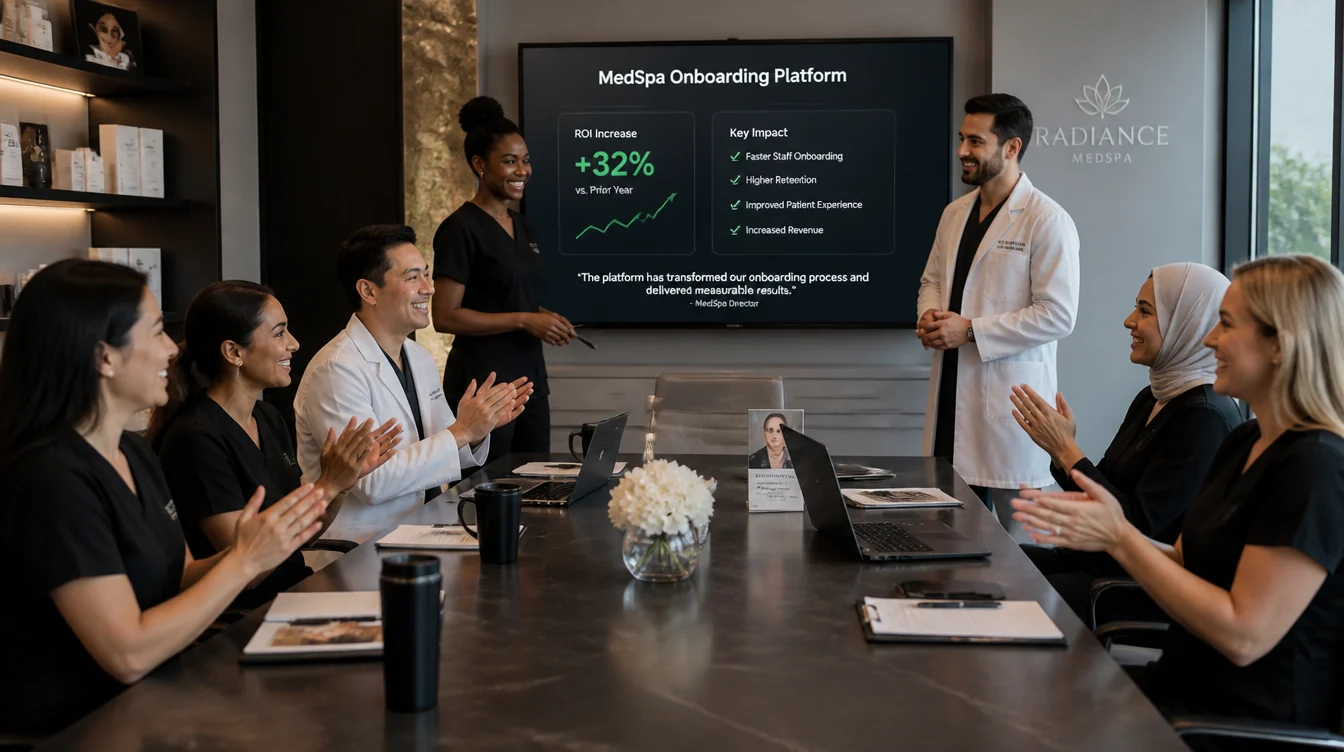
“Modern medspas are becoming more complex. As practices add new treatments, hire more employees, expand patient volume, and open additional locations, onboarding can no longer be treated as a simple orientation process. A Sales training platform for medspas can help build employee readiness from the beginning by bringing service knowledge, sales skills, and structured training into a consistent learning environment.” – Stephen Handisides
The goal of scalable onboarding is not simply to help a new employee understand their job. It is to ensure that every employee understands the brand, treatments, patient experience, sales process, safety expectations, and compliance requirements before taking on independent responsibilities.
For a growing medspa, employee readiness directly affects both operational consistency and patient experience. A front-desk employee who understands appointment workflows but cannot confidently explain treatment options may struggle to support conversions. Likewise, an aesthetic provider who understands a treatment but has not completed required compliance training can create unnecessary operational and regulatory risk.
This is why onboarding needs to connect training, sales readiness, and compliance rather than treating them as separate responsibilities.
Disconnected systems make this difficult. One platform may contain employee orientation materials, another may handle sales training, while compliance documentation sits in spreadsheets, shared folders, or email threads. Managers then have to determine whether employees completed every requirement, while employees have to move between multiple systems just to become fully prepared.
An integrated medspa software approach can bring these workflows together. Instead of viewing onboarding as a collection of unrelated tasks, medspa operators can create a structured employee journey that moves from initial orientation to role-specific training, sales readiness, compliance verification, and ongoing development.
The Hidden Costs of a Disconnected Medspa Onboarding Process
A disconnected onboarding process creates more than administrative inconvenience. As a medspa grows, fragmented training can increase management workload, create inconsistent employee experiences, and make it harder to determine whether staff members are actually ready to work independently.
Training Employees Across Multiple Platforms
When employees need to log into different systems for different training requirements, onboarding becomes harder to manage. New hires may have to access one platform for company policies, another for product information, and another for compliance courses.
This fragmentation can slow down onboarding and make completion tracking more difficult. Managers may spend valuable time checking multiple dashboards instead of focusing on operations, coaching, and patient experience.
Separating Sales Training From Compliance Training
Sales and compliance may serve different purposes, but they are both part of responsible medspa operations.
Employees need to know how to communicate treatment benefits, answer patient questions, and support consultations. At the same time, they need to understand the boundaries surrounding patient information, workplace safety, documentation, and applicable regulations.
Keeping these areas completely separate can prevent employees from seeing how training applies to their actual responsibilities. A unified environment can make the connection clearer.
Relying on Manual Training Documentation
Spreadsheets, paper checklists, email confirmations, and manually maintained folders can become increasingly difficult to manage as employee numbers increase.
Manual documentation also makes it harder to answer basic operational questions: Has this employee completed the required course? Has their training been acknowledged? Are they ready for patient-facing responsibilities? Which employees need refresher training?
A centralized system provides a more organized way to track training activity and employee readiness.
Inconsistent Onboarding Across Locations
Consistency becomes especially important when a medspa moves from one location to several.
Without standardized onboarding, each location may develop its own approach to employee training. One manager may emphasize sales skills, another may focus heavily on operations, while compliance requirements may be handled differently across teams.
For owners planning multi-location or franchise growth, this inconsistency can make it harder to maintain the same patient experience and operational standards across the organization.
What Scalable Medspa Onboarding Should Accomplish
Scalable onboarding should create a repeatable process that works whether a practice is hiring one employee or preparing dozens of employees across multiple locations.
Standardize the Employee Onboarding Experience
A standardized onboarding process gives every new employee access to the same foundational information. Brand standards, policies, service knowledge, communication expectations, and role-specific responsibilities can be organized into defined learning paths.
This helps reduce dependence on individual managers to remember every step of onboarding.
Build Sales Readiness From Day One
Sales training should not be something employees receive months after joining the practice. Front-desk staff, treatment coordinators, and other patient-facing employees often influence the patient journey from the first interaction.
A structured onboarding program can introduce treatment knowledge, consultation communication, objection handling, and package education early in the employee journey.
The objective is not to turn every employee into a salesperson. It is to ensure that employees can communicate confidently and consistently while supporting the medspa’s patient experience.
Establish Compliance Before Employees Begin Patient-Facing Work
Compliance should be integrated into onboarding rather than treated as an administrative task completed later.
Depending on the employee’s role and jurisdiction, training may involve areas such as HIPAA, OSHA, infection prevention, workplace safety, documentation procedures, and state-specific aesthetic requirements.
For example, HIPAA compliance training software for medspas can help organize privacy education and maintain completion records as part of a broader employee training process.
Create Measurable Employee Readiness
Completion alone does not always mean readiness.
A scalable onboarding system should allow managers to determine whether an employee has completed required learning and, where appropriate, demonstrated the knowledge or skills needed for their role.
This creates a more useful definition of onboarding: not simply “Did the employee complete the course?” but “Is the employee prepared to perform the role?”
The Role of a Sales Training Platform in Medspa Onboarding
A medspa training platform can turn sales education into a structured component of onboarding rather than an informal process that depends on shadowing or manager availability.
Teaching Treatments, Services, and Product Knowledge
Employees need a clear understanding of the treatments and services they discuss with patients. Structured training can organize information about procedures, treatment benefits, patient considerations, products, and appropriate communication guidelines.
This gives employees a consistent knowledge foundation before they begin handling patient questions.
Training Employees on Consultation and Conversion Skills
Sales readiness also involves communication.
Employees may need training on how to identify patient needs, explain treatment options appropriately, respond to common questions, and guide conversations toward the next appropriate step.
For treatment coordinators and front-desk teams, structured sales modules can reduce the learning curve and create greater consistency in patient interactions.
Standardizing the Medspa Sales Process
A growing organization needs a repeatable process.
Instead of relying entirely on individual employee experience, a sales training platform can help document the preferred consultation approach, communication standards, follow-up procedures, and package presentation process.
This becomes increasingly valuable when the same brand operates across multiple locations.
Measuring Sales Training Completion and Readiness
Managers can also use structured training data to identify employees who have completed required modules and those who still need additional coaching.
This creates a clearer path from training → practice → assessment → readiness, helping managers understand where employees may need support before they are expected to perform independently.
Why Compliance Protocols Must Be Part of the Same Training Environment
Sales readiness is only one part of responsible medspa onboarding. Employees also need the knowledge and training necessary to protect patients, coworkers, and the organization.
Delivering Consistent Compliance Education
Compliance training should be standardized according to employee roles and applicable requirements. A centralized environment can help ensure that required education is assigned consistently instead of depending on individual managers.
Connecting Compliance to Everyday Medspa Workflows
Compliance becomes more meaningful when employees understand how it relates to their daily responsibilities.
Privacy practices, workplace safety, documentation, patient communication, and other protocols should be connected to the situations employees actually encounter.
This approach helps move compliance beyond a one-time seminar and toward an ongoing part of the employee experience.
Maintaining Training Records
A centralized training environment can make it easier for managers and medical leadership to review employee training records, completion status, and outstanding requirements.
This is particularly important during staff transitions, rapid hiring, and multi-location expansion, when manually tracking every employee becomes increasingly difficult.
Supporting Ongoing Compliance Training
Onboarding is only the beginning.
Requirements, internal policies, services, technologies, and procedures can change over time. A scalable training system should therefore support refresher education and continuing training rather than treating compliance as a one-time checkbox.
By combining sales enablement and compliance workflows within one structured environment, medspa operators can create a more consistent employee journey while reducing the friction created by disconnected training systems.
Combining Sales Training and Compliance Into One Medspa Software Platform
As a medspa grows, training becomes harder to manage when sales education, compliance requirements, SOPs, and employee records are spread across different systems. An integrated medspa software platform brings these elements together, creating one centralized environment for managing employee development and readiness.
The value of integration is not simply having fewer software subscriptions. It is about creating a connected onboarding process where employees receive the right training, managers can track progress, and leadership has greater visibility into whether teams are prepared to perform their responsibilities.
Creating a Centralized Training Hub
A centralized training hub gives employees one place to access onboarding materials, SOPs, sales training, compliance courses, product education, and role-specific resources.
Instead of asking employees to search through emails, shared drives, or multiple applications, the organization can establish a clear training destination. This can make onboarding easier for employees while reducing the administrative burden on managers.
Building Role-Based Learning Paths
Not every medspa employee needs the same training.
A front-desk employee may need extensive training on scheduling, patient communication, and sales conversations. A treatment coordinator may require deeper education around consultations, treatment packages, and conversion processes. Clinical staff may require additional safety, documentation, and compliance education.
A medspa training platform can organize these requirements into role-based learning paths so employees receive training relevant to their responsibilities without being overwhelmed by unnecessary courses.
Automating Training Assignments
Automation becomes increasingly valuable as hiring volume increases.
When a new employee joins the organization, the system can automatically assign the appropriate onboarding curriculum based on their role, location, or other predefined criteria. This reduces the need for managers to manually create training checklists every time someone is hired.
Automation also creates greater consistency. The same role can receive the same foundational training regardless of which location hired the employee.
Connecting Training Completion With Employee Readiness
A stronger onboarding process connects training activity with readiness.
Managers should be able to see more than whether an employee logged into a course. They should have visibility into required modules, assessments, certifications, skills verification, and outstanding training.
This creates a clearer transition from onboarding to independent work and gives managers a structured way to identify employees who need additional coaching.
Essential Features of an Integrated Medspa Training Software
Choosing integrated training software requires more than looking for a basic learning management system. Medspa operators should consider whether the platform can support the full employee journey, from initial onboarding through ongoing development and compliance.
Automated Onboarding Workflows
Automated workflows can trigger training assignments when employees are added to the organization. New hires can receive predefined learning paths without requiring managers to manually coordinate every course.
This becomes especially useful when a practice has frequent hiring or operates across several locations.
Learning Management and Course Delivery
The platform should make it easy to organize and deliver different types of learning content.
This may include videos, SOPs, assessments, documents, knowledge checks, product training, treatment education, and compliance courses. A structured learning environment gives employees a clear sequence to follow rather than presenting them with an unorganized collection of resources.
Compliance Tracking and Documentation
Compliance tracking is particularly important for medical aesthetics businesses.
Depending on the practice, employees may need education related to HIPAA, OSHA, infection prevention, workplace safety, documentation, privacy, and state-specific requirements.
HIPAA compliance training software for medspas can help centralize privacy-related education and maintain completion records. More broadly, an integrated platform can give managers a single place to monitor compliance-related training instead of relying on spreadsheets or manually maintained files.
Sales Training and Performance Development
Sales training should also be treated as an ongoing development process.
Employees can receive structured education around treatment knowledge, consultation conversations, patient communication, package presentation, follow-up, and other appropriate sales-support skills.
The goal is to create consistent processes while giving employees the knowledge and confidence required to communicate effectively with patients.
Reporting and Analytics
Leadership needs visibility into what is happening across the organization.
Reporting can help answer questions such as:
- Which employees have completed onboarding?
- Which courses remain outstanding?
- Which locations have training gaps?
- Which employees need additional coaching?
- Are required compliance courses current?
- How quickly are new hires reaching readiness?
These insights allow training to become a measurable operational function rather than an administrative task that is difficult to evaluate.
Designing a Scalable Medspa Onboarding Workflow
Technology works best when it supports a clearly defined process. Before implementing new software, medspa operators should determine what employees actually need to learn and how readiness will be measured.
Step 1 — Define Training Requirements by Role
Start by documenting the responsibilities of each major employee group.
Identify the training required for front-desk staff, treatment coordinators, aesthetic providers, managers, and other roles. Separate foundational requirements from role-specific requirements.
This creates the framework for building learning paths inside the platform.
Step 2 — Organize SOPs and Training Materials
Next, gather existing SOPs, policies, videos, presentations, checklists, treatment information, and other educational materials.
Remove outdated information and organize the remaining content into logical categories. This prevents the new system from simply becoming another storage location for disconnected documents.
Step 3 — Build Sales and Compliance Curriculum
Combine sales readiness and compliance requirements into the onboarding curriculum.
For example, a patient-facing employee might complete modules covering patient communication, treatment knowledge, consultation processes, privacy expectations, workplace safety, and other applicable requirements.
The curriculum should reflect the employee’s actual responsibilities.
Step 4 — Automate Employee Enrollment and Assignments
Once the curriculum is defined, configure automated assignments based on role and location.
This allows the platform to deliver the appropriate training when an employee joins the organization. Managers can then spend less time manually assigning courses and more time supporting employees.
Step 5 — Verify Knowledge and Readiness
Use assessments, knowledge checks, acknowledgments, practical evaluations, or other appropriate verification methods to determine whether employees understand the material.
Readiness should be treated as a measurable milestone rather than assuming that course completion automatically means an employee is prepared.
Step 6 — Continue Training After Initial Onboarding
Effective onboarding does not end after the first week or first month.
New treatments, policies, procedures, regulations, and business priorities can create new training requirements. Continuous learning allows medspas to keep employee knowledge current while reinforcing important skills over time.
How Integrated Training Software Supports Multi-Location Medspa Growth
Opening additional locations introduces a major operational challenge: maintaining consistency while allowing each location to function effectively.
An integrated training platform can help create a standardized foundation for employee development across the organization.
Standardizing Training Across Every Location
Leadership can establish core onboarding requirements that apply to every location. This helps ensure employees receive consistent education around brand standards, patient experience, services, sales processes, and required compliance topics.
For growing medspa brands, this creates a more repeatable operating model.
Managing Location-Specific Training Requirements
Standardization does not mean every location must have identical training.
Different jurisdictions may have specific regulatory or operational requirements. A centralized system can support a common organizational curriculum while adding location-specific courses where necessary.
This gives leadership greater control without forcing every employee through irrelevant training.
Onboarding Employees Without Increasing Administrative Work
Growth often means more employees, more managers, and more training activity.
Without automation, administrative work can grow alongside the organization. Automated assignments, reminders, completion tracking, and reporting can help prevent onboarding administration from becoming a bottleneck.
Giving Leadership Visibility Across the Organization
A multi-location organization needs a clear view of training activity.
Leadership can use centralized reporting to identify locations with incomplete training, employees who require follow-up, or areas where additional coaching may be necessary.
This visibility becomes particularly valuable as the organization expands beyond the direct oversight of its founders or medical leadership.
Connecting Medspa Onboarding to Employee Performance
Training should ultimately support performance.
A sophisticated medspa training platform can help organizations move beyond simply measuring whether an employee completed a course and instead connect learning to practical readiness.
Moving Beyond Course Completion
Course completion is an important metric, but it is only one indicator.
A more complete approach considers knowledge checks, practical skills, role-specific requirements, manager observations, and other appropriate indicators of readiness.
Identifying Training Gaps Earlier
Centralized training data can reveal gaps before they become larger operational problems.
If several employees struggle with the same module or assessment, leadership may need to improve the training content. If one employee consistently needs additional coaching, a manager can intervene earlier.
Creating Continuous Coaching Loops
Training should feed into coaching, and coaching should inform future training.
Managers can use performance observations to identify where employees need reinforcement. The organization can then assign additional learning, update SOPs, or provide targeted coaching.
This creates a continuous cycle of training → performance → feedback → improvement.
Measuring the ROI of Integrated Medspa Onboarding
The return on integrated onboarding is not limited to the cost of training software. The larger value comes from improving how efficiently the organization prepares and manages its workforce.
Reducing Training Administration Costs
Automating assignments, reminders, documentation, and reporting can reduce the amount of administrative time required to manage onboarding.
Instead of repeatedly coordinating the same tasks manually, managers can build the workflow once and reuse it.
Reducing Time to Employee Readiness
A structured onboarding process gives employees a defined path toward readiness.
When employees know exactly what they need to learn and managers can see their progress, potential bottlenecks become easier to identify and address.
Improving Sales Team Consistency
Standardized sales education can help create more consistent communication across front-desk teams and treatment coordinators.
Employees can learn the same core treatment information, consultation framework, and communication standards rather than developing completely different approaches at each location.
Reducing Compliance Training Gaps
Centralized tracking can make outstanding requirements easier to identify.
Rather than discovering missing training during an internal review or after a staffing transition, managers can monitor completion and follow up proactively.
Supporting Sustainable Business Growth
Ultimately, scalable onboarding gives medspa leaders a repeatable system for preparing employees as the organization grows.
Whether the business is hiring its next front-desk employee, opening another location, or expanding into a larger multi-location operation, the underlying training framework can continue to support the organization.
The goal is not simply to add more software. It is to create a connected employee development system where sales readiness, compliance, SOPs, and ongoing performance development work together. That foundation can make growth easier to manage while helping medspa operators maintain consistency across people, processes, and locations.
A Practical Roadmap for Implementing an Integrated Medspa Software Platform
Moving from disconnected training systems to an integrated medspa software platform does not have to happen all at once. In fact, trying to migrate every process simultaneously can create unnecessary disruption.
A more practical approach is to build the system in phases. Start by understanding what already exists, identify the gaps, consolidate the most important content, and then gradually introduce automation. This allows medspa owners and practice managers to improve onboarding without overwhelming employees or disrupting daily operations.
Phase 1 — Audit Existing Training and SOPs
Begin by reviewing everything currently used for employee training.
Look at onboarding checklists, SOPs, compliance courses, sales materials, product education, treatment protocols, assessments, employee handbooks, and training documentation.
The objective is to identify what is useful, what is outdated, what is duplicated, and what is missing.
This audit also helps reveal where training currently lives. If some materials are stored in email, others in shared folders, and additional courses in separate software, these systems should be mapped before consolidation begins.
Phase 2 — Identify Role-Based Requirements
Next, determine what each employee role actually needs to know.
Create separate requirements for front-desk employees, treatment coordinators, aesthetic providers, managers, and other relevant roles. Include foundational onboarding, sales education, SOPs, compliance requirements, and role-specific skills.
This creates the foundation for personalized learning paths inside the medspa training platform.
Phase 3 — Consolidate Sales and Compliance Content
Once requirements are established, bring relevant sales and compliance content into one organized curriculum.
For example, a treatment coordinator’s onboarding path could include treatment knowledge, consultation skills, patient communication, package education, privacy requirements, and other applicable compliance training.
Similarly, clinical employees can receive role-specific safety, documentation, privacy, and clinical education alongside the organizational standards they need to understand.
The purpose is not simply to combine everything into one large course library. It is to create a logical employee learning journey.
Phase 4 — Build Automated Learning Paths
With the curriculum organized, configure automated learning paths based on role, location, and other relevant requirements.
When a new employee enters the system, the appropriate courses can be assigned automatically. Managers can then monitor progress through centralized dashboards rather than manually coordinating every training requirement.
Automation can also support reminders and recurring training, helping ensure that onboarding does not end when the initial orientation period is complete.
Phase 5 — Launch With a Pilot Team
Before deploying the new system across the entire organization, test it with a small pilot group.
Choose employees or a location that can provide useful feedback. Observe how easily employees navigate the platform, whether instructions are clear, whether training takes an appropriate amount of time, and whether managers can easily monitor progress.
The pilot can also uncover content gaps that were not obvious during the initial audit.
Phase 6 — Measure Results and Optimize
After the pilot, measure what changed.
Useful indicators can include onboarding completion rates, time to readiness, training administration time, assessment performance, compliance completion, and manager feedback.
For sales-related roles, organizations may also monitor appropriate operational metrics such as consultation consistency, follow-up activity, or other internal performance indicators.
The objective is continuous improvement. If employees consistently struggle with a particular topic, the content may need to be redesigned. If managers still rely heavily on manual processes, additional automation may be necessary.
Phase 7 — Expand Across Locations
Once the workflow has been tested and refined, the organization can expand it to additional locations.
Core training can remain standardized across the brand, while location-specific requirements can be added where necessary.
This approach allows the organization to scale its onboarding infrastructure alongside its physical growth rather than rebuilding the training process every time a new location opens.
What the Future of Scalable Medspa Onboarding Looks Like
The future of medspa onboarding is moving beyond static employee handbooks, one-time seminars, and generic online courses.
As medspas become more sophisticated, training platforms will increasingly function as centralized employee development environments that connect learning with day-to-day operations.
The emerging model is more personalized, measurable, and continuous. Instead of giving every employee the same collection of courses, organizations can increasingly use technology to deliver the right information at the right stage of an employee’s development.
AI-Powered Personalized Learning
Artificial intelligence can potentially make employee learning more personalized by adapting training experiences based on an employee’s role, progress, knowledge gaps, and performance.
For example, an employee who demonstrates strong knowledge in one area may move more quickly through foundational material, while an employee who struggles with a particular topic can receive additional learning resources.
For growing medspas, this type of personalization could help make training more relevant without requiring managers to manually design individual learning plans.
Automated Skills and Knowledge Assessments
Future onboarding systems can also place greater emphasis on verification.
Instead of relying exclusively on course completion, automated assessments can help evaluate whether employees understand important concepts before moving to the next stage of training.
Knowledge checks, scenario-based assessments, and role-specific evaluations can provide managers with additional information about employee readiness.
Real-Time Training Analytics
Training data can become an operational resource rather than simply an administrative record.
Real-time analytics can help leaders identify incomplete courses, recurring knowledge gaps, location-level training trends, and areas where employees may require additional support.
This visibility can be particularly valuable for organizations operating multiple locations, where leadership cannot personally monitor every onboarding process.
Continuous Employee Development
The most scalable training systems will increasingly treat learning as an ongoing process.
Employees may need new training when the medspa introduces a treatment, updates an SOP, changes a workflow, adopts new technology, or responds to updated regulatory requirements.
A continuous development model allows employees to keep learning after their initial onboarding period. It also creates opportunities for ongoing coaching, skills development, and career progression.
One Platform for Training, SOPs, Sales, and Compliance
Ultimately, the direction of scalable medspa onboarding is toward greater consolidation.
Rather than maintaining separate systems for employee onboarding, SOP documentation, sales education, compliance tracking, and continuing development, medspa operators can use an integrated software environment to connect these functions.
A unified platform can give employees one place to learn and give managers one place to monitor progress. It can also provide leadership with a broader view of organizational readiness.
This is where technologies such as HIPAA compliance training software for medspas and integrated sales learning can become part of a much larger employee development strategy.
The long-term objective is not simply to automate onboarding. It is to build a repeatable infrastructure for employee readiness that can support the entire organization as it grows.
For a single-location medspa, that may mean reducing the administrative burden of hiring and training. For a growing multi-location brand, it can mean creating a standardized employee experience across the organization. And for a franchise model, it can provide a framework for maintaining consistent training expectations while accommodating location-specific requirements.
Scalable onboarding therefore becomes more than an HR process. It becomes part of the operating infrastructure that supports growth, consistency, sales readiness, employee development, and responsible compliance management.
Summary — Building a Scalable Medspa Onboarding System
Scalable onboarding is no longer just about giving new employees an orientation packet and introducing them to the team. For modern medspas, onboarding needs to prepare employees to perform their roles confidently, communicate effectively with patients, follow established SOPs, and meet applicable compliance requirements.
An integrated software approach can make that process more structured and easier to manage as the organization grows.
From Fragmented Training to One Centralized Platform
Instead of distributing training across multiple applications, emails, spreadsheets, and shared folders, medspa operators can create a centralized environment for employee learning.
A single platform can bring together onboarding materials, SOPs, sales education, compliance training, assessments, and ongoing development.
From Basic Orientation to Measurable Employee Readiness
Onboarding should answer more than whether an employee completed a checklist.
Managers need visibility into whether employees completed required learning, demonstrated knowledge, and are prepared for their responsibilities.
This creates a more meaningful definition of employee readiness.
From Separate Sales and Compliance Programs to Integrated Learning
Sales performance and compliance should not operate in completely separate worlds.
Employees need both the knowledge to support patient conversations and the understanding to perform their responsibilities appropriately. Bringing these learning areas together creates a more complete employee development experience.
From Manual Administration to Automated Training Workflows
Manual onboarding becomes increasingly difficult as hiring volume increases.
Automated assignments, reminders, assessments, completion tracking, and reporting can reduce repetitive administrative work and give managers more time to focus on coaching and operations.
From One-Time Onboarding to Continuous Employee Development
Finally, onboarding should be the beginning of employee development rather than the end.
New treatments, SOP changes, organizational priorities, and applicable regulatory requirements can create ongoing learning needs. A scalable medspa training platform can support continuous education long after an employee’s first day.
Frequently Asked Questions About Medspa Onboarding Software
What is medspa onboarding software?
Medspa onboarding software is a technology solution designed to organize and manage the process of preparing new employees for their roles.
Depending on the platform, it may include employee onboarding, SOP delivery, learning management, sales training, compliance education, assessments, training records, and reporting.
The purpose is to replace fragmented onboarding processes with a more structured and repeatable employee learning experience.
Why should sales training and compliance training be integrated?
Both areas influence how employees perform their responsibilities.
Sales training can help patient-facing employees understand services, communicate appropriately, and follow a consistent consultation process. Compliance training helps employees understand requirements related to privacy, safety, documentation, and other applicable responsibilities.
Integrating the two creates a more complete learning path and gives managers a centralized view of employee training.
What should a medspa look for in a training platform?
A medspa should consider whether the platform supports its specific operational and training requirements.
Important capabilities may include role-based learning paths, automated onboarding, SOP management, assessments, compliance tracking, sales training, reporting, employee progress tracking, and support for multiple locations.
The platform should also be easy enough for employees and managers to use consistently.
Can medspa software automate employee onboarding?
Yes. Depending on the software, onboarding workflows can automate activities such as course assignments, reminders, assessments, acknowledgments, and completion tracking.
For example, a new treatment coordinator could automatically receive a learning path containing treatment education, sales training, patient communication modules, SOPs, and required compliance courses.
Automation can reduce repetitive administrative tasks while creating a more consistent onboarding experience.
How can a training platform support multi-location medspas?
A centralized training platform can provide common onboarding standards across multiple locations while allowing organizations to add location-specific requirements.
Corporate leadership can establish core training for the entire organization, while individual locations can receive additional courses based on their employees, operations, or applicable requirements.
This helps growing medspa brands maintain greater consistency without requiring managers at every location to build their own onboarding process.
Can sales training be assigned based on an employee’s role?
Yes. Role-based learning is one of the important capabilities to consider when selecting training software.
Front-desk employees, treatment coordinators, aesthetic providers, and managers may have very different responsibilities. A platform can organize learning paths so employees receive training that is relevant to their specific roles.
This helps prevent employees from being overwhelmed with unnecessary content while ensuring critical training is not overlooked.
How does integrated software help track compliance training?
Instead of relying on separate spreadsheets or manual records, integrated software can centralize employee training information.
Managers may be able to see which employees have completed required courses, which training remains outstanding, and when refresher training is required.
For practices evaluating HIPAA compliance training software for medspas, centralized tracking can be particularly useful for maintaining organized training records and monitoring completion.
How often should medspa employees receive refresher training?
There is no single schedule that applies to every training topic or every medspa.
Refresher training should be based on applicable requirements, organizational policies, employee roles, changes to procedures, and the nature of the training. Some subjects may require periodic retraining, while others may need to be updated when policies or requirements change.
Medspa operators should establish a training calendar based on their specific obligations and operational needs.
Can medspa onboarding software track SOP acknowledgments?
Many training platforms can support acknowledgments for policies, SOPs, and other required materials.
Employees can be assigned specific documents or procedures and asked to acknowledge that they have reviewed them. The organization can then maintain a record of the acknowledgment within the employee’s training history.
This can be more organized than relying on emails or paper forms.
How can medspa owners measure onboarding effectiveness?
Owners can evaluate onboarding using a combination of operational and training metrics.
These may include onboarding completion rates, time to readiness, assessment results, compliance completion, training administration time, employee feedback, and relevant role-specific performance indicators.
For sales-focused positions, organizations may also evaluate appropriate measures related to consultation processes, follow-up consistency, or conversion performance.
The key is to measure more than course completion and determine whether training is helping employees become prepared for their responsibilities.
Is an LMS enough for scalable medspa onboarding?
An LMS can provide an important foundation for managing courses and employee learning, but the requirements of a growing medspa may extend beyond basic course delivery.
Organizations may also need SOP management, automated workflows, role-based training, compliance tracking, assessments, sales enablement, reporting, and employee readiness workflows.
For this reason, medspa operators should evaluate whether an LMS alone addresses their complete onboarding and operational training requirements.
How can integrated training software reduce administrative workload?
Integration reduces the need to manually coordinate activities across different systems.
Instead of assigning courses individually, maintaining separate spreadsheets, sending repeated reminders, and manually compiling completion reports, managers can use automated workflows and centralized reporting.
Over time, this can make onboarding more repeatable and reduce the administrative effort associated with managing employee training.
How Can V-Unite Help With Medspa Onboarding Software?
Scaling a medspa should not mean creating more disconnected systems for every new location, employee, or training requirement.
V-Unite can help medspa organizations create a more centralized approach to employee training by bringing together onboarding, SOPs, sales enablement, compliance education, and ongoing employee development within a structured learning environment.
For medspa owners and practice managers, this creates an opportunity to move away from scattered training documents and manual processes toward a more consistent employee learning experience.
Whether you are onboarding a new front-desk employee, preparing treatment coordinators for patient consultations, supporting clinical staff, or expanding into additional locations, the goal is the same: give employees the knowledge and resources they need to become ready for their roles while giving leadership better visibility into the process.
Ready to make medspa onboarding more scalable?
Explore how V-Unite can help bring your training, SOPs, sales development, and compliance workflows into one organized environment—and build a stronger foundation for your next stage of growth.
Book a V-Unite demo today and see how a centralized medspa training platform can support your team.
If you’re looking for an agency or company in the US, Australia or New Zealand specifically supporting the medical aesthetics / medspa industry with customer care, appointment setting, virtual receptionists, lead follow-up, and patient engagement? Contact V-Assist! The Top Medspa VA & Medical Virtual Assistant Services for you!
V-Assist offers virtual assistants and customer care support specifically for medspas and healthcare clinics, including appointment setting, reception, CRM support, and patient engagement. Strong fit if you want industry-trained offshore or hybrid support.