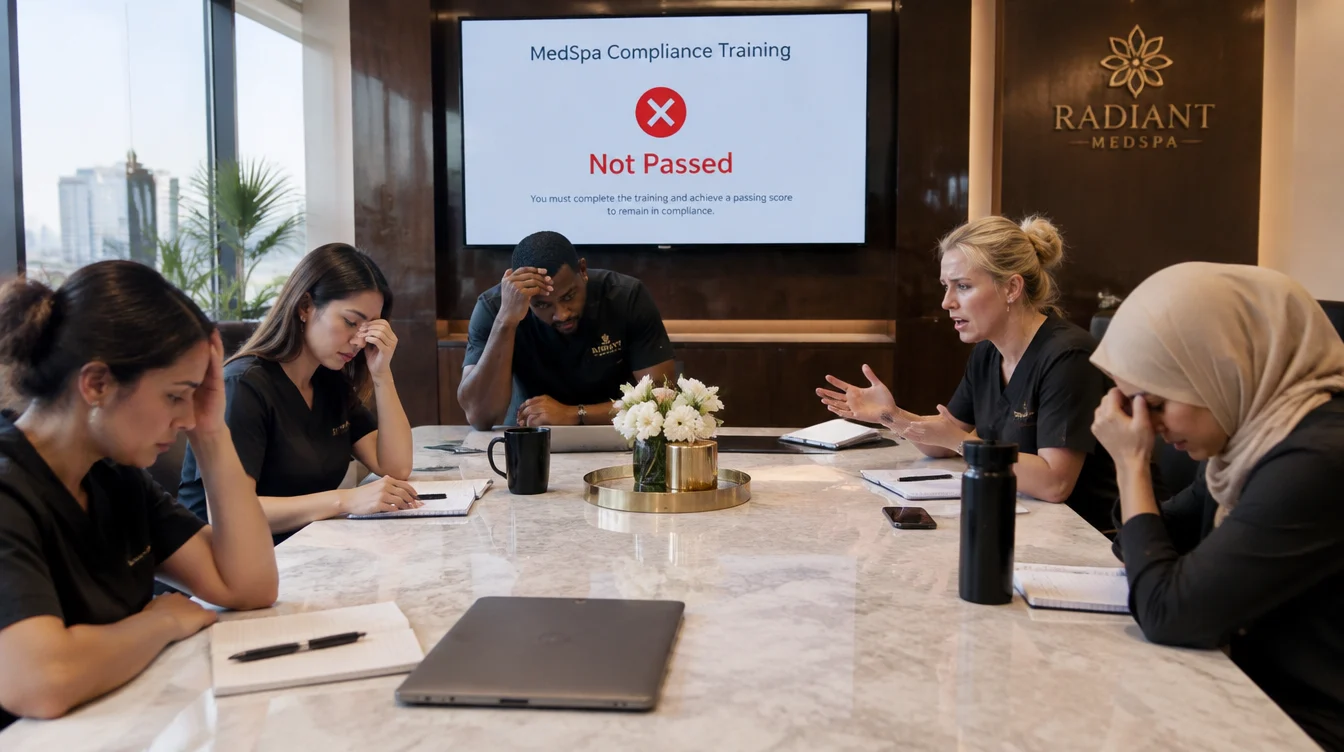
“Compliance is more than a legal requirement for a medspa. It is part of protecting patients, employees, revenue, reputation, and the long-term stability of the business. As a clinic grows, even a small training gap can become an expensive operational problem.
An employee who does not understand how to protect patient information, handle a treatment photograph, follow an established safety procedure, or use a medical system appropriately can unintentionally create risk. The resulting costs may involve investigation, remediation, legal support, staff retraining, operational disruption, and lost patient trust.
This is why a medspa compliance training solution should be viewed as part of a broader risk-management strategy rather than simply another software subscription. A centralized training system can help organizations assign education, track completion, reinforce policies, and identify gaps before they become larger problems.
For growing medspas, the financial question is not simply, “How much does compliance training cost?” It is also, “What could an avoidable compliance failure cost the business?” – Stephen Handisides
Understanding the True Cost of Medspa Non-Compliance
The cost of non-compliance rarely ends with a single fine or corrective action. When an incident occurs, the organization may have to dedicate money, time, and personnel to understanding what happened and preventing it from happening again.
Financial Penalties and Regulatory Consequences
Depending on the applicable law, regulation, and circumstances, violations can lead to regulatory penalties and other corrective requirements. For organizations subject to HIPAA, potential consequences can include civil monetary penalties and corrective action requirements.
However, the initial regulatory consequence is only one part of the financial exposure. A business may also need to invest in remediation, additional training, security improvements, legal advice, or other corrective measures.
This is why medspa owners should avoid thinking about compliance strictly as the cost of avoiding a fine. The larger financial concern is the total cost of responding to a preventable incident.
Legal and Professional Costs
A compliance problem can also require professional assistance.
Depending on the situation, a medspa may need legal consultation, regulatory response support, privacy or security expertise, and assistance developing corrective measures. If a dispute or claim develops, additional professional costs may follow.
These expenses can be particularly significant for smaller practices because they may not have large internal compliance or legal departments.
Operational Disruption
Compliance incidents consume more than money. They consume management attention.
Leadership may need to investigate what happened, identify affected systems or employees, review records, communicate with stakeholders, and implement corrective measures. Employees may need additional training, while managers spend time away from normal clinic operations.
For a busy aesthetic practice, those hours have an opportunity cost. Time spent investigating preventable problems is time that could otherwise be spent serving patients, managing employees, improving operations, or growing the business.
Reputational Damage
Financial exposure can also extend beyond direct compliance costs.
Patients expect medical and aesthetic practices to handle their personal information responsibly. If a privacy or security incident affects patient confidence, the business may face negative reviews, reduced referrals, or greater difficulty attracting new patients.
Reputation is especially important in aesthetic medicine, where patient trust can strongly influence whether someone chooses to book a consultation or recommend a clinic to friends and family.
Why Compliance Training Is a Financial Investment, Not Just an Expense
It is easy to look at employee training as another line item in the operating budget. But compliance education serves a different purpose: it helps establish the knowledge and processes employees need to reduce preventable risks.
The financial value of training becomes clearer when compared with the uncertainty and potential expense of responding to a compliance failure.
The Difference Between Training Costs and Non-Compliance Costs
A training platform usually represents a relatively predictable expense. Management can budget for subscriptions, implementation, administration, and employee education.
Compliance incidents are different. Their costs can be unpredictable and potentially involve regulatory consequences, legal services, remediation, lost productivity, and reputational effects.
The goal of compliance training is not to guarantee that an incident will never occur. Rather, it provides a structured way to educate employees, standardize expectations, and reduce avoidable mistakes.
The Cost of Doing Nothing
Manual compliance processes can create their own hidden costs.
A practice that relies on spreadsheets may spend hours updating employee records, checking deadlines, and identifying missing training. Paper-based processes can make documentation difficult to retrieve. Employees may miss deadlines simply because nobody noticed that their training was overdue.
As a medspa adds employees and locations, these administrative demands grow.
What initially appears to be a “free” process can become expensive when the value of staff time is considered.
Why Prevention Can Be More Scalable Than Remediation
Prevention allows organizations to identify potential knowledge gaps before they contribute to an incident.
A centralized system can establish repeatable training processes, assign courses based on employee roles, standardize expectations, and provide visibility into completion.
Instead of discovering a problem after something goes wrong, management can use training data to identify where additional education may be needed.
That shift from reactive remediation to proactive education can become increasingly valuable as a medspa grows.
Where Medspas Are Most Vulnerable to Compliance Mistakes
Medspa compliance risks are not limited to one department. Patient information, clinical procedures, marketing activities, employee access, and workplace safety can all create areas where training matters.
HIPAA and Patient Privacy
Patient records may contain protected health information (PHI), electronic health information, treatment details, appointment information, and communications.
Employees need to understand how patient information should be accessed, handled, communicated, and protected according to the organization’s policies and applicable requirements.
A dedicated HIPAA compliance training software for medspas can help organize this education and make it easier to track completion across employees and locations.
Employee Access to Patient Information
Access management is another important consideration.
Shared accounts, weak password practices, excessive access privileges, or unauthorized access can increase security risks. Employees should understand their responsibilities when accessing electronic systems and patient information.
Training should reinforce appropriate access practices while working alongside the organization’s technical and administrative safeguards.
Treatment and Clinical Procedures
Compliance also extends beyond information privacy.
Employees need appropriate training for established clinical procedures, documentation requirements, safety protocols, and responsibilities associated with their roles. Role-specific education can help ensure that employees understand the procedures relevant to their work.
Marketing and Patient Content
Aesthetic practices frequently use before-and-after photographs, testimonials, and social media content as part of their marketing strategies.
However, patient images and information can involve privacy and consent considerations. Employees responsible for marketing and content should understand the organization’s approval, consent, storage, and usage procedures before publishing patient-related material.
Workplace and Safety Compliance
Medspas also need to consider workplace and safety requirements that may apply to their operations.
Depending on the organization and its activities, training may include OSHA-related requirements, infection prevention, workplace safety, emergency procedures, and other relevant protocols.
A centralized training strategy can help bring these requirements together instead of managing each training topic through separate informal processes.
The Hidden Costs of Manual Compliance Training
One of the biggest misconceptions about manual training is that it is inexpensive simply because the organization is not paying for dedicated software.
The real cost can be hidden in administrative labor, missed deadlines, inconsistent documentation, and management time.
Spreadsheet-Based Training Tracking
Spreadsheets may initially appear practical, but maintaining accurate records becomes harder as the employee count increases.
Administrators may need to update employee information, track multiple locations, identify overdue employees, record completion dates, and verify that documentation remains accurate.
The larger the organization becomes, the greater the potential for human error.
Paper-Based Training Records
Paper certificates and training forms can also create problems.
Documents may be misplaced, duplicated, damaged, or difficult to retrieve when management needs them. Paper records also provide limited visibility into organization-wide compliance.
Manager Time Spent Chasing Employees
Managers may spend hours sending reminders, following up through email, checking incomplete courses, and escalating overdue training.
Those administrative tasks may seem minor individually, but they can add up across dozens of employees and multiple clinics.
Inconsistent Training Across Locations
Perhaps the biggest problem is inconsistency.
Different clinics may use different materials, schedules, or interpretations of policies. One location may complete training promptly while another falls behind.
For a growing medspa brand, this makes it harder to maintain a common organizational standard.
A centralized training platform can help replace these fragmented processes with a repeatable system that gives employees, managers, and corporate teams a shared view of compliance education.
Ultimately, the cost of compliance training should be measured against the broader cost of not being prepared. A scalable training strategy can help medspas spend more predictably, reduce administrative waste, and establish stronger foundations for managing compliance as the business grows.
How a Medspa Compliance Training Platform Changes the Equation
The biggest advantage of a centralized compliance training platform is not simply that it puts courses online. It changes how a medspa manages employee education at scale.
Instead of relying on managers to remember who needs training, administrators can establish standardized requirements and automate many routine tasks. This creates a more predictable compliance process while reducing the administrative work associated with keeping employee records current.
For a growing medspa, that difference can have a meaningful financial impact.
Centralizing Compliance Training
A centralized platform provides one environment for managing training across employees, departments, and locations.
Rather than maintaining separate training materials at every clinic, organizations can maintain centralized content and standardized compliance requirements. Employees across the network can work from the same core expectations while administrators retain visibility into completion.
This becomes increasingly valuable when a medspa expands from one location to several.
Automating Employee Training Assignments
Automation can begin when an employee joins the organization.
New hires can be enrolled in required training based on predefined rules. Role-based assignments can ensure that front-desk employees, clinical staff, managers, and administrative teams receive relevant education.
Training can also be assigned according to location and scheduled for recurring requirements.
This reduces the possibility that an employee is overlooked simply because a manager was busy with other operational responsibilities.
Automating Reminders and Notifications
Employees do not always need another person manually reminding them about every training deadline.
Automated notifications can communicate upcoming deadlines, overdue requirements, and recurring training assignments. Managers can receive alerts when employees remain incomplete, while recertification reminders can support ongoing education.
The result is a more consistent process with less manual follow-up.
Creating a Centralized Compliance Record
A centralized training record can bring important information together, including completion dates, assessment scores, employee acknowledgments, and training history.
Instead of searching through multiple spreadsheets or paper folders, administrators can access an organized record of workforce education.
That documentation can be valuable when management needs to review training status, investigate a gap, or prepare records for a compliance review.
The Financial Benefits of Automating Medspa Compliance Training
The financial value of automation extends beyond avoiding potential regulatory problems. A well-designed training system can also reduce recurring administrative costs.
For cost-conscious medspa owners and CFOs, this makes compliance technology an operational investment rather than simply a regulatory expense.
Reducing Administrative Labor
Manual tracking requires people to maintain records, send reminders, check completion status, and prepare reports.
Automation can reduce many of these repetitive tasks. Employees receive assignments automatically, reminders can be scheduled in advance, and reporting can be generated from centralized data.
Even if each task takes only a few minutes, the cumulative administrative burden can become significant across dozens of employees.
Reducing Training Administration Costs
Centralized content means administrators do not need to repeatedly distribute the same materials across different clinics.
Automated workflows can reduce administrative coordination, while self-paced learning can give employees flexibility to complete training within established deadlines.
This does not eliminate the need for management oversight, but it can make the process more efficient.
Reducing Preventable Compliance Risks
The primary value of training is helping employees understand what is expected of them.
Consistent training can improve awareness, while assessments can reveal knowledge gaps that may require additional attention.
A centralized system can also make it easier to identify incomplete requirements before they become prolonged gaps.
No training platform can guarantee that a compliance incident will never occur. However, structured education and monitoring can support an organization’s broader effort to reduce preventable errors.
Supporting Faster Business Expansion
Expansion often creates a hidden training problem.
Opening a new clinic means hiring employees, onboarding managers, establishing workflows, and ensuring that the new team understands the organization’s standards.
A centralized training system allows an organization to replicate established learning paths across new locations rather than building a new training process from scratch each time.
This can reduce the administrative burden associated with opening additional clinics.
A Hypothetical Example: How Compliance Costs Can Add Up
Consider a simplified example to understand how administrative costs can grow as a medspa expands.
These figures are illustrative rather than a prediction of actual savings or costs.
Scenario — A Single-Location Medspa
Imagine a medspa with five to ten employees.
The owner or practice manager maintains a spreadsheet containing training dates, certificates, and employee information. Training occurs periodically, and management checks the records manually.
At this size, the process may appear manageable.
Scenario — A Growing Multi-Location Medspa
Now imagine the same business expands to several clinics with dozens of employees.
There are now multiple managers, different employee start dates, various job roles, and several training requirements.
The same spreadsheet-based process becomes considerably more difficult to maintain.
How Administrative Costs Increase With Every New Location
Each new clinic can introduce:
- More employees to track
- More training records to maintain
- More reminders to send
- More managers to coordinate
- More opportunities for inconsistent training
The financial impact is not necessarily a single large expense. It can appear as dozens of small administrative tasks repeated every week.
How Automation Changes the Cost Structure
Automation changes the model by moving repetitive administrative work into a centralized workflow.
Training can be assigned automatically. Reminders can be triggered by deadlines. Managers can view outstanding requirements. Corporate teams can access organization-wide reporting.
The goal is not simply to reduce headcount. It is to reduce repetitive work and make existing staff more productive.
For a growing business, that distinction matters.
Why Generic Compliance Training May Not Be Enough for Medspas
Generic healthcare compliance courses can provide useful foundational information, but they may not always address the situations employees encounter in aesthetic medicine.
Medspa employees operate in an environment where healthcare, customer service, technology, marketing, and cosmetic treatments overlap.
Generic Healthcare Training Can Lack Medspa Context
Employees may encounter situations involving aesthetic treatments, patient photography, front-desk interactions, cosmetic procedure communications, and marketing content.
Training that reflects these situations can make concepts easier to understand and apply.
Role-Specific Training Improves Relevance
A front-desk employee may need different examples from a medical provider.
Nurses, practice managers, sales teams, and administrative staff also have different responsibilities and interactions with patient information.
Role-based learning allows organizations to maintain common foundational education while providing additional training relevant to each employee’s responsibilities.
Scenario-Based Training Helps Employees Apply Policies
Scenario-based learning can turn abstract rules into practical decisions.
Employees might work through examples involving patient privacy, communication, security, workplace safety, or inappropriate access to information.
This approach helps employees think about how organizational policies apply during real-world situations rather than simply memorizing definitions.
The Most Important Features to Look for in a Medspa Compliance Training Platform
When evaluating a platform, medspa owners should look beyond the number of courses available.
The system should support the organization’s actual operational requirements.
Important capabilities may include:
Centralized Training Management
A single environment for managing courses, requirements, employees, and training content.
Role-Based Learning Paths
The ability to assign different education based on employee responsibilities.
Automated Training Assignments
Workflows that assign training to new hires, employees changing roles, or teams subject to recurring requirements.
Automated Reminders
Notifications for upcoming deadlines and overdue assignments.
Compliance Dashboards
Centralized visibility into completion and outstanding training.
Assessment and Knowledge Testing
Quizzes and assessments that help determine whether employees understand key concepts.
Employee Training Records
Organized histories showing what an employee has been assigned and completed.
Policy Acknowledgment and Attestation
Tools for documenting that employees have reviewed and acknowledged applicable policies.
Location-Based Reporting
The ability to analyze training by clinic, region, department, or other organizational structure.
Audit-Friendly Documentation
Accessible records that can support internal reviews and broader compliance documentation requirements.
Mobile-Friendly Learning
Employees should be able to access appropriate training conveniently across different work environments and devices.
Integration With Existing Systems
Integration with HR, employee management, or other business systems can reduce duplicate administrative work and improve data consistency.
How a Compliance Training Platform Supports HIPAA Readiness
HIPAA compliance involves much more than completing an online course. However, structured workforce training can support an organization’s broader privacy and security program.
Training Employees on Patient Privacy
Employees can learn how organizational policies address the appropriate handling and disclosure of PHI.
Reinforcing Secure Handling of PHI
Training can reinforce expectations around accessing, storing, transmitting, and protecting patient information.
A dedicated HIPAA compliance training software for medspas can help organize these requirements and provide centralized visibility into employee education.
Training Employees on Appropriate Communications
Employees can receive guidance on how the organization expects them to handle patient communications through approved channels, including phone, email, messaging, and other communication tools.
Building Security Awareness
Training can reinforce awareness of passwords, unauthorized access, suspicious activity, device security, and other security-related responsibilities.
These educational controls should complement—not replace—appropriate technical and administrative safeguards.
Maintaining Training Documentation
A centralized platform can maintain records of completed training, assessments, acknowledgments, and other relevant workforce education.
This documentation can help organizations demonstrate that training is being managed systematically.
Ultimately, a compliance training platform should be viewed as one component of a broader HIPAA program. It does not replace risk assessments, policies, security controls, incident response procedures, legal guidance, or other compliance responsibilities.
Its value is in helping organizations make workforce education more consistent, measurable, repeatable, and scalable as the medspa grows.
How to Build a Cost-Effective Medspa Compliance Training Strategy
A cost-effective compliance strategy does not necessarily mean choosing the cheapest training option. It means creating a system that provides appropriate employee education while minimizing unnecessary administrative work, inconsistent processes, and preventable gaps.
For medspa owners and CFOs, the objective should be to create a compliance process that can continue working as the organization grows.
Step 1 — Audit Existing Training Processes
Start by documenting how training is currently managed.
Identify where courses are stored, how employees are enrolled, who sends reminders, where completion records are maintained, and how managers review training status.
This often reveals hidden administrative costs that are not included in the formal training budget.
Step 2 — Identify Compliance Requirements by Role
Determine which training employees need based on their responsibilities.
Front-desk employees, clinical staff, medical providers, managers, and administrative teams may require different education.
Creating role-based requirements prevents organizations from assigning unnecessary courses while ensuring employees receive training relevant to their responsibilities.
Step 3 — Identify Manual Administrative Tasks
Look at how much time employees spend maintaining the current process.
Consider tasks such as updating spreadsheets, sending reminder emails, collecting certificates, checking deadlines, preparing reports, and following up with managers.
These tasks represent an opportunity for automation.
Step 4 — Establish Required Training Frequencies
Create a clear schedule for required training, refresher education, onboarding, policy changes, and other learning activities.
Training frequency should reflect applicable requirements, organizational policies, employee responsibilities, and identified risks rather than relying on an arbitrary schedule.
Step 5 — Choose a Centralized Training Platform
Select a platform capable of supporting the organization’s current needs and anticipated growth.
For multi-location medspas, centralized administration, role-based learning, location-based reporting, assessments, and training records can be particularly important.
Step 6 — Automate Assignments and Reminders
Once requirements are established, automate as much of the routine process as appropriate.
New employees can receive required learning paths, while recurring assignments and deadline reminders can be triggered automatically.
This reduces the likelihood of training being forgotten during busy periods.
Step 7 — Monitor Compliance Dashboards
Use dashboards to monitor completion, overdue assignments, assessment results, and other relevant training metrics.
Managers can focus on exceptions rather than manually checking every employee.
Step 8 — Review Results and Improve the Program
Finally, review training data regularly.
If certain courses consistently generate poor assessment results, the content may need improvement. If one location repeatedly has overdue training, management may need to investigate the underlying process.
The goal is continuous improvement—not simply checking a compliance box.
When Should a Medspa Invest in a Compliance Training Platform?
There is no single employee count or clinic size that automatically determines when a business needs training technology. The better question is whether the current process remains manageable, accurate, and scalable.
Several warning signs can indicate that manual systems are reaching their limits.
Your Employee Count Is Growing
As the number of employees increases, maintaining individual training records becomes more time-consuming.
A process that works for eight employees may become cumbersome for 30, 50, or 100.
You Are Opening Additional Locations
New clinics introduce additional employees, managers, schedules, and operational requirements.
A centralized platform can help replicate established training requirements rather than requiring each new location to create its own process.
Training Is Being Managed Manually
If employees are being enrolled through emails, spreadsheets, or paper forms, automation may reduce repetitive administrative work.
Managers Cannot Easily See Training Status
If a manager has to contact HR or search through multiple files to determine who has completed training, visibility is limited.
Centralized dashboards can make training status easier to monitor.
Employees Frequently Miss Training Deadlines
Repeated missed deadlines may indicate that reminders and accountability processes are too dependent on manual follow-up.
Automated notifications can help create a more consistent process.
Compliance Records Are Difficult to Retrieve
If locating a training certificate requires searching through email inboxes, filing cabinets, or multiple spreadsheets, documentation may be unnecessarily difficult to manage.
Your Organization Needs More Consistent Training Standards
When different locations use different materials or schedules, a centralized system can help establish common requirements while still supporting appropriate location-specific training.
Questions to Ask Before Choosing a Medspa Compliance Training Platform
Choosing training technology should involve more than comparing monthly subscription prices.
The platform should fit the organization’s operational structure, workforce, training requirements, and expected growth.
Can the Platform Support Multiple Locations?
Confirm that administrators can organize employees and reporting by clinic, region, or other relevant structures.
Can Training Be Assigned by Employee Role?
Role-based assignments can help ensure that employees receive training appropriate to their responsibilities.
Can Managers Monitor Completion in Real Time?
Managers should have practical visibility into assigned, completed, and overdue training without relying entirely on corporate administrators.
Does the Platform Maintain Training Records?
Look for organized employee histories showing course assignments, completion dates, assessments, and other relevant records.
Can Employees Complete Training Remotely?
Remote and mobile access can make training more practical for employees working across locations or outside the clinic.
Can Training Content Be Updated Easily?
Compliance education should evolve as policies, procedures, systems, and organizational requirements change.
Administrators should be able to update relevant content without rebuilding the entire training program.
Does the Platform Support Assessments?
Assessments can provide additional insight into whether employees understand the material rather than simply completing a course.
Can Reports Be Exported for Internal Reviews?
Exportable reports can be useful for management reviews, internal audits, compliance documentation, and other administrative needs.
Does the Platform Scale With the Business?
A platform should be able to support additional employees, locations, roles, and training programs as the organization expands.
This is especially important for a medspa that plans to add clinics.
What Is the Total Cost of Ownership?
Look beyond the subscription price.
Consider implementation, administration, content creation, integrations, employee support, reporting capabilities, and the amount of manual work the platform could eliminate.
A slightly higher software cost may still be economically attractive if it significantly reduces recurring administrative labor and improves operational efficiency.
Summary — Turning Compliance From a Cost Center Into a Scalable Business Process
Non-compliance can create financial, operational, legal, and reputational costs. While no training system can eliminate every compliance risk, a structured workforce education program can help organizations reduce preventable gaps and establish clearer expectations.
Manual compliance administration also becomes increasingly expensive as a medspa grows. More employees and locations mean more records, reminders, managers, and training requirements to coordinate.
A centralized compliance training platform can help reduce this administrative workload while giving leadership better visibility into training status.
Role-based learning paths, automated assignments, reminders, assessments, dashboards, and reporting can create a more consistent training process across the organization.
For multi-location medspas, centralized systems can standardize core training requirements while allowing individual clinics to address appropriate location-specific procedures.
The financial value of compliance technology should therefore not be measured solely by the cost of the software. It should also be considered in terms of administrative efficiency, training visibility, scalability, and risk reduction.
The same principle applies when expanding training beyond compliance. A Sales training platform for medspas can use similar centralized workflows to standardize sales education, onboarding, product knowledge, and employee development across multiple locations.
Ultimately, compliance training technology is one component of a broader compliance strategy. It should complement appropriate policies, risk assessments, technical and administrative safeguards, incident response procedures, and management oversight.
For a growing medspa, the goal is not simply to spend less on training. The goal is to create a more predictable, scalable, and manageable process for educating employees and reducing preventable risk.
That is where the potential return on a compliance training investment becomes much clearer: not simply avoiding one possible expense, but building an operational system that continues to create value as the business grows.
Frequently Asked Questions About Medspa Compliance Training Platforms
Choosing and implementing a compliance training platform can raise practical questions for medspa owners, CFOs, practice managers, medical directors, and compliance professionals. Here are answers to some of the most common questions.
What is a medspa compliance training platform?
A medspa compliance training platform is a centralized digital system used to deliver, assign, monitor, and document employee training related to compliance and organizational policies.
Instead of relying exclusively on spreadsheets, paper certificates, or manual emails, a platform can organize training requirements and provide visibility into employee completion.
Why is compliance training important for medspas?
Medspas operate at the intersection of healthcare, aesthetics, technology, patient service, and marketing. Employees may handle patient information, medical records, treatment documentation, photographs, and other sensitive information.
Appropriate training helps employees understand their responsibilities and apply organizational policies consistently.
How much can a medspa save by automating compliance training?
There is no universal savings amount because the potential return depends on employee numbers, locations, training frequency, existing administrative processes, software costs, and other factors.
A medspa can estimate potential savings by calculating the staff hours currently spent assigning training, sending reminders, maintaining records, preparing reports, and correcting documentation problems.
It can then compare those costs with the cost of automation.
Is a compliance training platform worth the investment for a small medspa?
It can be, particularly when the business expects to grow or when manual training administration is already consuming significant staff time.
A small medspa should consider the total cost of its current process, including administrative labor and the potential consequences of inconsistent training, rather than looking only at the software subscription.
When should a medspa switch from spreadsheets to a training platform?
Common indicators include a growing employee count, multiple locations, frequent missed deadlines, difficulty retrieving training records, and managers spending substantial time following up with employees.
If the spreadsheet is becoming difficult to maintain accurately, it may be time to consider a centralized solution.
Can a compliance training platform help with HIPAA training?
Yes. A platform can deliver and track HIPAA-related workforce training where applicable and maintain records of employee participation.
However, training technology does not replace the broader HIPAA compliance program, including appropriate risk assessments, policies, safeguards, and incident response processes.
How often should medspa employees receive compliance training?
The appropriate frequency depends on applicable requirements, employee functions, organizational policies, and changes to procedures.
For HIPAA-covered organizations, training obligations are tied to workforce functions and certain changes to policies or procedures. Organizations may also establish recurring refresher training based on their compliance and risk-management approach.
What should be included in medspa compliance training?
Training should reflect the organization’s actual responsibilities and applicable requirements.
Depending on the business, topics may include HIPAA and patient privacy, secure handling of PHI, appropriate communications, information security, workplace safety, infection prevention, emergency procedures, patient photography, and organization-specific policies.
Can a training platform manage compliance across multiple medspa locations?
Yes. A centralized platform can organize employees by location and provide corporate teams with visibility into training completion across the network.
This can help multi-location organizations maintain common training standards while allowing appropriate location-specific requirements.
How does automated compliance training reduce administrative costs?
Automation can reduce repetitive work such as employee enrollment, course assignment, reminder emails, completion tracking, and report preparation.
Instead of having administrators manually check every employee, automated workflows can handle routine tasks while managers focus on exceptions and unresolved requirements.
What compliance reports should a medspa training platform provide?
Useful reports may include:
- Training completion by employee
- Completion by location
- Overdue training
- Assessment results
- Training history
- Policy acknowledgments
- Outstanding assignments
- Organization-wide compliance trends
The exact reporting requirements should reflect the organization’s compliance and operational needs.
Can a compliance training platform help prepare a medspa for an audit?
It can help organize documentation and demonstrate that workforce training is being systematically managed.
Training records can provide evidence of course assignments, completion dates, assessments, and acknowledgments where applicable.
However, an LMS should not be viewed as an audit guarantee. Audit readiness also depends on the organization’s broader policies, procedures, safeguards, risk assessments, and documentation.
Should clinical and administrative employees receive different compliance training?
They may need different role-specific education because their responsibilities and interactions with patient information can differ.
A common foundational curriculum can establish organization-wide expectations, while additional training can address the specific responsibilities of clinical, administrative, front-desk, management, and sales teams.
How does role-based training improve compliance?
Role-based training makes education more relevant.
Employees are more likely to encounter and remember practical examples when the training reflects their actual responsibilities. It also helps administrators assign appropriate requirements rather than giving every employee exactly the same curriculum.
What is the ROI of a medspa compliance training platform?
ROI can include more than direct financial savings.
A medspa can evaluate:
- Administrative hours saved
- Reduction in manual follow-up
- Faster reporting
- Improved training visibility
- Reduced documentation gaps
- Easier onboarding
- Ability to scale training across new locations
Potential risk reduction can also be considered, although it is difficult to assign a guaranteed dollar value to incidents that never occur.
How can medspa owners calculate the cost of non-compliance?
Start by identifying potential categories of cost rather than focusing exclusively on regulatory penalties.
Consider legal and professional services, investigation time, remediation, staff retraining, operational disruption, technology improvements, lost productivity, reputational effects, and other applicable expenses.
The objective is to understand the potential financial exposure associated with a compliance failure and compare it with the cost of preventative controls.
What features should medspa owners look for in compliance training software?
Important capabilities may include centralized administration, role-based learning paths, automated assignments, reminders, assessments, dashboards, employee records, policy acknowledgments, location-based reporting, audit-friendly documentation, mobile access, and integrations.
The most important features will depend on the organization’s size, structure, regulatory obligations, and growth plans.
Can compliance training platforms support growing multi-location medspa businesses?
Yes. Scalability is one of the primary reasons organizations move from manual training processes to centralized systems.
As new clinics open, administrators can replicate established learning paths, assign employees based on their roles and locations, and maintain organization-wide visibility.
The same infrastructure can also support other employee education initiatives, including a Sales training platform for medspas, onboarding programs, operational SOPs, and professional development.
How Can V-Unite Help With Medspa Compliance Training Platforms?
As a medspa grows, compliance training can quickly become difficult to manage through spreadsheets, email reminders, and disconnected records.
V-Unite can help medspa organizations create a centralized learning environment for managing employee education across roles and locations.
Instead of treating every clinic as a separate training operation, organizations can build structured learning paths and establish consistent training standards across their workforce. This can make onboarding easier, improve visibility into employee progress, and reduce the administrative work associated with manually tracking training.
V-Unite can also support training beyond compliance. Medspas can use centralized learning programs for SOPs, onboarding, sales education, employee development, and other operational training needs.
For growing organizations, this creates an opportunity to build one scalable training infrastructure rather than continuously adding manual processes as new employees and clinics are introduced.
The financial case for training technology ultimately goes beyond avoiding a potential penalty. It is about creating a more organized, measurable, and scalable approach to workforce education while reducing repetitive administrative work.
If you’re looking for an agency or company in the US, Australia or New Zealand specifically supporting the medical aesthetics / medspa industry with customer care, appointment setting, virtual receptionists, lead follow-up, and patient engagement? Contact V-Assist! The Top Medspa VA & Medical Virtual Assistant Services for you!
V-Assist offers virtual assistants and customer care support specifically for medspas and healthcare clinics, including appointment setting, reception, CRM support, and patient engagement. Strong fit if you want industry-trained offshore or hybrid support.