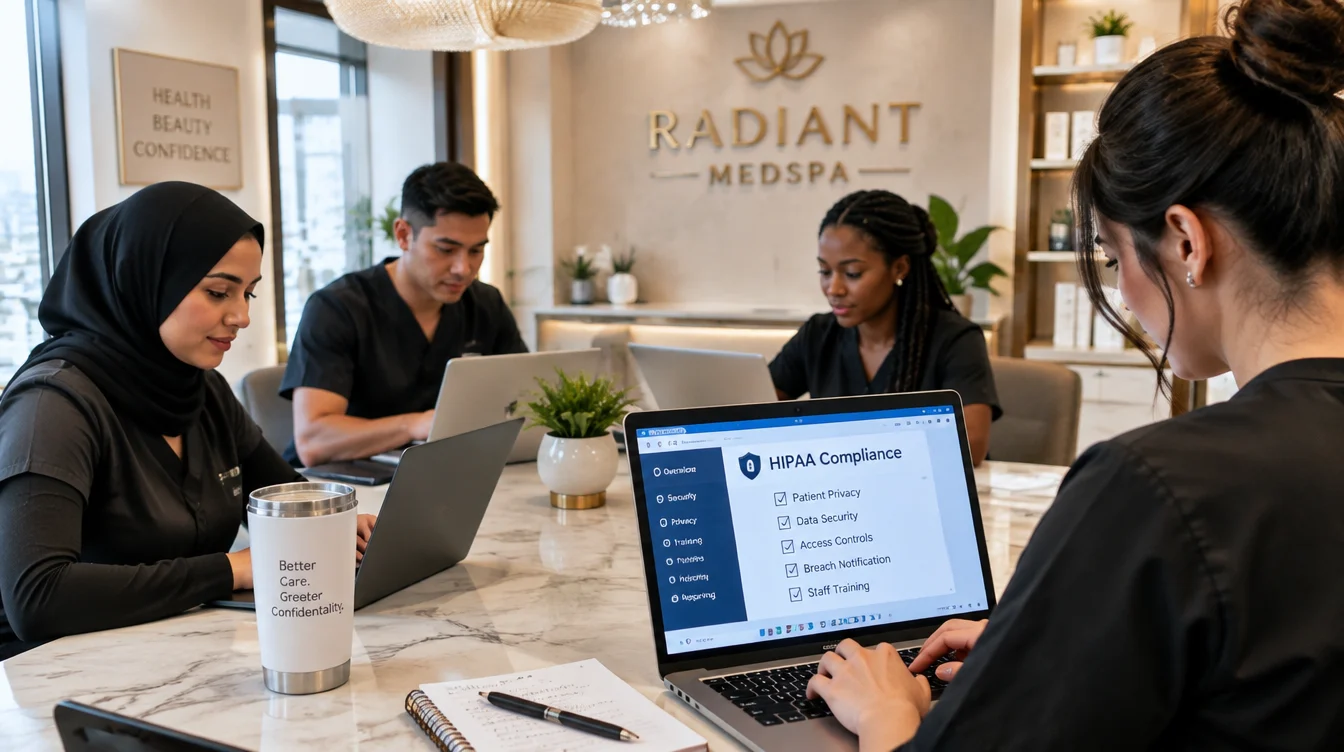
“For a single-location medspa, maintaining consistent privacy and security practices can already require careful coordination. As the business expands to multiple clinics, however, HIPAA compliance becomes significantly more difficult to manage. Different teams, managers, systems, schedules, and day-to-day habits can create gaps in how patient information is handled.
This is where a medspa training platform can become an important part of a centralized compliance strategy. Instead of relying on occasional meetings, paper certificates, or spreadsheets, multi-location medspas can use a centralized training environment to deliver required education, monitor completion, and maintain documentation across every clinic.” – Stephen Handisides
HIPAA compliance is not simply about creating policies and placing them in an employee handbook. Workforce members need to understand the policies and apply them appropriately to their daily responsibilities. HHS states that covered entities must train workforce members on privacy policies and procedures as necessary and appropriate for their functions.
That distinction is particularly important for growing medspa organizations. A policy may say that patient information must be protected, but employees still need practical guidance on how to handle patient records, treatment information, photographs, communications, and electronic systems.
A centralized training solution can help establish the same expectations across locations while giving corporate teams greater visibility into employee participation and completion.
Throughout this article, we will explore how training solutions can help multi-location medspas approach HIPAA compliance through training, auditing, documentation, monitoring, and continuous improvement.
Understanding HIPAA Compliance for Multi-Location Medspas
HIPAA compliance starts with understanding what information needs protection and which requirements apply to the organization.
What HIPAA Protects in a Medspa Environment
Medspas may handle a wide range of information that can constitute protected health information (PHI), depending on the circumstances and the organization’s HIPAA status. This can include patient records, treatment information, photographs associated with patient care, payment-related information, appointment details, and communications containing identifiable health information.
Electronic protected health information, or ePHI, receives additional protection under the HIPAA Security Rule. The Security Rule requires regulated entities to implement appropriate administrative, physical, and technical safeguards for ePHI.
For a multi-location organization, the challenge is making sure these protections are understood and consistently applied at every branch.
Which HIPAA Rules Matter Most to Medspas?
Three major HIPAA frameworks are particularly relevant when an organization is subject to HIPAA:
- Privacy Rule: Governs permitted uses and disclosures of PHI.
- Security Rule: Establishes safeguards for electronic PHI.
- Breach Notification Rule: Establishes notification requirements following certain breaches of unsecured PHI.
Workforce policies and administrative procedures are also essential. Employees need to know what is expected of them, who can access information, how incidents should be reported, and what procedures apply when policies change.
This is why HIPAA education should not be treated as a one-time orientation exercise.
When Is a Medspa Considered a HIPAA Covered Entity?
Not every business that handles health-related information is automatically a HIPAA covered entity. HIPAA generally applies to health plans, healthcare clearinghouses, and healthcare providers that conduct certain electronic healthcare transactions.
Because medspa business structures can vary, organizations should evaluate their specific operations, relationships, transactions, and use of patient information to determine which HIPAA requirements apply.
For multi-location businesses, this evaluation becomes especially important when clinics share corporate systems, providers, administrative teams, technology platforms, or patient information.
Why HIPAA Compliance Is Harder to Standardize Across Multiple Clinics
Expansion introduces a simple but significant problem: more locations mean more opportunities for inconsistency.
One clinic may have an experienced front-desk team that understands how to verify patient information before discussing an appointment. Another location may have newer employees who require additional guidance. One manager may conduct regular privacy reminders, while another may focus primarily on daily operational issues.
Without centralized oversight, these differences can gradually create compliance gaps.
Different Locations Can Develop Different Work Habits
Front-desk procedures, patient communications, document handling, and technology usage can vary between clinics.
Employees may develop different approaches to:
- Handling printed patient information
- Communicating with patients by phone or electronic channels
- Protecting computer screens and shared devices
- Storing or disposing of documents
- Accessing patient information
The goal of centralized training is not necessarily to make every location operate identically. Rather, it establishes consistent organization-wide expectations while allowing appropriate procedures to reflect local operations.
Employee Turnover Creates Ongoing Training Gaps
Multi-location medspas are constantly hiring and moving employees between roles. New front-desk employees, temporary staff, clinical professionals, managers, and promoted employees may all have different training requirements.
Training also needs to account for policy changes and situations that require additional education.
HIPAA’s Privacy Rule includes requirements around workforce training, including training new workforce members within a reasonable period and providing training when material changes affect employees’ functions. It also requires covered entities to document that required training has been provided.
A centralized platform makes these processes easier to organize at scale.
Decentralized Training Makes Compliance Documentation Difficult
Paper certificates and spreadsheets may work for a small operation, but they become increasingly difficult to manage as the number of employees and locations grows.
Compliance teams need to answer practical questions:
- Who has completed required training?
- Who is overdue?
- Which clinic has outstanding requirements?
- When did an employee complete training?
- Did the employee complete the required assessment?
- Can the organization produce documentation when needed?
A centralized digital record can make this information easier to retrieve and review.
Different Technologies Can Create Different Security Risks
Multi-location medspas may use EHR systems, practice-management software, scheduling platforms, communication applications, shared computers, tablets, and mobile devices.
Each technology environment can introduce different privacy and security considerations. Training therefore needs to address not only HIPAA concepts but also how employees should use the organization’s actual systems.
The Role of a Centralized Training Solution in HIPAA Compliance
A centralized training solution gives multi-location medspas a common framework for educating employees and monitoring compliance.
Create One Compliance Standard for Every Clinic
Corporate teams can establish standardized training requirements, policies, learning objectives, and employee expectations.
Instead of allowing each location to develop its own informal training process, the organization can define a baseline that applies across the network.
This creates a more consistent foundation for compliance while making it easier for managers to understand what their teams are expected to complete.
Assign Training Based on Employee Roles
Not every employee interacts with PHI in exactly the same way.
A centralized system can organize learning based on roles such as:
- Front-desk teams
- Medical providers
- Nurses and clinical staff
- Practice managers
- Corporate and operations teams
Role-based training can make education more relevant while helping administrators identify which employees require specific courses.
This same structure can eventually support other learning requirements, including a Sales training platform for medspas, where sales and patient-coordination teams can receive training appropriate to their responsibilities.
Deliver Training Across Multiple Locations
A centralized system can also simplify enrollment and administration.
Employees can be organized by location, department, and role while corporate administrators maintain visibility across the organization. Remote employees and in-person teams can follow the same training standards without requiring every clinic to organize its own training sessions.
For growing medspa organizations, this creates a scalable foundation for compliance.
Using Training Solutions to Build a HIPAA Compliance Audit Framework
Training becomes even more valuable when it is connected to an organized audit framework.
Step 1 — Establish a Baseline Compliance Standard
Start by defining the organization’s required HIPAA training, policies, and learning objectives.
The organization can then identify which requirements apply across every clinic and which may need to address location-specific procedures.
Step 2 — Map Training Requirements to Employee Roles
Determine who needs each course and identify employees who have access to PHI or ePHI.
General HIPAA education can be combined with role-specific training so that employees receive information relevant to their responsibilities.
Step 3 — Establish Required Training Frequencies
Create clear schedules for:
- New-hire training
- Recurring awareness education
- Policy-change training
- Incident-related retraining
A HIPAA compliance training software for medspas can help automate assignments and identify employees who have not completed required education.
Step 4 — Document Completion and Participation
Finally, maintain digital records of training completion, assessment results, certificates, training dates, and employee acknowledgments.
This documentation provides an important audit trail. HHS guidance specifically recognizes the importance of documenting required workforce training.
For multi-location medspas, that means compliance teams can move beyond simply saying, “Our employees received HIPAA training.” They can demonstrate who was trained, what they completed, when they completed it, and whether requirements remain outstanding.
That shift—from having policies to being able to demonstrate consistent implementation—is one of the most important advantages of centralized training for a growing medspa organization.
What a HIPAA Training Audit Should Measure
A successful HIPAA training program should provide more than a list of employees who have opened or completed a course. For a multi-location medspa, an effective training audit should help management understand whether required education is being completed, where potential knowledge gaps exist, and which clinics or teams may require additional attention.
With a centralized medspa training platform, compliance officers and operations leaders can turn training activity into measurable information. Instead of manually contacting every clinic for records, administrators can monitor completion, assessments, acknowledgments, and overdue requirements from one system.
Training Completion Rates
Completion rates are one of the most basic—but important—metrics to track. Administrators should be able to see organization-wide completion as well as break the data down by clinic, department, or employee role.
For example, a company may appear to have a high overall completion rate while one particular location has significantly more outstanding training. Looking deeper into location-level data makes those inconsistencies easier to identify.
Overdue and Missing Training
A training audit should clearly identify employees who have not completed assigned courses by the required deadline.
Automated reminders can reduce the administrative work involved in chasing employees individually. If training remains overdue, predefined escalation procedures can notify managers, HR, compliance personnel, or other designated leaders.
This creates accountability without forcing compliance teams to manually maintain spreadsheets and send repeated emails.
Knowledge Assessment Results
Completion alone does not necessarily demonstrate understanding. Quizzes, scenario-based questions, and knowledge assessments can help determine whether employees understand the concepts covered during training.
Administrators can analyze results to identify recurring knowledge gaps and compare patterns between locations. If several employees at one clinic repeatedly struggle with the same topic, that may indicate a need for additional education or clarification.
Policy Acknowledgment and Attestation
Training solutions can also provide a structured way to document employee acknowledgment of organizational policies.
Version-controlled policies help administrators identify which version an employee reviewed and when acknowledgment occurred. When procedures change, updated policies can be distributed and new acknowledgments collected, creating a clearer record of communication.
Using Dashboards to Compare HIPAA Training Across Clinics
One of the biggest challenges for a multi-location medspa is visibility. An operations director cannot realistically stand inside every clinic and observe how each employee handles patient information.
Training dashboards provide another layer of oversight by bringing relevant learning and compliance indicators together.
Location-Level Compliance Dashboards
A location-level dashboard can show training completion by clinic, outstanding assignments, upcoming requirements, and historical trends.
This allows local managers to quickly understand what needs attention. Instead of waiting for corporate leadership to discover an issue, clinic managers can proactively address outstanding requirements within their own teams.
Corporate-Level Visibility
At the corporate level, dashboards can consolidate information from multiple branches into organization-wide reporting.
Executives, HR leaders, operations directors, and compliance teams can review regional comparisons and organization-wide training status without collecting separate reports from every location.
For an enterprise aesthetic franchise, this becomes increasingly valuable as the network expands. Ten, 20, or 50 clinics should not require 50 separate methods of tracking compliance education.
Identifying High-Risk Training Gaps
Dashboards can also highlight patterns that deserve further review.
These might include repeated assessment failures, employees with significantly overdue assignments, or locations that consistently show lower completion rates.
Importantly, training data should be treated as an indicator rather than proof that a HIPAA violation has occurred. It helps management determine where to investigate, reinforce education, or improve processes.
Turning HIPAA Training Data Into an Audit Trail
Training data becomes especially valuable when an organization can transform it into organized, retrievable documentation.
A multi-location medspa should be able to demonstrate its workforce training processes rather than relying on scattered certificates or the recollection of individual managers.
Why Training Records Matter During Compliance Reviews
The HIPAA Privacy Rule requires covered entities to train workforce members as necessary and appropriate for their functions and to document required training. Maintaining organized records can therefore help demonstrate that the organization has established and followed a workforce training process.
A centralized system can provide evidence of who received training, when it occurred, and what requirements were completed.
This also establishes greater internal accountability. Managers can see outstanding requirements, employees know what they are responsible for completing, and compliance teams have a consistent process for monitoring participation.
What Documentation Should Be Retained?
Depending on the organization’s policies and applicable requirements, centralized training records may include:
- Course completion records and dates
- Assessment or knowledge-check results
- Employee policy acknowledgments
- Training certificates
- Records of assigned courses
- Relevant retraining or remediation activity
Organizations should establish appropriate documentation and retention practices based on applicable HIPAA requirements and their specific compliance obligations.
Making Documentation Easy to Retrieve
Records lose much of their operational value when administrators cannot find them quickly.
Searchable employee profiles, centralized records, exportable reports, and filters based on location or role can dramatically simplify compliance reviews.
Instead of searching through filing cabinets, email attachments, and spreadsheets from individual branches, compliance personnel can retrieve relevant training information from one controlled environment.
Using Training to Identify Real-World HIPAA Compliance Risks
HIPAA education becomes more useful when it connects regulatory concepts with situations employees encounter every day.
A generic presentation may explain PHI, but employees also need to understand what protecting patient information looks like at the front desk, on a smartphone, during a phone conversation, or when handling patient photographs.
Patient Communication and Messaging
Text messages, emails, phone calls, voicemail, and social media can all create privacy considerations when patient information is involved.
Training should explain the organization’s approved communication procedures, which systems employees should use, how patient identity should be verified when appropriate, and when an interaction needs to be escalated.
Employees should not have to improvise privacy practices whenever a patient sends a message.
Front-Desk Privacy Risks
The reception area is another important training environment.
Employees may need to consider conversations that can be overheard, visible computer screens, printed documents, patient check-in processes, and the handling of information left on desks or printers.
Role-specific training helps transform broad privacy requirements into practical habits employees can apply during busy clinic operations.
Photography and Patient Treatment Content
Before-and-after photography is particularly relevant to aesthetic practices.
Teams need clear procedures for capturing, storing, accessing, sharing, and using patient images. Patient authorization and consent processes also need to be understood, particularly when images or patient information may be considered for marketing purposes.
Training can help employees distinguish between documentation for treatment purposes and separate uses of patient information that may require additional authorization or controls.
Remote and Mobile Workforce Risks
Multi-location organizations may also have corporate employees, virtual administrative teams, or managers who access systems remotely.
Training should therefore address working from home, personal devices, mobile applications, secure access, and appropriate handling of ePHI outside the physical clinic.
As technology changes, these topics should be revisited rather than treated as a one-time lesson.
Automating HIPAA Compliance Training Across Multiple Locations
The larger a medspa network becomes, the less practical manual training administration becomes.
Automation allows HR, operations, and compliance teams to create repeatable processes that can continue functioning as new clinics and employees are added.
This is one of the key advantages of using HIPAA compliance training software for medspas rather than relying exclusively on manual tracking.
Automated Employee Enrollment
New-hire workflows can automatically assign training based on an employee’s role, department, or location.
A new front-desk coordinator, for example, may receive a different training path from a clinical provider or regional operations manager. This helps ensure relevant training is assigned consistently rather than depending on individual managers to remember every requirement.
Automated Training Reminders
The platform can send reminders as deadlines approach and notifications when assignments become overdue.
Manager alerts can provide another layer of accountability, helping local leadership address outstanding training before it becomes a long-term gap.
Automated Reporting
Completion reports, exception reports, executive dashboards, and location-level reports give different stakeholders the information relevant to their responsibilities.
A clinic manager may need to know which five employees have outstanding training, while an operations director may need a broader comparison of completion across 20 locations.
The same centralized data can support both views.
Automated Recertification and Refresher Training
Training should evolve alongside policies, systems, employee responsibilities, and identified risks.
Automated workflows can support periodic refresher education, policy-change training, and knowledge checks based on an organization’s established requirements.
The same scalable learning infrastructure can also support other areas of workforce development. For example, a Sales training platform for medspas can use role-based assignments, assessments, automated reminders, and reporting to standardize sales education across locations.
Ultimately, automation is not a replacement for active compliance management. It provides the infrastructure that makes consistent oversight more manageable. For growing medspa organizations, that means less time chasing records and more visibility into where training is complete, where gaps remain, and where additional attention may be required.
Building a Continuous HIPAA Compliance Improvement Cycle
HIPAA compliance should not be treated as a once-a-year training event or a checklist completed only before an audit. For a multi-location medspa, compliance is an ongoing operational process that needs to evolve as employees, technology, policies, and clinic locations change.
A centralized training solution can help turn compliance into a continuous improvement cycle:
Train → Assess → Audit → Identify Gaps → Remediate → Update → Repeat.
The value of this approach is that every training cycle produces information that can be used to improve the next one.
Train Employees
Start by providing employees with the training required for their responsibilities. General HIPAA education can be combined with role-specific scenarios relevant to front-desk, clinical, administrative, management, and corporate employees.
Training should explain not only what HIPAA requires but also how employees are expected to apply organizational policies during everyday interactions.
Assess Knowledge
Completion does not necessarily mean comprehension. Knowledge checks, quizzes, assessments, and scenario-based questions can help determine whether employees understand important concepts.
Assessment results can also reveal topics that require additional explanation or reinforcement.
Audit Results
Once training and assessments are complete, compliance teams can review the available data.
They can examine organization-wide completion, compare locations, identify overdue assignments, and review recurring assessment issues.
This provides a more meaningful picture than simply counting how many employees opened a course.
Identify Gaps
The next step is determining where the organization has opportunities for improvement.
For example, a recurring assessment problem at one clinic may indicate that employees need additional training. A pattern of overdue assignments could suggest that the clinic’s training process needs stronger management oversight.
Training data does not automatically establish that a HIPAA violation has occurred. Instead, it provides useful signals that can guide further investigation and corrective action.
Deliver Remediation
When gaps are identified, organizations can assign targeted refresher training, coaching, policy reviews, or additional assessments.
Remediation should be appropriate to the identified issue and the employee’s responsibilities.
A centralized medspa training platform makes it easier to assign and document these activities without creating a separate process for every clinic.
Update Policies and Training
HIPAA compliance programs need to evolve alongside business operations.
New technology, updated workflows, organizational changes, identified risks, or changes to applicable requirements may require policies and training content to be reviewed.
When training and policy management are connected, updated information can be distributed more consistently across the organization.
Repeat the Process Across Every Location
The final step is repetition.
Multi-location medspa organizations can apply the same improvement cycle across individual clinics, regions, and the corporate organization. This creates an ongoing process rather than an isolated compliance event.
Over time, training data can help leaders identify recurring patterns and prioritize where additional attention is needed.
How Corporate and Clinic Leaders Can Share HIPAA Compliance Responsibilities
Centralized technology can improve visibility, but technology alone does not create accountability. Multi-location medspas need clearly defined responsibilities between corporate teams, regional leaders, clinic managers, and individual employees.
When everyone understands their role, compliance becomes part of normal operations rather than something handled exclusively by the corporate compliance department.
Corporate Compliance and Training Teams
Corporate teams typically establish the organization-wide framework.
Their responsibilities may include:
- Establishing training standards
- Defining required courses
- Monitoring organization-wide completion
- Maintaining training content
- Coordinating policy updates
- Reviewing compliance trends
They can use centralized reporting to identify patterns across the entire clinic network.
Regional and Area Managers
Regional or area managers can provide another layer of oversight.
They may monitor performance across their assigned locations, address recurring training gaps, and escalate unresolved issues to corporate leadership.
This helps bridge the gap between centralized standards and local implementation.
Clinic Managers
Clinic managers are often closest to employees and day-to-day operations.
They can ensure staff members complete assigned training, reinforce organizational policies, answer operational questions, and support remediation when additional education is required.
Their role is particularly important because many privacy risks arise during everyday clinic activities.
Employees
Employees ultimately play a critical role in maintaining privacy and security.
They are responsible for completing required training, following organizational policies and procedures, protecting patient information, and reporting potential incidents through the appropriate channels.
Training should make these responsibilities clear rather than leaving employees to interpret expectations on their own.
Choosing the Right HIPAA Compliance Training Solution for a Multi-Location Medspa
Not every learning management system is designed around the operational realities of a growing medspa. When evaluating a solution, leaders should consider whether it can support multiple locations, different employee roles, centralized oversight, and ongoing compliance documentation.
The right platform should support the organization’s broader compliance program rather than simply deliver online courses.
Centralized Administration
Corporate administrators should be able to manage training requirements from one central environment while still maintaining appropriate visibility into individual locations.
Role-Based Learning Paths
Different employees have different responsibilities. Role-based learning paths can ensure that front-desk employees, providers, nurses, managers, and corporate teams receive relevant education.
Location-Based Reporting
The ability to filter data by clinic makes it easier to identify location-specific completion gaps and compare training activity across the organization.
Automated Training Assignments
Automation can assign courses when employees join the organization, change roles, move locations, or become subject to new training requirements.
This reduces reliance on manual spreadsheets and individual reminders.
Compliance Dashboards
Dashboards can give compliance and operations leaders a quick view of completion rates, overdue training, assessment performance, and other relevant indicators.
Assessment and Knowledge Testing
Look for tools that support quizzes, assessments, knowledge checks, and other methods of evaluating whether employees understand the material.
Training Records and Audit Trails
A useful platform should maintain accessible records of course completion, training dates, assessments, acknowledgments, and other relevant documentation.
This can help organizations demonstrate that required workforce education is being managed systematically.
Policy Management
If the platform supports policy distribution and acknowledgment, organizations can create a stronger connection between employee education and the policies employees are expected to follow.
Mobile and Remote Learning
Employees may work across clinics, from home, or in other locations. Mobile and remote access can make it easier for distributed teams to complete required education without waiting for an in-person session.
Integration With Existing Business Systems
Integration can also be important as an organization grows.
A training solution may need to work alongside HR systems, employee directories, practice-management technology, communication tools, or other business systems. Reducing duplicate data entry can make administration more efficient.
For organizations that want to expand beyond compliance education, the same infrastructure can support additional learning initiatives. For example, a Sales training platform for medspas can help standardize sales education, product knowledge, communication skills, and other role-specific learning across multiple locations.
Summary: Building a Scalable HIPAA Compliance System for Growing Medspas
As a medspa expands from one location to multiple clinics, HIPAA compliance becomes more operationally complex. More employees, systems, devices, managers, and patient interactions create more opportunities for inconsistent processes.
Standardized training can help establish consistent expectations across locations. A centralized LMS can provide greater visibility into course completion, assessments, policy acknowledgments, and training documentation.
Role-based and scenario-based education can also make compliance training more relevant to the actual responsibilities employees perform every day—from front-desk communication to clinical workflows and patient photography.
Most importantly, auditing should not be treated as a once-a-year activity. Organizations can use training data to continuously identify gaps, prioritize remediation, update education, and improve processes across their clinic network.
A HIPAA compliance training software for medspas can provide the infrastructure needed to organize these activities at scale, but technology should support—not replace—the broader compliance program.
A strong HIPAA strategy still requires appropriate policies, risk assessments, privacy and security procedures, workforce accountability, incident response processes, and ongoing organizational oversight.
For growing medspas, the goal is not simply to have more training. The goal is to create a repeatable system where employees understand their responsibilities, managers can see where gaps exist, corporate teams can monitor performance, and the organization can continuously improve how it protects patient information.
Frequently Asked Questions About HIPAA Compliance Training for Multi-Location Medspas
Managing HIPAA training across multiple medspa locations can raise practical questions for owners, compliance teams, HR professionals, and practice managers. The following answers address some of the most common questions about creating a scalable and trackable training program.
Do all employees at a multi-location medspa need HIPAA training?
Training requirements depend on the organization’s HIPAA status and the employee’s functions. For covered entities, the HIPAA Privacy Rule requires workforce members to receive training as necessary and appropriate for their functions.
Rather than assuming every employee needs identical training, multi-location medspas should determine what education is appropriate for each role and level of access to PHI.
How often should medspa employees receive HIPAA training?
HIPAA does not simply establish a universal annual training requirement for every workforce member. Covered entities must provide training as required by the Privacy Rule and when functions or policies materially change.
Organizations may also establish their own recurring training schedules based on their risk management strategy, policies, and applicable requirements.
How can a medspa track HIPAA training across multiple locations?
A centralized LMS can organize employees by location, department, and role while tracking course assignments, completion dates, assessment results, and outstanding requirements.
This gives corporate teams visibility across the entire organization without requiring every clinic to maintain separate spreadsheets.
What should be included in a medspa HIPAA training program?
A training program should address the HIPAA requirements relevant to the organization and the employee’s responsibilities.
Topics may include protecting PHI, appropriate uses and disclosures, privacy procedures, security awareness, incident reporting, patient communications, and organization-specific policies.
Role-based scenarios can make the training more relevant to actual medspa workflows.
Can an LMS help a medspa prepare for a HIPAA compliance audit?
Yes. An LMS can help organize training records and demonstrate that required workforce education has been assigned and completed.
However, an LMS is only one component of a broader HIPAA compliance program. It does not replace a formal risk assessment, privacy and security controls, policies, or other compliance activities.
How can managers identify employees with overdue HIPAA training?
A centralized training platform can provide dashboards and reports showing employees with incomplete or overdue assignments.
Automated reminders can notify employees before or after deadlines, while manager alerts can provide additional visibility when training remains incomplete.
Should HIPAA training differ between clinical and administrative employees?
It can. Employees interact with patient information differently depending on their responsibilities.
A clinical employee may need training focused on clinical documentation and access to patient information, while a front-desk employee may need more emphasis on patient identification, scheduling communications, and privacy at reception.
Role-based learning allows organizations to maintain consistent foundational education while adding relevant content for specific positions.
How can multi-location medspas standardize HIPAA training?
Organizations can establish centralized training requirements, standardized policies, consistent learning objectives, and common assessment criteria.
A centralized medspa training platform can then distribute these requirements across locations while allowing administrators to monitor completion and identify gaps.
What HIPAA training records should a medspa maintain?
Organizations should maintain appropriate documentation of required workforce training. Depending on the organization’s processes, this may include course completion records, dates of training, assessment results, policy acknowledgments, and relevant retraining or remediation records.
Organizations should establish retention practices based on applicable requirements and their own compliance policies.
How can scenario-based training improve HIPAA awareness?
Scenario-based training places employees in situations that resemble what they may encounter during normal operations.
For example, a scenario might involve a patient asking for information by phone, an employee receiving a patient message through an unauthorized channel, or a staff member discovering printed patient information in an inappropriate location.
These exercises can help employees connect HIPAA concepts with practical decisions.
Can HIPAA training be automated for new employees?
Yes. A training system can connect employee onboarding workflows with role- and location-based training assignments.
When a new employee is added, the appropriate training can be assigned automatically based on predefined requirements. This reduces the possibility of a new hire being overlooked during a busy clinic opening or onboarding period.
How can a training platform help corporate teams monitor clinic-level compliance?
Corporate teams can use centralized dashboards to compare training completion, outstanding requirements, assessment results, and other learning metrics by location.
This allows leadership to identify trends without requiring each clinic to create its own reporting system.
What is the difference between HIPAA training and a HIPAA risk assessment?
HIPAA training focuses on educating workforce members about relevant privacy and security responsibilities.
A risk assessment is a broader evaluation of potential risks and vulnerabilities involving PHI and ePHI and the organization’s safeguards.
Training can support the overall compliance program, but it does not replace a risk assessment.
How should medspas handle HIPAA training after a policy change?
When a policy changes in a way that affects employee functions, organizations should evaluate whether additional training is necessary.
A centralized system can distribute updated training or policy materials, require employee acknowledgment when appropriate, and maintain records showing who completed the updated education.
How can a multi-location medspa use training data to identify compliance gaps?
Training data can reveal patterns such as consistently overdue assignments, repeated assessment failures, or locations with lower completion rates.
These patterns can help compliance and operations teams determine where additional investigation, coaching, refresher training, or process improvement may be appropriate.
The data should be treated as a management signal rather than automatic proof of a HIPAA violation.
How Can V-Unite Help With HIPAA Compliance Training for Multi-Location Medspas?
Managing compliance training manually becomes increasingly difficult as a medspa adds locations, employees, and operational complexity. V-Unite can provide a centralized learning environment designed to help organizations organize, deliver, and monitor workforce training across distributed teams.
With V-Unite, multi-location medspa organizations can build structured learning paths, organize employees by role or location, assign training requirements, and maintain visibility into employee progress.
For compliance teams and practice leaders, centralized reporting can make it easier to see where training has been completed and where additional attention may be required. For HR and operations teams, automated learning workflows can help make onboarding and continuing education more consistent across clinics.
The platform can also support training beyond HIPAA compliance. Organizations can use structured learning programs for onboarding, operational SOPs, sales education, and other workforce development initiatives.
For growing medspa organizations, the objective is simple: create one scalable training system that helps every location work from the same standards while giving leadership the visibility needed to manage continuous learning.
If your medspa is expanding across multiple locations and you’re looking for a more organized way to manage compliance and employee training, V-Unite can help you build a centralized training strategy designed around your organization’s needs.
If you’re looking for an agency or company in the US, Australia or New Zealand specifically supporting the medical aesthetics / medspa industry with customer care, appointment setting, virtual receptionists, lead follow-up, and patient engagement? Contact V-Assist! The Top Medspa VA & Medical Virtual Assistant Services for you!
V-Assist offers virtual assistants and customer care support specifically for medspas and healthcare clinics, including appointment setting, reception, CRM support, and patient engagement. Strong fit if you want industry-trained offshore or hybrid support.