

“Learning how to start a medspa franchise begins with understanding how the business model works, what makes it different from an independent medical spa, and how much financial and operational responsibility comes with ownership. In 2026, medical aesthetics continues to attract entrepreneurs and healthcare professionals interested in services such as Botox, dermal fillers, laser treatments, and skin rejuvenation.
A franchise can provide a recognizable brand, established operating procedures, and structured training. However, success depends on choosing the right franchise, understanding local medical regulations, and developing a realistic financial plan.” – Stephen Handisides
What Is a MedSpa Franchise and How Does It Work?
A medspa franchise is a business arrangement in which an entrepreneur purchases the right to operate a medical spa using an established company’s brand, business model, and operating systems. In exchange, the franchisee typically pays an initial franchise fee and ongoing royalties, marketing contributions, or other contractual fees.
Depending on the brand, the franchisor may provide assistance with site selection, clinic design, equipment sourcing, staff training, marketing campaigns, technology systems, and business operations.
The franchisee generally manages the location’s financial performance, customer experience, staffing, and daily business activities. Licensed healthcare professionals must handle medical services within their legal scope of practice, while the ownership and management structure must comply with applicable state laws.
For non-physician investors, this distinction is especially important. Some states restrict who can own or control a medical practice. A compliant structure may involve a physician-owned professional entity and a separate Management Services Organization (MSO) that handles permitted administrative functions.
Before signing a franchise agreement, clarify which responsibilities belong to the franchisor, the franchisee, and the licensed medical entity.
How a MedSpa Franchise Differs From an Independent Medical Spa
The main difference is the level of independence. An independent medical spa allows its owner greater flexibility in branding, pricing, marketing, service selection, and vendor relationships. A franchise operates within an established framework and must follow the franchisor’s contractual requirements.
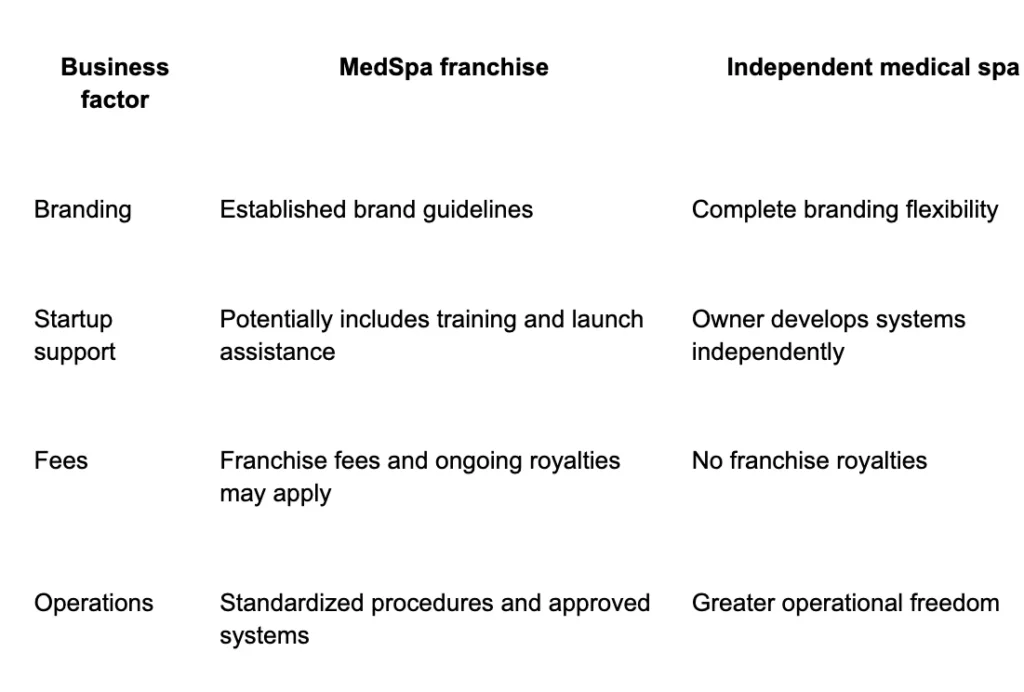
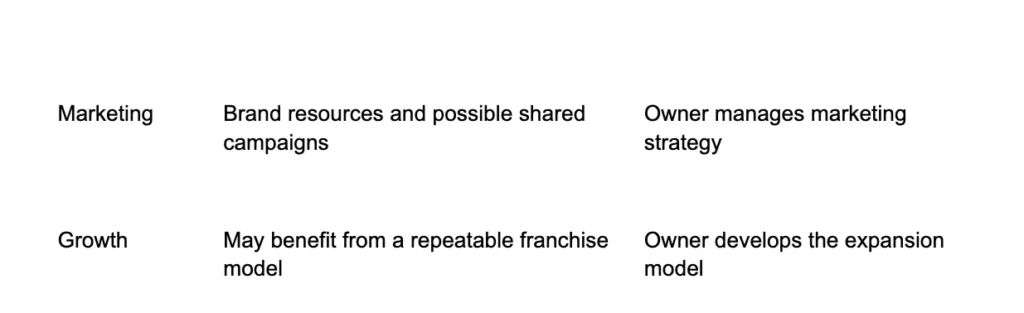
A franchise may help reduce the learning curve, particularly for first-time operators. However, franchise fees can increase ongoing expenses, and standardized procedures may limit certain business decisions.
An independent clinic may offer more control and avoid franchise royalties, but the owner must build the brand, processes, and customer acquisition strategy from the ground up.
The better option depends on your experience, financial resources, risk tolerance, and long-term business goals.
The Benefits and Challenges of Investing in a MedSpa Franchise
One of the main advantages of a medspa franchise is access to an established business framework. Instead of developing every process independently, franchisees may receive operating manuals, marketing resources, training programs, and guidance on opening a new location.
Other potential benefits include:
- Brand recognition: An established name may help build initial customer awareness.
- Standardized operations: Documented procedures can support consistent service and administrative workflows.
- Training support: Franchise programs may help prepare staff for customer service, sales, and business operations.
- Expansion opportunities: Proven systems may make it easier to replicate operations across multiple locations.
- Vendor relationships: Approved suppliers and negotiated purchasing arrangements may simplify procurement.
However, these advantages do not guarantee profitability. A franchisee must still account for rent, payroll, medical supplies, equipment, insurance, marketing, royalties, and other operating expenses.
Additional challenges include limited control over certain business decisions, contractual restrictions, competition, and the difficulty of recruiting qualified clinical professionals. Local demand and state regulations can also affect the viability of a location.
Before investing, evaluate the franchise’s actual support capabilities, speak with current and former franchisees, and review the financial disclosures and contractual obligations carefully.
Emerging Medical Aesthetics Trends Shaping Franchise Opportunities in 2026
Several trends are influencing how medical aesthetics businesses attract clients, deliver services, and compete in 2026. Understanding these developments can help prospective franchisees identify opportunities that align with consumer demand.
Preventive aesthetics and natural-looking results remain important considerations for many clients. Treatments designed to support skin quality, address early signs of aging, and deliver subtle improvements can help clinics build long-term relationships with customers.
Technology-driven treatments are another consideration. Advances in laser platforms, skin analysis, and other aesthetic technologies may expand service offerings, although equipment investments must be justified by local demand and realistic utilization rates.
Memberships and treatment packages can also support more predictable revenue. Rather than relying exclusively on one-time appointments, medspas can offer recurring memberships, treatment plans, and loyalty programs where appropriate and legally permitted.
Meanwhile, digital booking, automated appointment reminders, customer relationship management (CRM) software, and online reviews are becoming increasingly important for improving the customer experience.
For franchise investors, the key is to distinguish genuine market opportunities from temporary trends. Before committing to a brand, examine its service portfolio, technology investments, customer retention strategy, and ability to adapt to changing consumer preferences.
Evaluating Whether a MedSpa Franchise Is the Right Investment
Before researching individual brands, determine whether owning a medspa aligns with your finances, experience, and lifestyle. A franchise can provide operational support, but it remains a business investment that requires active oversight, disciplined financial management, and a willingness to navigate healthcare-related regulations.
Assess Your Financial Readiness and Available Investment Capital
Start by reviewing your available capital, borrowing capacity, existing financial obligations, and willingness to accept investment risk.
The total medical spa franchise cost involves more than the initial franchise fee. Your budget may need to cover lease deposits, renovations, treatment equipment, technology, insurance, licensing, initial inventory, recruitment, marketing, and working capital.
You should also maintain sufficient reserves to cover operating expenses while the clinic builds its customer base. Avoid committing all your available funds to construction and equipment purchases.
Request an itemized startup budget from the franchisor, compare it with independent estimates, and discuss financing options with qualified lenders. If you plan to use an SBA-backed loan in the United States, confirm current eligibility requirements and assess whether projected cash flow can support the repayment schedule.
Evaluate Your Business Experience and Management Capabilities
You do not necessarily need to be a physician to invest in every medspa business model, but your ownership eligibility and responsibilities depend on applicable state laws.
Successful operators need skills in budgeting, team management, marketing, customer service, sales, and performance monitoring. Healthcare experience can be valuable, but business owners from other industries may also succeed when they build a qualified team and follow appropriate governance arrangements.
Assess your strengths and identify gaps before investing. For example, if you have strong marketing experience but limited healthcare operations knowledge, prioritize franchises that offer credible training and access to experienced clinical leadership.
Understand the Time Commitment and Operational Responsibilities
A medspa franchise is not automatically a passive investment. During the launch phase, owners may need to coordinate contractors, recruit employees, implement systems, oversee marketing, and resolve operational issues.
After opening, responsibilities can include reviewing financial reports, monitoring appointment volume, managing staffing, evaluating customer feedback, and maintaining consistent service standards.
Even with a general manager, owners should establish clear reporting procedures and performance indicators. Clinical decisions must remain with appropriately licensed professionals, and administrative oversight must respect applicable medical practice laws.
Identify Your Long-Term Business Goals and Growth Expectations
Determine whether you want to operate one profitable location, develop a portfolio of clinics, or eventually sell your business.
Your goals influence your choice of franchise, financing strategy, location, and management structure. A single-location owner may prioritize manageable operating expenses and local customer retention. A multi-unit investor may place greater emphasis on standardized systems, leadership development, and scalable technology.
Set measurable targets for revenue, operating margins, customer retention, and expansion. Treat these targets as planning assumptions rather than guaranteed outcomes, and make sure the franchise agreement supports your intended growth strategy.
Researching and Comparing MedSpa Franchise Opportunities
Once you understand your investment capacity and objectives, compare franchise brands using consistent criteria. A polished website or attractive revenue claim should never replace careful due diligence.
Identify Established and Emerging MedSpa Franchise Brands
Create a shortlist of established and emerging brands operating in your intended market. Review their service offerings, geographic coverage, target customers, franchise history, and expansion plans.
Consider whether the brand serves the demographic in your chosen area and whether competing clinics already offer similar treatments. Evaluate local demand before assuming that a nationally recognized name will automatically attract customers.
Compare Franchise Fees, Royalties, and Marketing Contributions
Request a complete breakdown of initial fees, recurring royalties, advertising contributions, technology charges, renewal fees, and other contractual payments.
Compare the total cost of ownership rather than focusing exclusively on the advertised franchise fee. Even relatively small recurring charges can materially affect profitability as revenue grows.
Evaluate Brand Recognition, Training Support, and Operational Systems
Ask what support the franchisor provides before and after opening. This may include site selection, clinic design, recruitment guidance, clinical staff training, marketing resources, and ongoing operational reviews.
Evaluate its technology recommendations, standard operating procedures, supplier arrangements, and performance reporting. Speak with existing franchisees to understand whether the promised support is delivered consistently.
Review Franchise Disclosure Documents and Financial Performance Representations
In the United States, carefully review the Franchise Disclosure Document (FDD), including its fees, contractual obligations, litigation history, financial statements, and any financial performance representations.
Item 19 is particularly relevant when the franchisor provides financial performance information. Examine the underlying assumptions, reporting periods, sample size, and whether the figures reflect comparable locations.
Have a franchise attorney and qualified financial adviser review the documents before signing or paying substantial nonrefundable fees.
Identify Red Flags When Evaluating a MedSpa Franchise Opportunity
Be cautious of guaranteed profit claims, vague startup budgets, pressure to sign quickly, limited franchisee references, and unclear clinical ownership arrangements.
Other warning signs include inadequate training, unexplained recurring fees, weak financial disclosures, and unrealistic revenue projections that exclude major operating expenses.
A credible franchisor should answer difficult questions transparently and provide enough information for you to evaluate the opportunity independently.
Building a Comprehensive MedSpa Franchise Financial Plan
A detailed financial plan helps you understand how much capital you need to open and sustain the business.
Calculate Initial Franchise Fees and Startup Investment Requirements
List the initial franchise fee, professional advisory expenses, business formation costs, deposits, and other opening requirements. Use the franchisor’s current disclosure documents and supplier quotations to establish realistic estimates.
Estimate Real Estate, Renovation, Equipment, and Technology Costs
Budget for rent deposits, leasehold improvements, plumbing and electrical work, treatment rooms, signage, furniture, and equipment purchases or leases.
Your technology budget should include an aesthetic electronic medical record (EMR) system, scheduling software, point-of-sale (POS) tools, payment processing, and secure data management.
Budget for Medical Supplies, Inventory, Insurance, and Licensing
Include initial treatment supplies, skincare inventory, medical waste disposal, liability insurance, permits, and applicable professional licensing expenses. Requirements vary by location and service offering, so verify them before committing to a property.
Account for Staffing, Payroll, Training, and Pre-Launch Expenses
Estimate recruitment, wages, payroll taxes, benefits, training, and pre-opening marketing. Include expenses incurred before the clinic generates meaningful revenue.
Establish a Working Capital Reserve for the First 6–12 Months
Maintain a cash reserve to cover rent, payroll, supplies, royalties, debt payments, and other expenses during the ramp-up period. The appropriate reserve depends on the clinic’s cost structure, expected demand, and financing terms.
Calculating MedSpa Franchise Profitability and Return on Investment
A strong financial plan should demonstrate how the clinic could become profitable under realistic operating conditions.
Project Monthly Revenue Based on Services, Pricing, and Appointment Volume
Estimate revenue by service category using average treatment prices, expected appointment volume, and realistic provider capacity. Account for cancellations, discounts, and seasonal demand.
Calculate Fixed Costs, Variable Expenses, Royalties, and Operating Margins
Include rent, salaries, insurance, supplies, payment processing, marketing, royalties, and other recurring expenses. Distinguish operating profit from cash available after loan payments, taxes, and capital expenditures.
Determine Your Break-Even Point and Expected Cash Flow
Calculate the revenue required to cover fixed and variable costs. Use conservative appointment-volume assumptions to determine how much cash the business may need before reaching break-even.
Build Conservative, Moderate, and Optimistic Financial Scenarios
Model different assumptions for customer acquisition, treatment prices, staffing costs, and repeat visits. This reveals how the business might perform if growth is slower or stronger than expected.
Estimate Payback Period, Return on Investment, and Long-Term Profitability
Compare the initial investment with projected cash flows to estimate the payback period and potential return. Include ongoing capital needs and exit-related considerations, and avoid treating projections as guaranteed results.
Securing Financing for Your MedSpa Franchise
Once you have estimated your startup costs and projected revenue, the next step is securing enough funding to launch and sustain your clinic. Financing should cover more than construction and equipment purchases; it must also support payroll, marketing, supplies, and other operating expenses while the business establishes a reliable customer base.
Compare Personal Capital, Bank Loans, and Small Business Financing
Prospective franchisees typically consider personal savings, conventional bank loans, small business financing, or a combination of these options. Each has different implications for ownership, repayment obligations, and financial risk.
Personal capital reduces reliance on lenders but can expose your personal savings to business losses. Bank loans may provide substantial funding, although approval depends on factors such as credit history, collateral, business projections, and repayment capacity.
In the United States, eligible businesses may consider the Small Business Administration’s (SBA) 7(a) loan program, which can support uses such as working capital, equipment, and certain real estate or leasehold improvements. The program has eligibility requirements, and approval is not guaranteed.
Compare the total financing cost, required down payment, interest rate, repayment period, and personal guarantee requirements before selecting a funding source.
Explore Franchise Financing Programs and Equipment Leasing
Some franchisors maintain relationships with lenders or offer guidance on financing the initial investment. Ask whether these programs are available, what fees apply, and whether the financing terms are competitive with independent lenders.
Equipment leasing is another option for expensive laser platforms and other aesthetic technologies. It can reduce the initial cash outlay, but lease payments, maintenance obligations, usage restrictions, and end-of-contract terms should be included in your financial projections.
Compare leasing with purchasing based on the equipment’s expected useful life, utilization rate, maintenance costs, and potential replacement needs. Avoid acquiring expensive technology simply because financing makes the monthly payment appear manageable.
Prepare Financial Statements, Business Plans, and Loan Applications
A well-prepared application helps lenders assess whether your medspa franchise can generate sufficient cash flow to repay its obligations.
Prepare a comprehensive business plan that includes:
- An itemized startup budget and funding request.
- Market research and competitor analysis.
- Revenue projections and operating expense estimates.
- Monthly cash flow forecasts and break-even calculations.
- Your management team’s experience and qualifications.
- The proposed franchise agreement and supporting financial documents.
Lenders may also request personal financial statements, tax returns, credit information, collateral details, and evidence of available investment capital. The SBA recommends preparing a business plan, identifying how funds will be used, and developing credible financial projections before approaching lenders.
Evaluate Debt Repayment Obligations and Financing Risks
Before accepting a loan, calculate the monthly payments under different revenue scenarios. Determine whether the business can continue meeting its obligations if bookings develop more slowly than expected or operating expenses increase.
Consider variable interest rates, personal guarantees, balloon payments, equipment financing commitments, and potential early repayment penalties. Maintain sufficient working capital rather than using every available dollar for opening expenses.
A sound financing strategy balances growth opportunities with the ability to withstand unexpected costs.
Choosing the Right Location and Target Market
Location can influence visibility, customer acquisition costs, appointment volume, and long-term profitability. Before signing a lease, evaluate whether the surrounding market can support your planned services and pricing.
Research Local Demand for Medical Aesthetics Services
Study local demand for treatments such as injectables, laser hair reduction, skin rejuvenation, and other services your franchise intends to offer.
Review search trends, local clinic offerings, customer reviews, and relevant demographic data. Speak with the franchisor about its site-selection process and any market research it provides.
A large population does not automatically translate into strong demand. The goal is to identify a serviceable market with enough potential customers to support your projected appointment volume.
Analyze Competitors, Household Income, and Target Customer Demographics
Map competing medspas, dermatology practices, plastic surgery clinics, and other providers offering similar treatments. Compare their services, pricing, customer reviews, promotions, and apparent positioning.
Evaluate household income, age distribution, commuting patterns, and the characteristics of customers most likely to purchase your services. Use multiple data sources instead of relying on a single demographic indicator.
Your target market should align with both the franchise’s brand positioning and the local community’s purchasing power.
Evaluate Foot Traffic, Accessibility, Parking, and Visibility
Consider whether customers can easily find, reach, and park at the proposed location. A visible storefront may help awareness, while a clinic in a medical or professional building may appeal to customers who prioritize convenience and privacy.
Check nearby businesses, public transport access, signage restrictions, opening-hour requirements, and accessibility provisions. Compare the value of a high-traffic location with its potentially higher rent.
Assess Lease Terms, Build-Out Requirements, and Expansion Potential
Review the lease’s duration, renewal options, rent escalation clauses, maintenance responsibilities, permitted use, and conditions for early termination.
Confirm that the premises can accommodate the proposed treatment rooms, plumbing, electrical systems, equipment, and other facility requirements. Obtain construction estimates before committing to a lease, and verify zoning and permitting requirements with local authorities.
If you plan to expand, consider whether the location can support additional treatment rooms or whether the franchise agreement offers a realistic path to operating additional units.
Understanding Legal Requirements and Medical Spa Regulations
Medical spa ownership involves more than registering a business and signing a franchise agreement. Because treatments may constitute the practice of medicine, the legal structure must distinguish business management from clinical decision-making.
Requirements vary by state, treatment type, and professional license. Before committing to a location, consult healthcare counsel familiar with medical aesthetics and the laws governing your intended market.
Verify State Medical Board Rules and Medical Practice Ownership Requirements
Start by reviewing the rules of the relevant state medical board, nursing board, pharmacy board, and other applicable regulators. Determine which treatments require physician involvement, which professionals may perform them, and what supervision or delegation rules apply.
Pay particular attention to the Corporate Practice of Medicine (CPOM) doctrine. In states that restrict corporate medical practice, non-physicians may be prohibited from owning or controlling certain medical practices or making clinical decisions.
These rules differ significantly by state. A franchise model that is lawful in one jurisdiction may require a different structure in another.
Determine the Appropriate Business Structure and Ownership Model
Depending on state law, a medspa may use a physician-owned professional entity alongside a separate Management Services Organization (MSO).
The professional entity generally handles medical services and clinical decisions, while the MSO may provide permitted administrative services such as marketing, facilities, staffing support, and technology.
A management services agreement (MSA) defines the relationship between the entities, including fees, responsibilities, and service arrangements. It must be structured carefully to avoid improper control over medical judgment or compensation arrangements prohibited by law.
Non-physician entrepreneurs should have healthcare counsel review the ownership model, franchise agreement, and management agreements before investing.
Understand Medical Director Requirements and Clinical Supervision Rules
Determine whether your planned services require a medical director, supervising physician, or other designated clinical leader. Confirm the required qualifications, availability, supervision responsibilities, and documentation.
The medical director’s role should be substantive rather than merely nominal. Clinical protocols, patient assessments, treatment decisions, emergency procedures, and staff competency requirements must be managed by appropriately qualified professionals.
Obtain Business Licenses, Facility Permits, and Required Professional Credentials
Depending on your location and services, you may need business registrations, zoning approvals, building permits, facility licenses, professional credentials, and authorization for specific treatments or equipment.
Verify credentialing and renewal requirements before hiring staff or advertising services. Create a compliance calendar to track license expirations, inspections, training requirements, and regulatory filings.
Establish HIPAA Privacy, OSHA Safety, and Patient Recordkeeping Procedures
If your US medspa is a covered entity or business associate under applicable HIPAA rules, establish appropriate safeguards for protected health information. These may include access controls, staff training, secure communications, incident response procedures, and compliant vendor agreements where required.
Develop workplace safety procedures covering bloodborne pathogens, chemical hazards, personal protective equipment, equipment handling, and medical waste where applicable. OSHA guidance emphasizes workplace hazard assessment, preventive controls, and employee safety training.
Maintain accurate patient records, consent documentation, treatment notes, and incident reports in accordance with applicable legal and professional requirements.
Review Franchise Agreements, Insurance Requirements, and Liability Exposure
Have a franchise attorney review the agreement’s fees, territory rights, renewal provisions, termination conditions, mandatory suppliers, and dispute-resolution clauses.
Discuss professional liability, general liability, property coverage, workers’ compensation, cyber insurance, and other relevant policies with a qualified insurance adviser. Confirm which party is responsible for each policy and whether coverage limits meet contractual and legal requirements.
Designing Your MedSpa Franchise Facility and Service Menu
Your facility should support safe clinical workflows, an inviting customer experience, and efficient daily operations. Design decisions should reflect the franchise’s standards, local requirements, and the services you intend to provide.
Plan Treatment Rooms, Reception Areas, and Patient Consultation Spaces
Create a layout that supports reception, private consultations, treatment delivery, storage, and appropriate sanitation procedures.
Consider patient privacy, staff movement, accessibility, equipment dimensions, and the separation of clean and used supplies. Confirm that the proposed layout satisfies building, fire, sanitation, and applicable healthcare requirements before construction begins.
Select Medical Aesthetic Equipment and Approved Treatment Technologies
Evaluate equipment based on clinical suitability, provider training, manufacturer support, maintenance, warranties, and total cost of ownership.
Ask the franchisor which devices are approved and whether equipment purchases must come from designated suppliers. Verify applicable regulatory clearances and ensure that devices are used only by appropriately qualified professionals within their authorized scope.
Compare purchasing and leasing options using realistic assumptions about treatment volume and equipment utilization.
Choose Profitable Services That Align With Local Market Demand
Build your service menu around local demand, available clinical expertise, treatment capacity, and the franchise’s permitted offerings.
Estimate the contribution margin of each service by subtracting its direct costs from its selling price. Include consumables, provider compensation, equipment usage, and other treatment-specific expenses.
Avoid offering every available treatment at launch. A focused menu can simplify training, inventory management, and marketing while the business establishes its customer base.
Develop Service Packages, Memberships, and Transparent Pricing
Consider treatment packages and memberships that encourage repeat visits and make pricing easier for customers to understand.
Set prices by reviewing local competitors, direct treatment costs, franchise requirements, and customer expectations. Clearly communicate package terms, cancellation policies, expiration rules, and refund conditions.
Ensure that promotions, membership arrangements, and sales incentives comply with applicable healthcare, consumer protection, and professional rules.
Establish Inventory Management and Medical Supply Procurement Procedures
Create purchasing procedures for injectables, skincare products, consumables, and other supplies. Track stock levels, expiration dates, storage conditions, supplier credentials, and product traceability where applicable.
Use approved vendors and maintain reliable reorder points to reduce shortages and waste. For multi-location operators, centralized purchasing and standardized inventory records can improve consistency and visibility into costs.
Recruiting and Building a Qualified MedSpa Franchise Team
Your team directly affects patient safety, customer satisfaction, operational efficiency, and profitability. Build a staffing plan that meets clinical requirements while keeping administrative responsibilities manageable.
Identify Required Clinical, Administrative, and Management Roles
Typical roles include a medical director or other required clinical leader, licensed providers, aesthetic practitioners where authorized, a practice manager, and front-desk or patient coordination staff.
The exact team depends on your service menu, operating hours, patient volume, and state requirements. Start with essential positions and expand as demand grows rather than hiring a large team before revenue supports it.
Recruit Licensed Medical Professionals and Experienced Aesthetic Practitioners
Verify each candidate’s license, qualifications, experience, and eligibility to perform the intended treatments. Assess clinical competence, communication skills, professionalism, and commitment to patient safety.
Develop a structured onboarding program covering clinic protocols, equipment, documentation, emergency procedures, customer service, and role-specific responsibilities.
Define Responsibilities for the Medical Director, Practice Manager, and Front Desk
Establish clear reporting lines and written job descriptions.
- Medical director: Oversees assigned clinical governance responsibilities, protocols, and supervision as required by law.
- Practice manager: Coordinates staffing, budgets, scheduling, inventory, and administrative performance.
- Front-desk team: Manages appointments, customer inquiries, check-ins, payments, and appropriate follow-ups.
Keep clinical decisions with authorized healthcare professionals. Clear responsibilities help prevent confusion and support consistent service across locations.
Establish Compensation Structures, Scheduling Policies, and Performance Expectations
Develop compensation packages that reflect qualifications, local labor markets, responsibilities, and budget constraints.
Set expectations for attendance, training completion, documentation, customer service, and operational performance. Use appropriate performance indicators, such as appointment utilization, retention, and customer satisfaction, without allowing sales targets to compromise clinical judgment.
Review incentive structures with qualified legal counsel to ensure compliance with applicable healthcare and professional rules.
Use Specialized Virtual Assistants to Support Nonclinical Administrative Workflows
A specialized medical virtual assistant can help manage nonclinical tasks such as appointment scheduling, reminder messages, lead follow-ups, CRM updates, and routine administrative coordination.
For franchisees, this support may reduce the administrative burden on in-house staff and help standardize workflows across multiple locations. It can be especially useful when a clinic is building its customer base or when owners are overseeing several units.
However, outsourcing does not remove the business’s responsibility for privacy, security, and regulatory compliance. Establish appropriate access permissions, confidentiality agreements, vendor oversight, and training before allowing a virtual assistant to handle patient information. Where HIPAA applies, determine whether a business associate agreement and other safeguards are required.
The goal is to build a team in which licensed professionals manage clinical care, local staff maintain the patient experience, and specialized administrative support improves efficiency without compromising compliance.
Creating a Standardized MedSpa Franchise Training and Onboarding System
A successful medspa franchise needs more than a recognizable brand and well-equipped treatment rooms. It also needs a standardized training system that helps employees understand their responsibilities, follow established procedures, and deliver consistent customer experiences.
For franchisees planning to operate multiple locations, structured onboarding is particularly important. Without consistent training, clinics may develop different workflows, documentation practices, and service standards that make expansion more difficult.
Develop Role-Based Training Programs for Clinical and Nonclinical Staff
Start by identifying the knowledge and skills required for each position. Clinical professionals, practice managers, front-desk coordinators, and marketing personnel have different responsibilities and should receive training tailored to their roles.
Clinical training should cover authorized procedures, patient screening, infection prevention, emergency response, documentation, and appropriate equipment use. Nonclinical training can focus on appointment management, customer communication, privacy practices, sales processes, and administrative workflows.
Create a structured onboarding plan that introduces employees to the franchise’s policies, systems, and expectations before they begin their assigned duties. Training should reflect applicable licensing requirements and the employee’s authorized scope of practice.
Standardize Standard Operating Procedures Across Daily Clinic Operations
Standard operating procedures (SOPs) help employees complete recurring tasks consistently. Develop clear, documented procedures for opening and closing the clinic, handling appointments, managing inventory, responding to complaints, maintaining records, and escalating incidents.
For clinical activities, SOPs should be developed and approved by appropriately qualified professionals. Administrative procedures should clearly identify responsibilities, required documentation, and approval processes.
Store approved procedures in a central location and establish version control so employees at every branch use the current instructions. When procedures change, communicate the updates and provide additional training where necessary.
Implement a Learning Management System for Employee Onboarding and Compliance Training
A learning management system (LMS) can centralize training materials, onboarding courses, assessments, and completion records. Instead of relying entirely on in-person instruction or scattered documents, franchise operators can use an LMS to deliver consistent learning experiences across locations.
Look for features such as role-based learning paths, automated reminders, assessment tools, completion tracking, and reporting dashboards. The platform should also support updates when company policies or applicable regulatory requirements change.
For growing franchises, an LMS can make it easier to assign required training to new employees, monitor completion, and identify knowledge gaps before they affect operations.
Verify Staff Competency Through Assessments and Practical Skills Validation
Completing a course does not automatically demonstrate that an employee can perform a task correctly. Combine knowledge assessments with practical skills validation appropriate to each role.
For clinical staff, qualified supervisors should evaluate relevant competencies before authorizing employees to perform assigned procedures. Administrative employees may be assessed on appointment scheduling, recordkeeping, customer communication, and privacy-related workflows.
Document the results, identify areas requiring improvement, and provide additional coaching before employees work independently on tasks requiring demonstrated competence.
Maintain Training Records and Schedule Ongoing Professional Development
Maintain accurate records of completed courses, assessment results, professional credentials, and required renewals. Assign responsibility for monitoring expiration dates and scheduling refresher training.
Ongoing development should cover new equipment, revised SOPs, updated software, customer service improvements, and relevant regulatory changes.
A consistent training framework helps franchise owners protect service quality while preparing their teams for future growth.
Establishing Efficient MedSpa Franchise Operations
Efficient operations help a medspa deliver a consistent patient experience while controlling costs and reducing avoidable errors. Franchisees should develop clear workflows that support clinical quality, administrative efficiency, and financial accountability.
Standardize Patient Registration, Consultations, and Appointment Scheduling
Establish a consistent process for new patient inquiries, registration, appointment booking, check-in, consultations, payment, and follow-up.
Use approved intake forms and scheduling procedures to reduce duplicate entries and missing information. Make sure employees know when to refer clinical questions to qualified healthcare professionals rather than providing advice outside their role.
Standardized workflows can reduce administrative delays and help customers receive a more organized experience at every location.
Implement Protocols for Patient Screening, Informed Consent, and Follow-Up
Create documented procedures for patient screening, medical history collection, contraindication assessment, informed consent, and post-treatment communication.
Qualified healthcare professionals must determine whether a treatment is appropriate and explain relevant risks, benefits, and alternatives. Administrative employees should follow established procedures for collecting information and directing clinical concerns to the appropriate professional.
Follow-up protocols should identify who contacts patients, when contact occurs, how responses are documented, and how potential complications are escalated. These procedures should reflect the treatment provided and applicable clinical requirements.
Create Procedures for Inventory Control, Equipment Maintenance, and Quality Assurance
Use a standardized inventory system to monitor supplies, expiration dates, storage conditions, purchasing, and product usage. Establish reorder points for essential items and investigate recurring shortages or waste.
Maintain equipment servicing schedules and records, following manufacturer instructions and applicable regulatory requirements. Document inspections, maintenance issues, and corrective actions.
Quality assurance reviews should identify recurring problems, evaluate compliance with approved procedures, and establish clear responsibilities for resolving deficiencies.
Establish Cancellation, No-Show, Refund, and Customer Service Policies
Create transparent policies for cancellations, missed appointments, deposits, refunds, package terms, and customer complaints. Communicate these policies before customers commit to a booking or purchase.
Apply policies consistently while allowing appropriate exceptions when required by law or justified by the circumstances. Staff should know when they can resolve an issue themselves and when it requires management approval.
Clear policies help protect revenue, reduce misunderstandings, and build customer trust.
Monitor Daily Operations Using Standardized Checklists and Performance Dashboards
Daily checklists help employees confirm that essential tasks are completed, including opening procedures, equipment checks, inventory reviews, and closing activities.
Combine checklists with a dashboard tracking operational indicators such as appointment utilization, cancellation rates, customer retention, supply costs, and customer satisfaction.
For multi-location franchises, standardized reporting makes it easier to compare performance, identify underperforming branches, and share successful practices.
Selecting the Right Technology for Your MedSpa Franchise
Technology should simplify daily operations rather than create additional administrative work. Choose systems that support clinical documentation, customer management, financial reporting, and consistent processes across locations.
Choose Practice Management Software and Electronic Health Record Systems
Evaluate practice management software and electronic health record (EHR) systems based on scheduling, documentation, treatment history, reporting, user permissions, and integration capabilities.
An aesthetics-focused platform may also support before-and-after photographs, treatment plans, consent documentation, and inventory tracking. Confirm that its features meet your clinical needs and applicable privacy requirements.
Before purchasing, compare subscription costs, implementation support, staff training, data migration, and the ability to access records if you change providers.
Integrate Appointment Scheduling, Payments, and Customer Relationship Management
Where practical, connect scheduling, payment processing, and customer relationship management (CRM) systems to reduce duplicate data entry.
A well-integrated system can help staff track inquiries, manage bookings, process payments, and monitor customer engagement. For multiple locations, confirm that the platform supports centralized reporting while allowing appropriate location-level access.
Automate Appointment Reminders, Lead Follow-Ups, and Patient Communications
Automated reminders can reduce missed appointments and help staff manage routine communications more efficiently. CRM workflows can also assign new inquiries, trigger follow-up tasks, and notify employees when leads require attention.
Configure communications carefully. Marketing messages, treatment-related communications, consent requirements, and privacy obligations may be subject to different rules. Ensure automation respects customer preferences and applicable legal requirements.
Implement Secure Data Access, User Permissions, and Privacy Controls
Use role-based access so employees can view only the information necessary for their responsibilities. Implement strong authentication, secure backups, staff training, and documented procedures for suspected data incidents.
Evaluate technology vendors’ security practices and contractual obligations. Where HIPAA applies, determine whether business associate agreements and other safeguards are required.
Review user access regularly, particularly when employees change roles or leave the organization.
Use Analytics and Reporting Tools to Monitor Multi-Location Performance
A centralized reporting system can help franchise owners compare revenue, appointment volume, treatment mix, labor costs, retention, and inventory expenses across branches.
Use consistent metric definitions so comparisons are meaningful. For example, distinguish booked appointments from completed appointments and revenue from collected cash.
Review results regularly with location managers and use the findings to prioritize improvements in staffing, marketing, scheduling, and cost control.
Building a Marketing Strategy Before Opening
Marketing should begin before the clinic opens. A coordinated pre-launch strategy helps introduce the brand, attract potential customers, and generate early appointment inquiries.
Develop a Local Brand Positioning and Digital Marketing Plan
Define your target audience, service priorities, value proposition, and local competitive advantage. Determine why customers should consider your clinic and how your messaging will communicate that value.
Build a marketing calendar covering website content, social media, email communications, local partnerships, and launch promotions. Align your plan with the franchisor’s brand guidelines and approved advertising practices.
Optimize Your MedSpa Website and Google Business Profile for Local SEO
Create location-specific website pages that clearly describe your services, service area, business hours, and booking process. Use relevant local keywords naturally and ensure the site works well on mobile devices.
Claim and maintain your Google Business Profile where eligible. Keep business information accurate, add appropriate photographs, and develop a consistent process for requesting and responding to customer reviews.
Local SEO takes time, so begin building your online presence before launch rather than waiting until the clinic is open.
Create Educational Content That Builds Trust in Medical Aesthetic Services
Publish useful content that answers common questions about treatment suitability, preparation, recovery, expected outcomes, and potential risks. Educational articles, short videos, and frequently asked questions can help prospective patients make informed decisions.
Have clinical content reviewed by qualified professionals and avoid unsupported claims, guaranteed results, or misleading before-and-after presentations.
Consistent educational content can strengthen credibility and support both organic search visibility and social media engagement.
Launch Paid Advertising Campaigns Across Google, Facebook, and Instagram
Paid search can help reach people actively looking for aesthetic services, while Facebook and Instagram campaigns can introduce the brand to relevant local audiences.
Start with a controlled budget, track calls and qualified inquiries, and compare the cost of acquiring customers across channels. Use accurate landing pages and clear calls to action.
Follow applicable advertising, privacy, platform, and healthcare rules. Avoid misleading medical claims and ensure targeting methods do not improperly use sensitive health information.
Build a Lead Generation Funnel With Consultations, Offers, and Follow-Up Campaigns
Create a straightforward path from initial awareness to appointment booking. For example, a prospective customer may discover an educational post, visit a service page, submit an inquiry, and schedule a consultation.
Use appropriate offers, clear booking instructions, and timely follow-ups to help prospects take the next step. Track lead response times, consultation bookings, attendance, and conversion rates.
Make sure any promotional offer is transparent and does not encourage inappropriate treatment or interfere with independent clinical decisions.
Launching Your MedSpa Franchise Successfully
A structured opening plan helps coordinate construction, staffing, marketing, compliance, and technology. Treat the launch as a series of measurable milestones rather than a single opening-day event.
Create a Pre-Opening Timeline With Clear Milestones and Responsibilities
Develop a timeline covering financing, lease execution, permits, construction, equipment installation, recruitment, training, marketing, and final inspections.
Assign an owner and deadline to each milestone. Include contingency time for licensing delays, contractor issues, equipment delivery, and other dependencies that could affect the opening date.
Complete Facility Inspections, Equipment Testing, and Staff Training
Before accepting patients, confirm that required inspections and approvals are complete. Test equipment according to manufacturer instructions, verify technology integrations, and ensure that essential supplies are available.
Confirm that employees have completed required onboarding and competency checks. Clinical services should not begin until the appropriate legal, facility, staffing, and clinical requirements are satisfied.
Build a Founding Customer Database Through Pre-Launch Marketing
Use local SEO, social media, community partnerships, and permitted advertising to generate early interest. Invite prospective customers to register for updates or request consultations through appropriate, transparent channels.
Collect only the information needed for the stated purpose, obtain appropriate consent, and establish clear procedures for protecting customer data.
Conduct a Soft Opening to Test Patient Flow and Operational Readiness
A soft opening allows the team to test booking, registration, consultations, payments, inventory handling, and customer communications under controlled conditions.
Start with manageable appointment volume and gather feedback from staff and customers. Address workflow problems before increasing capacity or expanding promotional activity.
Measure Launch Performance and Resolve Early Operational Bottlenecks
During the first several weeks, monitor inquiries, booking conversion, completed appointments, cancellations, customer feedback, operating expenses, and cash flow.
Identify bottlenecks such as slow lead responses, scheduling gaps, supply shortages, or inconsistent documentation. Assign corrective actions and review progress regularly.
Scaling Your MedSpa Franchise Beyond the First Location
Opening your first clinic is an important milestone, but expanding into additional locations requires a different level of financial discipline and operational maturity. Before pursuing another medspa franchise location, establish that your existing business can operate consistently, generate sustainable cash flow, and maintain patient satisfaction without requiring constant intervention from the owner.
Determine When Your First Location Is Financially Ready to Expand
Avoid opening a second location simply because the first clinic has attracted customers or generated strong initial revenue. Evaluate its financial performance over a meaningful period and confirm that the business can support its operating expenses, debt obligations, and future investments.
Review key indicators such as operating margins, cash flow stability, appointment utilization, customer retention, and the proportion of revenue generated by repeat visits. Also consider whether the clinic has sufficient management capacity to operate without your daily involvement.
A second location should have a separate financial forecast, startup budget, and working capital reserve. Expansion is more sustainable when the first clinic provides a reliable operational foundation rather than depending on optimistic projections.
Replicate Successful Operating Procedures Across Multiple Locations
Multi-location growth becomes easier when every branch follows documented operating procedures. Standardize essential workflows for scheduling, patient registration, inventory management, customer service, reporting, and facility maintenance.
Clinical protocols must be developed and overseen by appropriately qualified professionals, with adjustments made for applicable state requirements and the services offered at each location.
Create a central operations manual and assign responsibility for keeping it current. This allows new locations to benefit from proven processes while reducing the risk of inconsistent service delivery.
Standardize Franchise Training, Compliance Monitoring, and Performance Reporting
Every branch should follow a consistent framework for onboarding, competency validation, compliance training, and performance measurement.
A learning management system (LMS) can help deliver role-based training, assign required courses, record assessments, and flag incomplete learning activities. Managers can use centralized dashboards to monitor training completion and identify areas requiring additional support.
Establish regular operational reviews and compliance audits. These should assess whether employees follow approved procedures, maintain appropriate records, and meet applicable professional and regulatory requirements.
Centralize Marketing, Administrative Support, and Technology Systems
Centralized support can reduce duplicated work as your franchise grows. Depending on the franchise agreement and applicable laws, shared services may include digital marketing, recruitment coordination, bookkeeping, reporting, technology administration, and nonclinical customer support.
A consistent technology stack also makes it easier to compare performance across locations. Standardized practice management software, customer relationship management (CRM) tools, and financial reporting can improve visibility into revenue, expenses, and customer retention.
Specialized virtual assistants may support nonclinical administrative workflows, including appointment reminders and lead follow-ups, when appropriate privacy safeguards and vendor arrangements are in place.
Evaluate Expansion Financing, New Territories, and Additional Franchise Agreements
Before committing to another location, assess financing availability, territory rights, additional franchise fees, and any contractual obligations associated with expansion.
Review the new market’s demographics, competition, expected demand, lease costs, staffing availability, and regulatory requirements. A promising market does not automatically make a viable investment if operating expenses or customer acquisition costs are too high.
Build a separate financial model for each proposed location and evaluate how expansion could affect the existing business. A disciplined approach helps protect cash flow and reduces the risk of growing faster than your management systems can support.
Creating a 12-Month MedSpa Franchise Launch Roadmap
A structured 12-month roadmap can help prospective franchisees organize the decisions and activities required to open a clinic. The timeline below is a planning framework, not a guarantee: financing delays, licensing requirements, construction work, and franchise-specific approvals may extend the schedule.
Months 1–2: Research Franchise Brands and Validate the Business Model
Begin by researching established and emerging franchise brands. Compare their service offerings, fees, support programs, financial disclosures, and operating requirements.
Research the local market, assess competitors, and identify the customer groups most likely to purchase your planned services. Develop preliminary revenue projections and estimate the total startup investment.
Milestone: Select a shortlist of suitable franchise opportunities and establish an initial feasibility assessment.
Months 3–4: Finalize Financing, Legal Due Diligence, and Location Selection
Review the franchise disclosure documents, consult a franchise attorney, and assess medical ownership restrictions in your intended state.
Compare financing options and prepare a detailed business plan. Begin evaluating potential properties based on demand, accessibility, lease terms, build-out requirements, and expansion potential.
Milestone: Establish a credible funding plan, complete key legal reviews, and identify a suitable location.
Months 5–7: Complete Lease Negotiations, Facility Design, and Licensing
Negotiate lease terms subject to appropriate legal review and required approvals. Coordinate facility design, construction estimates, equipment selection, and technology planning.
Begin the necessary business registrations, facility applications, and professional credentialing processes. Confirm that the proposed ownership and clinical supervision arrangements meet applicable requirements.
Milestone: Advance the facility build-out and licensing process while confirming the operational requirements for opening.
Months 8–9: Recruit Employees, Configure Technology, and Deliver Training
Recruit qualified clinical professionals and administrative staff. Establish responsibilities, compensation structures, scheduling policies, and onboarding plans.
Configure practice management software, EHR systems, payment processing, CRM workflows, and reporting dashboards. Develop SOPs and assign role-based training.
Milestone: Build the team and prepare the systems needed for safe, consistent daily operations.
Months 10–11: Launch Marketing Campaigns and Test Operational Readiness
Begin local SEO, website optimization, Google Business Profile preparation, educational content, and appropriate paid advertising.
Test appointment scheduling, patient registration, payments, inventory procedures, communications, and reporting. Complete applicable inspections and verify that required approvals are in place before providing regulated services.
Milestone: Generate early customer interest and resolve operational issues before the official opening.
Month 12: Open the MedSpa, Monitor Performance, and Optimize Operations
Open the clinic once all necessary approvals, staffing requirements, equipment checks, and operational preparations are complete.
Monitor appointment volume, customer feedback, lead conversion, operating expenses, and cash flow. Review performance regularly and make adjustments to staffing, scheduling, marketing, and inventory management.
Milestone: Establish a reliable operating rhythm and a measurable plan for improving performance during the first year.
Summary: Building a Profitable and Sustainable MedSpa Franchise in 2026
Understanding how to start a medspa franchise requires more than choosing a brand and securing funding. Long-term success depends on combining a realistic financial plan, compliant medical ownership arrangements, qualified staff, effective technology, and a marketing strategy that attracts and retains customers.
The strongest franchise opportunities are those that align with your financial capacity, local market demand, operational capabilities, and long-term business goals.
Key Financial Decisions to Make Before Investing
Before committing capital, calculate the complete startup investment, including franchise fees, facility improvements, equipment, licensing, recruitment, marketing, and working capital.
Compare financing options carefully and evaluate the impact of royalties, debt payments, and recurring expenses on projected cash flow. Build conservative, moderate, and optimistic financial scenarios to understand how the business might perform under different conditions.
Most importantly, ensure that you have sufficient liquidity to manage unexpected expenses and a slower-than-expected launch.
Essential Operational Systems to Establish Before Opening
Establish the systems needed to manage appointments, patient records, payments, inventory, staffing, and financial reporting. Document standard operating procedures and define responsibilities before the clinic begins serving customers.
Choose technology that can support your current operations and future expansion. For franchisees planning multiple locations, centralized reporting, consistent workflows, and scalable training systems can make growth easier to manage.
The Importance of Compliance, Staff Training, and Patient Experience
Regulatory compliance must remain a priority throughout the business lifecycle. Verify medical ownership restrictions, professional licensing requirements, clinical supervision rules, privacy obligations, and facility requirements before opening.
Invest in staff onboarding, competency validation, and ongoing professional development. At the same time, create a patient experience built around clear communication, appropriate treatment recommendations, transparent pricing, and reliable follow-up.
These foundations help protect patients, strengthen trust, and support consistent service delivery across locations.
How to Build a Scalable Franchise Business With Long-Term Growth Potential
A scalable medspa franchise needs repeatable systems, reliable financial reporting, qualified leadership, and a clear understanding of local demand.
Focus first on establishing a stable initial location. Once it demonstrates sustainable performance and can operate without constant owner intervention, evaluate whether your finances, staffing, and management systems can support another branch.
Growth should be driven by proven performance rather than ambition alone. By combining careful investment decisions with standardized operations and continuous improvement, franchise owners can build a business positioned for long-term development.
Frequently Asked Questions About Starting a MedSpa Franchise in 2026
How Much Does It Cost to Start a MedSpa Franchise in 2026?
The total medical spa franchise cost depends on the brand, location, facility size, equipment requirements, and services offered. Your budget may include:
- Initial franchise fees and required deposits.
- Lease deposits, construction, and leasehold improvements.
- Treatment equipment, furniture, and technology.
- Medical supplies, initial inventory, insurance, and licensing.
- Recruitment, payroll, training, and pre-opening marketing.
- Working capital to cover expenses during the initial operating period.
As a preliminary planning exercise, an entrepreneur might model a total investment of approximately $250,000 to $750,000 or more for a leased, professionally equipped location. This is an illustrative budgeting range, not a verified industry average or a current quotation from a specific franchise. Some concepts may require substantially less or more capital.
Request the franchisor’s current Franchise Disclosure Document and itemized investment estimates. Add local contractor quotations, equipment proposals, and sufficient working capital before determining whether the opportunity is financially viable.
Is Owning a MedSpa Franchise Profitable?
A medspa franchise can be profitable, but profitability is not guaranteed. Results depend on local demand, service mix, pricing, appointment volume, customer retention, staffing costs, rent, equipment expenses, marketing, and franchise royalties.
A clinic that attracts customers but has excessive operating expenses may struggle to generate positive cash flow. Conversely, disciplined scheduling, appropriate staffing, effective marketing, and strong customer retention can improve financial performance.
Evaluate projected operating profit and cash flow rather than relying on revenue claims alone. Review comparable franchise locations and investigate the assumptions behind any financial performance representations.
How Long Does It Take for a MedSpa Franchise to Break Even?
The break-even timeline varies by startup investment, operating expenses, pricing, appointment volume, and the speed at which the clinic builds its customer base.
Operating break-even occurs when revenue covers the relevant operating costs. Recovering the original investment is a separate milestone and may take considerably longer.
Prepare monthly cash flow projections, account for loan repayments and other obligations, and model scenarios in which revenue develops more slowly than expected. Do not rely on a single optimistic opening forecast when deciding how much working capital to reserve.
Can a Non-Physician Own a MedSpa Franchise?
Potentially, yes, but the answer depends on the state, the services offered, and applicable medical practice ownership laws.
Some states restrict non-physicians from owning or controlling entities that practice medicine. A compliant arrangement may involve a physician-owned professional entity and a separate Management Services Organization (MSO) providing permitted administrative services.
However, an MSO structure is not automatically lawful in every jurisdiction. Obtain advice from healthcare counsel familiar with the relevant state’s Corporate Practice of Medicine rules before signing a franchise agreement or committing to a location.
What Licenses and Permits Are Required to Open a MedSpa?
Requirements depend on the state, municipality, facility, and treatments offered. Potential requirements include business registration, zoning approval, building permits, facility licenses where applicable, professional licenses, and authorizations associated with particular treatments or equipment.
You may also need to satisfy fire safety, sanitation, workplace safety, and medical waste requirements.
Confirm the applicable requirements with the relevant state licensing boards and local authorities. Verify that the clinic’s ownership, staffing, and clinical supervision arrangements are compliant before opening.
Do I Need a Medical Director to Operate a MedSpa Franchise?
A medical director or other designated clinical leader may be required depending on the jurisdiction and services provided. Certain procedures may require physician oversight, specific supervision arrangements, or performance by professionals with particular qualifications.
Even where a particular title is not legally required, appropriate clinical governance remains essential for services involving medical judgment.
Verify the applicable rules with the relevant licensing boards and healthcare counsel. Any designated medical director should have clearly defined responsibilities and appropriate authority over clinical matters.
What Services Should a New MedSpa Franchise Offer First?
Start with services that match local customer demand, available clinical expertise, franchise requirements, equipment capacity, and realistic profitability expectations.
Potential offerings may include selected skin rejuvenation treatments, laser-based services, injectables where legally permitted, and professional skincare programs.
Evaluate each service’s direct costs, expected appointment volume, provider requirements, equipment investment, and regulatory obligations. A focused initial service menu may be easier to manage than launching with every available treatment.
Clinical suitability and patient safety should always take precedence over sales targets.
How Many Employees Does a MedSpa Franchise Need to Start?
There is no universal staffing number. Requirements depend on opening hours, appointment volume, service mix, clinical supervision rules, and administrative workload.
A smaller clinic might begin with a lean team consisting of appropriately qualified clinical personnel, required clinical leadership, and administrative support. Some roles may be combined when legally appropriate, while others require dedicated personnel.
Build a staffing schedule around expected demand and applicable professional requirements. Include coverage for breaks, leave, training, and unexpected absences rather than calculating staffing solely from the number of treatment rooms.
How Can a MedSpa Franchise Reduce Operating Costs Without Compromising Patient Care?
Focus on operational efficiency rather than cutting essential clinical resources.
- Optimize appointment scheduling and reduce avoidable gaps.
- Track inventory, expiration dates, and product usage.
- Standardize administrative workflows and documentation.
- Use appropriate automation for reminders and routine communications.
- Review supplier pricing and equipment utilization.
- Centralize suitable administrative functions across locations.
Avoid reducing costs by compromising required staffing, professional supervision, infection prevention, equipment maintenance, or patient safety. Sustainable savings come from reducing waste and improving processes.
How Can a MedSpa Franchise Maintain Consistent Training and Compliance Across Multiple Locations?
Create a centralized training framework supported by documented SOPs, role-based onboarding, competency assessments, and regular compliance reviews.
An LMS can help assign training, record course completion, schedule refreshers, and identify outstanding requirements. Managers should also verify practical competency where appropriate rather than relying only on online course completion.
Use consistent reporting standards across locations while adapting procedures to state-specific legal and clinical requirements. Assign clear responsibility for monitoring credentials, training records, and policy updates.
What Marketing Strategies Work Best for a New MedSpa Franchise?
A balanced strategy combines local search visibility, educational content, paid advertising, social media, referrals, and timely follow-up.
Start by optimizing the clinic website and Google Business Profile. Publish useful educational content, maintain accurate business information, and make appointment booking straightforward.
Google Ads can reach people actively searching for services, while Facebook and Instagram may help introduce the brand to local audiences. Track lead quality, booking conversion, customer acquisition cost, and repeat visits to understand which channels generate meaningful results.
All marketing should follow applicable healthcare advertising, privacy, consumer protection, and platform policies.
When Should a MedSpa Franchise Owner Open a Second Location?
Consider expansion when the first location has demonstrated sustainable financial performance, stable cash flow, consistent customer demand, and reliable operating procedures.
You should also have qualified management, adequate staffing capacity, documented training systems, and enough capital to fund the second location without destabilizing the first.
Evaluate the next market independently, including competition, lease costs, workforce availability, and regulatory requirements. Expansion is most defensible when the existing business can operate effectively without requiring the owner to personally resolve every daily issue.
How Can V-Unite Help With Starting a MedSpa Franchise in 2026?
Launching a medspa franchise requires more than a financial plan and a suitable location. You also need a reliable way to train employees, standardize operating procedures, and maintain consistent service standards as your business grows.
V-UNITE can support this process by helping medspa businesses organize training content, employee onboarding, and standardized learning workflows. For franchise owners, a centralized training approach can make it easier to prepare new hires, communicate updated procedures, and maintain consistency across locations.
With a structured training system, your team can spend less time searching for instructions and more time following clearly documented workflows. As your franchise expands, standardized learning resources can also help reduce the burden of repeatedly delivering the same introductory training.
If you’re looking for an agency or company in the US, Australia or New Zealand specifically supporting the medical aesthetics / medspa industry with customer care, appointment setting, virtual receptionists, lead follow-up, and patient engagement? Contact V-Assist! The Top Medspa VA & Medical Virtual Assistant Services for you!
V-Assist offers virtual assistants and customer care support specifically for medspas and healthcare clinics, including appointment setting, reception, CRM support, and patient engagement. Strong fit if you want industry-trained offshore or hybrid support.