
“Opening a medical spa franchise involves more than choosing a location, hiring staff, and marketing aesthetic treatments. Franchise owners must also understand the legal and clinical requirements governing medical services. Securing a qualified medical director for medspa franchise operations is an important step toward protecting patients, maintaining regulatory compliance, and building a sustainable business.
Medical director requirements can vary significantly depending on the state, the treatments offered, the professionals performing them, and the business’s ownership structure. Understanding these rules before opening a location helps franchisees avoid costly compliance problems and establish clear responsibilities between business management and clinical leadership.” – Stephen Handisides
Why Medical Director Oversight Matters in a MedSpa Franchise
Medical director oversight helps ensure that clinical services are delivered according to applicable laws, professional standards, and established patient safety protocols. Depending on state requirements and the treatments offered, a medical director may oversee clinical policies, review staff qualifications, establish treatment protocols, and help ensure that complications are handled appropriately.
For a medspa franchise, consistent clinical oversight is especially important when multiple locations operate under one brand. Standardized procedures can support quality and accountability, but each location must still comply with the laws applicable to its jurisdiction.
A medical director should have clearly defined duties, appropriate authority, and sufficient involvement to fulfill those responsibilities. Simply listing a physician’s name on paperwork may not satisfy applicable oversight requirements.
How Medical Director Requirements Differ Across States
There is no single nationwide set of medical director rules that applies identically to every medspa. States differ in their approaches to medical business ownership, physician supervision, advanced practice provider authority, and the delegation of aesthetic procedures.
For example, a state may require physician involvement for certain injectable treatments, while another may permit qualified nurse practitioners or physician assistants to perform particular services under different supervision or collaboration arrangements. Estheticians may also face restrictions on procedures that penetrate the skin or involve prescription products.
A franchisee medspa owner should therefore verify the rules for the specific state where the clinic will operate rather than relying on another franchise location’s arrangements. Requirements may also depend on the treatment, the provider’s credentials, and whether the service legally constitutes the practice of medicine.
The Risks of Operating a MedSpa Without Proper Clinical Oversight
Operating without legally required medical oversight can expose a medspa to regulatory investigations, professional disciplinary action, financial penalties, litigation, and interruptions to business operations. Physicians may also face professional consequences if they accept oversight responsibilities without fulfilling the duties required by law.
Patient safety is another significant concern. Injectable treatments, prescription-based therapies, and certain energy-based procedures can result in complications that require timely clinical assessment and appropriate escalation.
Without clear protocols, staff may not know when to stop a procedure, contact a qualified clinician, or activate emergency services. In a franchise environment, these gaps can affect multiple locations and damage the reputation of the entire brand.
Establishing genuine clinical oversight, documenting responsibilities, and training staff are practical steps toward reducing these risks. However, a medical director agreement alone does not guarantee compliance.
What Franchisees Should Know Before Opening a Medical Spa
Before launching a medspa franchise, prospective owners should determine which entity will provide medical services, who can legally own that entity, and how clinical decisions will be made.
They should also identify the treatments planned for the location, confirm the qualifications required of each provider, and establish a compliant medical director arrangement when needed.
Franchisees should coordinate with healthcare attorneys, qualified medical professionals, and relevant licensing authorities before signing contracts or beginning operations. These early decisions can affect the business’s structure, staffing, insurance, and long-term expansion plans.
Understanding the Role of a Medical Director in a MedSpa
A medical director provides clinical leadership within the boundaries of applicable law and the responsibilities established by the professional arrangement. In a medspa franchise, this role helps connect patient care requirements with the business’s operational processes without allowing commercial objectives to override independent clinical judgment.
What Is a Medical Director, and What Are Their Core Responsibilities?
A medical director is a licensed physician who assumes defined clinical oversight responsibilities for a healthcare practice or medical service. The exact duties depend on state law, the services offered, and the terms of the agreement.
Responsibilities may include developing clinical protocols, reviewing provider qualifications, supporting compliance with medical standards, monitoring quality and patient safety, and establishing procedures for documenting and escalating adverse events.
Medical directors may also help determine whether proposed services fall within the authorized scope of practice of the professionals delivering them. They must retain the clinical authority required by applicable law and cannot delegate responsibilities that must legally remain with a physician.
How Medical Directors Oversee Clinical Procedures and Patient Safety
Effective oversight involves more than signing documents or being available by phone. Depending on legal requirements and clinical circumstances, it may include reviewing treatment protocols, evaluating provider competency, auditing records, and monitoring compliance with safety procedures.
For example, a medspa offering injectable treatments may need protocols for patient assessment, informed consent, contraindications, product handling, documentation, and complication management.
The medical director should also help establish clear escalation procedures so staff know when a concern requires immediate physician involvement or emergency medical services. The required level of supervision and availability must reflect applicable law and the treatments performed.
The Difference Between Medical Directors, Supervising Physicians, and Collaborating Providers
These titles can describe different legal and professional relationships, although their precise meanings vary by state.
A medical director generally provides broader clinical leadership and oversight. A supervising physician oversees specified activities performed by another healthcare professional when state law requires supervision. A collaborating physician works with an advanced practice provider under a collaboration arrangement where required or permitted by law.
One physician may hold more than one role, but the titles are not automatically interchangeable. Franchisees should confirm which relationship the state requires for each service and provider category rather than assuming that appointing a medical director satisfies every supervision or collaboration obligation.
How Medical Director Responsibilities Differ From Franchise Management Duties
Franchise management focuses on business operations, including scheduling, marketing, staffing logistics, customer service, and financial performance. Medical directors focus on clinical oversight and patient safety within their legal authority.
These functions can coordinate, but their boundaries matter. Business managers should not pressure clinicians to recommend unnecessary treatments, disregard contraindications, or make clinical decisions based on sales targets.
A well-structured medspa franchise separates commercial decision-making from independent medical judgment while establishing clear communication and accountability between the clinical and business teams.
State Medical Director Rules and MedSpa Regulations
State regulations determine how a medspa can operate, who may perform medical aesthetic treatments, and what clinical oversight is required. For franchise owners planning to expand into multiple states, understanding these differences is essential to building a compliant operating model.
Why Medical Spa Laws Vary by State
Medical spa regulations reflect differences in state medical practice acts, nursing laws, professional licensing requirements, and business ownership restrictions. Consequently, a treatment permitted under one state’s supervision framework may be subject to different conditions elsewhere.
For example, California provides specific guidance on medical spa ownership and the performance of medical procedures. Its Medical Board emphasizes that medical treatments must be provided by qualified professionals within applicable legal requirements.
Franchise executives should therefore avoid applying one state’s operating procedures automatically across an entire franchise network.
Understanding Physician Licensing and State Medical Board Requirements
A medical director generally needs an active medical license in the state where the relevant clinical responsibilities are performed, subject to applicable exceptions and requirements for telehealth or multistate practice.
Before appointing a physician, franchisees should verify the license through the relevant state medical board. They should also review any disciplinary history, practice restrictions, and additional credentials relevant to the services offered.
For multistate franchises, a physician licensed in one state should not automatically be assumed eligible to oversee every other location. Each jurisdiction’s licensing and supervision requirements must be assessed independently.
How State Regulations Define Medical Director Eligibility
Eligibility depends on the applicable state laws, the professional’s license, and the responsibilities assigned to the role. Some jurisdictions impose specific requirements on physician supervision, while others recognize different arrangements for qualified nurse practitioners or other licensed professionals.
Franchisees should establish whether the proposed medical director can legally oversee the intended treatments, supervise the relevant providers, and fulfill any required availability or documentation obligations.
Identifying Which Treatments Require Physician Oversight
Not every service offered by a medspa has the same regulatory classification. Facials and other cosmetic services may be subject to different rules from prescription injectables, medical-grade laser treatments, and procedures involving prescription devices.
Owners should create a treatment-by-treatment compliance matrix that identifies:
- Who may legally perform each procedure.
- Whether a medical evaluation or prescription is required.
- Whether supervision, collaboration, or delegation is permitted.
- Whether the physician must be physically present or immediately available.
- What documentation, training, and emergency protocols are required.
This matrix should be reviewed whenever the clinic introduces a new service or changes its staffing model.
How to Verify Current Regulations Before Opening a Franchise Location
Start with the state’s medical board, nursing board, physician assistant licensing authority, and other relevant regulators. Review applicable statutes, administrative regulations, official guidance, and licensing requirements.
Have healthcare counsel confirm how those rules apply to the franchise’s ownership structure, services, and proposed medical director agreement. Document the findings and establish a process for reviewing regulatory changes.
Corporate Practice of Medicine Laws and Franchise Ownership
Corporate Practice of Medicine (CPOM) rules can significantly affect how a medspa franchise is structured. These laws may restrict non-physicians or ordinary business entities from owning or controlling medical practices, although the rules and exceptions differ by state.
What Is the Corporate Practice of Medicine Doctrine?
The Corporate Practice of Medicine doctrine generally seeks to prevent unlicensed businesses from controlling professional medical judgment. Depending on the jurisdiction, restrictions may apply to ownership, clinical staffing decisions, treatment protocols, medical records, and other aspects of patient care.
The California Medical Board, for example, identifies restrictions on non-physician control of medical practices and emphasizes the importance of preserving physicians’ independent clinical judgment.
How Corporate Practice of Medicine Laws Affect MedSpa Franchise Models
A franchise agreement does not override state healthcare laws. Even when a franchise brand supplies marketing, training, technology, and operational support, the medical practice must still comply with applicable ownership and clinical control requirements.
A non-physician franchisee may be able to own or operate certain business functions in some jurisdictions, but that does not necessarily mean the franchisee can own or control the entity providing medical services.
Distinguishing Business Ownership From Clinical Decision-Making Authority
Business owners can generally focus on permitted commercial activities, such as facilities, customer experience, marketing, and administrative support. Clinical decisions must remain with the appropriately authorized healthcare professionals.
For example, a franchise manager may coordinate staffing schedules but should not dictate whether a patient is medically suitable for an injectable treatment. Sales goals should never determine whether a procedure is clinically appropriate.
Structuring Management Services Agreements and Professional Entities
Some franchise models use a Management Services Organization (MSO) to provide administrative support to a separately structured professional medical entity.
Under this model, the MSO may handle permitted services such as marketing, technology, facilities, and nonclinical administration, while the professional entity retains the clinical authority required by law.
However, using separate entities does not automatically make a structure compliant. Healthcare counsel should review management fees, decision-making authority, contractual terms, and applicable fee-splitting restrictions.
Understanding the Legal Risks of Improper Corporate Control Over Medical Care
Improper arrangements may expose the franchise, its owners, and participating physicians to regulatory scrutiny, penalties, contractual disputes, and potential professional discipline.
The key is to structure the relationship so that business efficiency does not undermine independent medical judgment. This distinction becomes especially important when expanding a medspa franchise across jurisdictions with different CPOM rules.
Medical Director Qualifications and Credentialing Requirements
Choosing a medical director requires more than finding a physician willing to sign an agreement. Franchisees need to verify professional qualifications, assess clinical competency, and establish appropriate safeguards before patient care begins.
Verifying an Active and Unrestricted Medical License
Confirm that the physician holds the required state license and check for restrictions, disciplinary actions, or other limitations that could affect the role. Repeat verification periodically rather than relying solely on the initial credentialing review.
Evaluating Relevant Clinical Experience and Aesthetic Medicine Training
Look for experience relevant to the clinic’s actual services, including appropriate training in aesthetic procedures, patient assessment, complication recognition, and treatment safety.
A medical license alone does not establish competency in every aesthetic procedure. The physician should be qualified to provide the oversight and clinical guidance the role requires.
Understanding Specialty-Specific Credentialing and Competency Requirements
Review any additional credentials, procedure-specific training, or competency assessments required by law, professional standards, or the clinic’s policies. Verify that delegated procedures fall within the legal authority and demonstrated competence of each provider.
Reviewing Malpractice Insurance and Professional Liability Coverage
Confirm that the medical director’s professional liability coverage applies to the actual duties performed, including medical direction, supervision, delegation, and aesthetic procedures where relevant. Review policy limits, exclusions, and any requirements for additional coverage.
The franchise should also evaluate its own insurance arrangements with a qualified broker or insurance professional.
Conducting Background Checks and Ongoing Credential Verification
Use appropriate credentialing processes to review education, training, licensing history, references, and relevant disciplinary records. Establish periodic recredentialing and clear procedures for responding to expired licenses, new restrictions, or changes in professional status.
Medical Director Agreements and Contractual Responsibilities
A clear medical director agreement helps protect the physician, the franchise owner, and the patients receiving care. For a medical director for medspa franchise arrangement, the contract should define clinical responsibilities, oversight expectations, compensation, and procedures for ending the relationship. It should also reflect applicable state laws rather than relying on a generic agreement used across every location.
Essential Elements of a MedSpa Medical Director Agreement
A well-prepared agreement should identify the parties, covered locations, scope of services, clinical responsibilities, compensation, insurance requirements, recordkeeping obligations, and termination procedures. It should also clarify who maintains clinical records, handles compliance reviews, and manages patient safety concerns.
Healthcare counsel should review the agreement for compliance with state medical practice laws, corporate practice of medicine restrictions, fee-splitting rules, and other applicable requirements. The agreement must reflect the actual working relationship, not simply provide paperwork to satisfy a licensing requirement.
Defining Clinical Duties, Availability, and Oversight Expectations
The contract should specify the medical director’s responsibilities, including protocol development, provider competency reviews, clinical quality monitoring, and oversight of treatment-related incidents where applicable.
It should also establish expectations for availability, communication, documentation, and escalation. If the physician must be physically present or immediately available for particular procedures, the agreement and operating procedures should address those requirements explicitly.
Establishing Compensation Structures That Avoid Improper Incentives
Medical director compensation should be commercially reasonable and reflect legitimate services actually provided. Depending on the arrangement, compensation may be structured as a fixed monthly fee, an hourly rate, or another appropriately documented method.
Payments should not be designed to reward referrals, generate unnecessary procedures, or improperly influence clinical decisions. Federal and state anti-kickback, fee-splitting, and other healthcare fraud laws may apply depending on the parties, services, payment sources, and circumstances.
Franchisees should obtain legal advice before tying compensation to revenue, patient volume, referrals, or treatment sales. A written rationale for the compensation methodology can support transparency and accountability.
Addressing Contract Termination, Replacement, and Continuity of Care
The agreement should explain how either party can terminate the relationship, including notice requirements, immediate termination for specified compliance concerns, and procedures for replacing the medical director.
Before ending the arrangement, the parties should establish how patient follow-up, outstanding clinical concerns, medical records, and required regulatory notifications will be handled. The franchise should also determine whether operations must pause if a required medical director or supervising physician is no longer available.
Coordinating Agreements Across Multiple Franchise Locations
Multi-location franchises should track each location’s medical director, license verification, contract status, authorized services, and supervision requirements.
A standardized agreement can improve administrative consistency, but it should include state-specific provisions where necessary. Centralized compliance tracking should support local accountability rather than assume that one physician’s appointment automatically satisfies the requirements of every location.
Delegation and Supervision of MedSpa Treatments
Delegation allows qualified healthcare professionals to perform certain services within legally permitted boundaries. However, a physician’s involvement does not automatically authorize every employee to perform every treatment. Medspa franchisees must verify the rules for each procedure, provider category, and state.
Which Aesthetic Treatments May Require Physician Supervision?
Treatments involving prescription medications, injectable products, medical lasers, and other medical procedures may trigger specific licensing, evaluation, supervision, or delegation requirements.
The precise requirements depend on state law and the treatment involved. Franchise owners should verify whether a procedure requires a physician’s assessment, an order or prescription, direct supervision, or another legally defined arrangement.
Understanding Delegation Rules for Injectables, Lasers, and Other Procedures
Botulinum toxin injections, dermal fillers, and certain laser procedures require particular attention because they may involve medical judgment, prescription products, or risks of serious complications.
A physician should delegate only activities permitted by law and appropriate to the receiving professional’s qualifications and demonstrated competency. Written protocols should define authorized procedures, limitations, documentation, and escalation requirements.
Distinguishing Tasks That Can Be Delegated From Those Requiring a Licensed Provider
Administrative tasks such as appointment scheduling and routine intake coordination can generally be assigned to appropriately trained administrative personnel. Clinical assessments, prescribing, and procedures requiring professional licensure must remain with individuals legally authorized to perform them.
The distinction should be documented in role descriptions and operating procedures. Job titles, internal training certificates, and franchise policies cannot expand an employee’s legal scope of practice.
Verifying Staff Licenses, Training, and Clinical Competency
Before assigning clinical duties, the franchise should verify the employee’s active license, relevant training, and competency for the specific procedure. Verification should continue throughout employment, with periodic reviews and documented remediation where needed.
Training records should demonstrate that the employee understands relevant protocols, contraindications, infection prevention, documentation, and emergency response procedures.
Establishing Appropriate On-Site and Remote Supervision Arrangements
Supervision arrangements should reflect state law, the procedure’s risk, and the professional’s authorization. Some circumstances may permit remote consultation or supervision, while others may require on-site physician presence or a more direct level of oversight.
The agreement should specify communication methods, availability expectations, escalation processes, and documentation requirements.
Understanding Why Remote Oversight Does Not Automatically Satisfy State Requirements
Video calls, telephone availability, and electronic signatures do not automatically meet legal supervision requirements. A state may require physical presence, specific response times, or other conditions for particular procedures.
Franchisees should verify whether remote oversight is permitted for each service and location. Telehealth rules, when relevant, must also be considered separately from rules governing on-site procedures.
Scope of Practice Requirements for MedSpa Franchise Staff
A medspa franchise must ensure that every employee performs only services authorized by their professional license, training, and applicable state law. Defining these boundaries protects patients and reduces the risk of improper delegation.
Defining the Permitted Duties of Physicians, Nurse Practitioners, and Physician Assistants
Physicians may diagnose conditions, prescribe treatments, and perform or supervise procedures within their qualifications and applicable laws. Nurse practitioners (NPs) and physician assistants (PAs) have different levels of authority depending on state law, including rules governing independent practice, collaboration, supervision, and prescribing.
Franchisees should verify each provider’s legal authority rather than assume that all advanced practice professionals have identical responsibilities. The Washington State Department of Health provides guidance emphasizing the importance of understanding each professional’s scope of practice.
Understanding Registered Nurse and Licensed Practical Nurse Restrictions
Registered nurses (RNs) and licensed practical or vocational nurses (LPNs/LVNs) may perform certain aesthetic procedures when permitted by state law and supported by appropriate authorization, training, and supervision.
Their authority to assess patients, administer medications, or perform injectables varies by jurisdiction and circumstances. Franchise owners should verify applicable nursing board requirements and document the conditions under which each procedure may be performed.
Clarifying the Role of Estheticians and Other Nonmedical Personnel
Estheticians generally provide cosmetic services within their licensing limits. Their licenses do not automatically authorize medical procedures such as prescription injections, medical diagnosis, or treatments restricted to licensed healthcare professionals.
Administrative employees can support scheduling, intake, and customer service but should not make independent clinical decisions. Additional training cannot replace a license when one is legally required.
Preventing Unlicensed Practice and Improper Delegation
Establish written job descriptions, approved procedure lists, and escalation procedures for every role. Managers should know which services require a licensed clinician and should never pressure employees to perform procedures beyond their authorization.
The franchise should investigate scope-of-practice concerns promptly and suspend affected duties when necessary while the issue is reviewed.
Creating Role-Based Clinical Responsibilities for Every Franchise Location
Develop a responsibility matrix identifying who may assess patients, prescribe medications, perform procedures, document care, and respond to complications.
Review the matrix whenever staffing, services, or regulations change. For a multi-location medspa franchise, central templates can support consistency, but each location must meet its state’s requirements.
Patient Evaluations, Medical Assessments, and Treatment Approvals
Appropriate patient evaluation helps determine whether a treatment is suitable and whether additional clinical assessment is necessary. Franchisees should establish clear processes that prioritize patient welfare over appointment volume or sales targets.
Establishing Requirements for Initial Patient Consultations
Initial consultations should collect relevant medical history, treatment goals, allergies, current medications, previous procedures, and other information required for safe care.
The consultation process must identify which activities can be completed by administrative personnel and which require a licensed clinician. Patient intake forms should support, not replace, a required medical evaluation.
Determining When a Licensed Clinician Must Evaluate a Patient
Medical assessment requirements depend on the procedure, the patient’s circumstances, and state law. Treatments involving prescriptions or medical judgment may require evaluation by an appropriately authorized clinician before treatment.
The medical director should help establish criteria for when an evaluation is required and who is qualified to conduct it. Required assessments must not be delegated to staff lacking the relevant authority.
Documenting Medical History, Contraindications, and Informed Consent
Patient records should accurately document relevant history, assessment findings, treatment decisions, informed consent, and follow-up instructions. Consent should explain material risks, expected benefits, alternatives, and relevant aftercare.
Documentation requirements vary, but records should be complete, timely, and accessible to authorized personnel. Consent forms do not eliminate professional responsibilities or make an otherwise inappropriate treatment acceptable.
Creating Treatment Approval and Referral Protocols
Written protocols should define who can approve treatments, when additional evaluation is needed, and how patients should be referred to other healthcare professionals.
Staff should understand when to delay or decline a procedure because of potential contraindications, incomplete information, or concerns outside their authority.
Identifying Patients Who Require Additional Medical Assessment
Patients reporting concerning symptoms, significant medical conditions, previous complications, or unexpected reactions may need further evaluation before treatment.
Staff should recognize these situations without attempting to diagnose conditions beyond their scope. Urgent concerns require prompt escalation under established clinical and emergency procedures.
Prescription Medications, Injectables, and Medical Supplies
Prescription products and medical supplies require careful management because improper prescribing, storage, purchasing, or administration can create patient safety and regulatory risks.
Understanding Prescribing Authority and Prescription Requirements
Only professionals authorized by applicable law may prescribe medications. A medical director’s presence does not automatically authorize every employee to prescribe or administer prescription products.
The franchise should establish procedures for lawful prescribing, patient-specific orders where required, prescription documentation, and compliance with applicable federal and state rules.
Establishing Protocols for Botox, Dermal Fillers, and Other Injectables
Protocols for botulinum toxin products and dermal fillers should address patient selection, clinical assessment, product verification, informed consent, administration by authorized professionals, documentation, and follow-up.
Staff should also know how to recognize potential complications and when urgent medical assessment is necessary. Training and supervision must reflect each provider’s legal authority and demonstrated competency.
Managing Medication Storage, Handling, and Administration
Follow product labeling, manufacturer instructions, applicable storage conditions, expiration dates, infection prevention practices, and medication administration requirements.
Assign clear responsibility for inventory checks, secure storage, temperature monitoring where necessary, and the documentation of product use. Additional controls may apply to certain regulated medications.
Verifying Authorized Purchasing and Approved Suppliers
Purchase prescription products and medical supplies through legitimate, authorized channels. Verify supplier credentials, product authenticity, labeling, and applicable distribution requirements.
Avoid products of uncertain origin or items that cannot be appropriately verified. Procurement procedures should also account for recalls and product safety alerts.
Maintaining Inventory Records and Applicable Medication Documentation
Maintain accurate records of purchases, receipts, storage, dispensing or administration, expiration dates, and lot or batch numbers where applicable. These records can help support traceability, recall responses, and internal audits.
Clinical Protocols, Standard Operating Procedures, and Documentation
Consistent clinical procedures help a medspa franchise maintain patient safety, support regulatory compliance, and deliver reliable care across locations. A medical director should help establish appropriate clinical protocols while ensuring that each location follows the laws governing its services and personnel.
Developing Standardized Clinical Protocols for Franchise Locations
Standardized clinical protocols define how treatments are assessed, performed, documented, and followed up. They should address patient eligibility, contraindications, informed consent, infection prevention, treatment preparation, and escalation procedures.
For a medspa franchise, standardized protocols can reduce inconsistencies between locations. However, corporate templates must be adapted to state-specific requirements and reviewed by qualified clinical leadership before implementation.
Documenting Treatment Decisions and Medical Director Oversight
Accurate documentation demonstrates how clinical decisions were made and whether required oversight occurred. Depending on the service and applicable rules, records may include treatment approvals, protocol reviews, supervision activities, competency assessments, and follow-up recommendations.
Medical directors should ensure that documentation reflects actual activities rather than relying on signatures or generic attestations that do not establish meaningful oversight.
Maintaining Accurate Patient Records and Treatment Histories
Patient records should include relevant medical history, allergies, medications, assessments, consent, treatment details, product information where applicable, and follow-up instructions.
Consistent records help clinicians evaluate treatment suitability, identify potential complications, and coordinate ongoing care. Access should be limited to authorized personnel, with appropriate procedures for correcting errors and maintaining record integrity.
Establishing Infection Prevention, Equipment Safety, and Sanitation Procedures
Clinical protocols should specify hand hygiene, personal protective equipment, cleaning and disinfection, instrument handling, sharps disposal, and applicable sterilization requirements.
Equipment procedures should cover maintenance, safe operation, manufacturer instructions, and removal of faulty devices from service. Staff must receive training appropriate to their responsibilities and the treatments offered.
Reviewing and Updating Clinical SOPs When Regulations Change
Standard operating procedures (SOPs) should be reviewed periodically and whenever relevant laws, clinical guidance, equipment, or services change.
Assign responsibility for approving revisions, communicating updates, and confirming that affected employees understand the new requirements. Maintain version histories so each franchise location can identify which procedures are current.
Medical Director Responsibilities for Patient Safety and Emergency Preparedness
A medical director’s responsibilities extend beyond routine treatment oversight. Appropriate emergency planning helps staff respond quickly to adverse reactions, procedural complications, and other unexpected events.
Creating Emergency Response Plans for Aesthetic Procedures
Emergency plans should reflect the risks associated with the treatments offered. They should define staff responsibilities, escalation pathways, emergency contacts, transfer procedures, and circumstances requiring activation of emergency medical services.
Plans must be consistent with applicable laws and professional standards, with clear instructions for situations requiring immediate clinical intervention.
Training Staff to Recognize and Escalate Adverse Reactions
Employees should understand how to recognize concerning symptoms, communicate relevant information, and escalate incidents without attempting assessments beyond their qualifications.
Training should include scenario-based exercises, emergency communication, and clear criteria for seeking urgent assistance. Staff should know that patient safety takes priority over scheduling or customer service considerations.
Establishing Protocols for Complications From Injectables and Laser Treatments
Injectables and energy-based procedures can cause complications that require prompt assessment. The medical director should help establish procedure-specific response protocols, including when treatment must stop, when a qualified clinician must intervene, and when emergency care is necessary.
Staff should not attempt interventions for which they lack authorization or training. Protocols should be consistent with product labeling, device instructions, and applicable clinical standards.
Maintaining Appropriate Emergency Equipment and Supplies
The clinic should maintain emergency equipment and supplies appropriate to its procedures, foreseeable risks, and legal requirements. Assign responsibility for checking availability, expiration dates, maintenance, and staff familiarity with the equipment.
Emergency arrangements should also account for access to emergency services and any additional equipment or medications required by applicable rules.
Documenting Incidents and Implementing Corrective Actions
Document adverse events, near misses, actions taken, communications, referrals, and follow-up according to applicable requirements. The medical director and designated leaders should review incidents to identify preventable problems and opportunities to improve protocols.
Corrective actions may include additional training, equipment changes, revised procedures, or temporary suspension of a service when safety concerns warrant it.
MedSpa Compliance Training and Staff Competency Verification
Compliance training helps employees understand their responsibilities and apply approved procedures consistently. For franchise owners, an organized training system can also make it easier to demonstrate that staff received the instruction required for their roles.
Training Employees on State-Specific Medical Spa Regulations
Training should explain relevant licensing boundaries, supervision requirements, documentation obligations, patient privacy, and escalation procedures. Multi-state franchises should provide location-specific guidance instead of assuming that one training program satisfies every jurisdiction’s requirements.
Building Role-Based Training Programs for Clinical and Administrative Staff
Physicians, nurses, estheticians, and administrative employees have different responsibilities. Training should reflect those differences, with clinical modules for authorized providers and appropriate privacy, scheduling, and patient communication training for administrative personnel.
Role-based learning helps prevent employees from performing tasks outside their legal authority.
Verifying Competency Before Employees Perform Delegated Procedures
Completing an online course does not necessarily demonstrate practical competency. Where relevant, competency verification should include documented training, observation, supervised practice when permitted, and formal assessment by an appropriately qualified professional.
Delegation should occur only when legally permitted and supported by the individual’s demonstrated ability to perform the assigned task safely.
Tracking Licenses, Certifications, and Required Continuing Education
Maintain records of license status, expiration dates, relevant certifications, and continuing education obligations. Assign responsibility for monitoring upcoming renewals and responding to expired credentials or new restrictions.
Automated reminders can help, but the franchise should verify credentials through the appropriate licensing authorities.
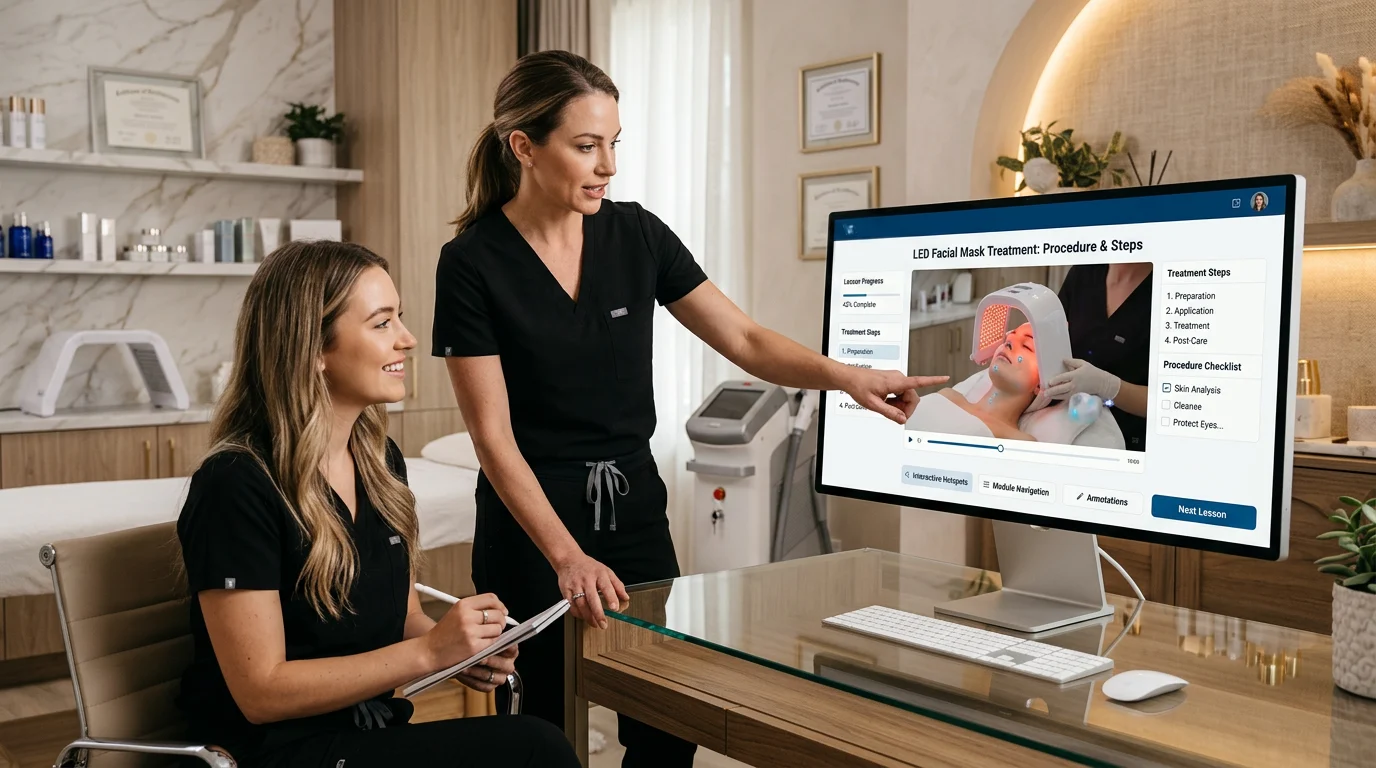
Using a MedSpa Training Platform to Standardize SOPs Across Franchise Locations
A medspa training platform can centralize SOPs, assign role-specific courses, record acknowledgments, and track completion across locations. It can also help franchise leadership distribute revised policies and identify training gaps.
A platform supports compliance management but does not independently establish legal compliance. Clinical leaders must ensure that training content is accurate, current, and appropriate to the applicable jurisdiction.
Maintaining Training Records for Audits and Compliance Reviews
Retain training completion records, assessment results, competency documentation, policy acknowledgments, and relevant renewal information according to applicable requirements.
Organized records help management identify gaps and demonstrate the implementation of training policies during internal reviews or regulatory inspections.
HIPAA, Patient Privacy, and Medical Record Management
Patient privacy is an important operational and legal consideration for medical aesthetic practices. Medspa owners must determine which privacy requirements apply to their business and establish safeguards appropriate to the information they collect and maintain.
Understanding HIPAA Obligations for MedSpa Businesses and Providers
The Health Insurance Portability and Accountability Act (HIPAA) applies to covered entities and business associates as defined by federal law. Not every cash-pay medspa is automatically subject to HIPAA, so applicability should be assessed based on the organization’s activities and relationships.
When HIPAA applies, relevant requirements may include privacy, security, breach notification, and business associate obligations.
Defining Medical Director Responsibilities for Patient Information Protection
Medical directors should support appropriate clinical confidentiality practices within their responsibilities. The organization should clearly assign responsibility for privacy policies, security controls, incident response, and compliance oversight.
Establishing Secure Access to Electronic Health Records
Use appropriate access controls, unique user accounts, authentication, audit logs, secure backups, and other safeguards based on the system and applicable requirements. Employees should access only the information necessary for their authorized duties.
Training Franchise Staff on Confidentiality and Data Security
Train employees to recognize phishing attempts, protect login credentials, handle records securely, and avoid unauthorized disclosures through email, messaging, or social media.
Staff should know how to report suspected breaches or inappropriate access promptly.
Managing Patient Records, Data Sharing, and Record Retention
Establish written policies for record retention, authorized disclosures, patient access requests, secure transfers, and disposal. Retention periods and other obligations may vary by state, record type, and applicable federal law.
Franchise Agreements, Brand Standards, and Clinical Independence
A successful medspa franchise must balance consistent brand operations with independent clinical judgment. Franchise agreements and corporate policies should support quality and accountability without allowing commercial priorities to override patient care.
Separating Franchise Brand Standards From Medical Judgment
Brand standards may address customer experience, facilities, marketing, and administrative processes. Decisions about diagnosis, treatment suitability, and clinical care must remain with professionals authorized to make them.
Defining Which Clinical Policies the Franchisor Can Standardize
A franchisor may support common documentation templates, training systems, and quality processes where legally permitted. However, clinical policies require appropriate professional review and state-specific adaptation.
Protecting Medical Directors’ Authority Over Clinical Decisions
Agreements should preserve the medical director’s authority over matters that legally require clinical judgment. Physicians should be able to decline unsafe or inappropriate procedures without pressure from franchise management.
Establishing Corporate Compliance Monitoring Without Interfering With Care
Corporate teams can monitor training completion, credentialing status, SOP acknowledgments, and other appropriate compliance indicators. Access to clinical records and clinical audit activities must follow applicable privacy laws and professional requirements.
Managing Conflicts Between Revenue Targets and Patient Safety
Revenue goals should never determine whether a patient receives a treatment that is clinically inappropriate. Establish escalation and reporting procedures for concerns about sales pressure, unsafe practices, or interference with professional judgment.
For a medspa franchise, protecting clinical independence is essential to patient trust, responsible growth, and long-term business sustainability.
Multi-Location Medical Director Oversight and Operational Scalability
As a medspa franchise grows, maintaining consistent clinical oversight becomes more complex. Each location must meet applicable licensing, supervision, and patient safety requirements, even when the franchise uses centralized policies and management systems.
Determining Whether One Medical Director Can Oversee Multiple Locations
One physician may be permitted to oversee multiple locations, depending on state law, the treatments offered, and the physician’s ability to fulfill the required responsibilities. Franchisees should assess whether the arrangement provides meaningful oversight rather than relying on a physician’s name alone.
Evaluating State Rules for Coverage, Availability, and Supervision
Confirm each state’s requirements for physician presence, availability, supervision, and delegation. Remote oversight may be allowed in some circumstances but prohibited or restricted in others.
Standardizing Clinical Governance Across Franchise Locations
Use consistent clinical policies, documentation templates, and reporting procedures while adapting them to local requirements. Clear accountability helps ensure that every location follows approved practices.
Conducting Location-Level Compliance Audits and Performance Reviews
Review licenses, training records, clinical documentation, and applicable supervision requirements regularly. Audits should identify gaps and assign corrective actions with clear deadlines.
Building Escalation Processes for Clinical Issues Across the Franchise Network
Establish reporting channels for adverse events, scope-of-practice concerns, and potential regulatory violations. Staff should know whom to contact and when urgent medical attention is required.
Common Medical Director Compliance Mistakes MedSpa Franchisees Should Avoid
Appointing a Medical Director Without Verifying Credentials
Verify the physician’s license, restrictions, relevant experience, and ability to fulfill the proposed role before signing an agreement.
Assuming Franchise-Wide Policies Satisfy Every State’s Laws
Standardized policies must be reviewed against each jurisdiction’s specific requirements. A process permitted at one location may not be lawful elsewhere.
Allowing Unlicensed Personnel to Perform Restricted Medical Procedures
Clearly define staff responsibilities and prohibit procedures that exceed an individual’s legal authority. Internal training cannot replace a required professional license.
Relying on Paper Agreements Without Meaningful Clinical Oversight
A signed contract does not establish compliance if the physician does not perform the required duties. Document actual oversight activities and maintain appropriate communication.
Overlooking Staff Training, Documentation, and Competency Records
Maintain current credentials, training records, competency assessments, and relevant clinical documentation. Missing records can make compliance difficult to demonstrate.
Expanding Into New States Without Reviewing Local Requirements
Before opening a new location, review ownership restrictions, licensing rules, provider authority, and medical director requirements with qualified healthcare counsel.
How to Build a Medical Director Compliance Checklist for a MedSpa Franchise
A structured checklist helps franchisees identify gaps before opening and maintain compliance as the business grows.
Verify Ownership Structure and Corporate Practice of Medicine Requirements
Confirm that the professional entity, franchise arrangement, and management services agreements comply with applicable corporate practice of medicine and fee-splitting restrictions.
Confirm Medical Director Credentials and Contractual Responsibilities
Verify licensing, relevant qualifications, insurance, defined duties, compensation, and availability requirements.
Validate Treatment Delegation and Supervision Arrangements
Document which professionals may perform each treatment and identify any required evaluation, prescription, supervision, or delegation arrangements.
Review Clinical SOPs, Patient Records, and Emergency Protocols
Confirm that clinical procedures, recordkeeping, infection prevention, and emergency response plans are current and appropriate for the services offered.
Audit Staff Licenses, Training Records, and Competency Assessments
Verify credentials and ensure staff have completed the training and competency assessments required for their responsibilities.
Schedule Periodic Legal, Clinical, and Operational Compliance Reviews
Assign review dates and responsible individuals. Update policies when laws, services, equipment, or staffing arrangements change.
Summary: Building a Compliant and Scalable MedSpa Franchise
Prioritize State-Specific Legal Requirements and Qualified Clinical Leadership
Understand local requirements before opening and appoint qualified clinical leadership when required.
Maintain Clear Boundaries Between Franchise Operations and Medical Decisions
Business objectives should never override independent clinical judgment or patient safety.
Standardize Training, Documentation, and Patient Safety Protocols
Consistent systems help franchisees maintain accountability across locations while meeting local requirements.
Review Medical Director Arrangements as the Franchise Expands
New locations, treatments, and staffing models may require revised agreements and additional compliance reviews.
Partner With Qualified Healthcare Attorneys and Compliance Professionals
Expert guidance helps owners navigate complex regulations and establish an appropriate operating structure.
Frequently Asked Questions About Medical Director Rules for MedSpa Franchises
Does Every MedSpa Need a Medical Director?
Not necessarily. Requirements depend on state law, services offered, and the professionals performing them. Some jurisdictions require specific physician oversight arrangements.
Can a Non-physician Own a MedSpa Franchise?
Potentially. Ownership restrictions vary by state, and a non-physician may need to separate business operations from the professional medical entity.
Can One Medical Director Oversee Multiple MedSpa Locations?
Possibly, if permitted by applicable law and the physician can meet the required oversight obligations at every location.
Does a Medical Director Need to Be Physically Present at a MedSpa?
Not always. Presence requirements depend on the jurisdiction, procedure, and applicable supervision rules. Remote availability does not automatically satisfy them.
Which MedSpa Treatments Require Physician Supervision?
Prescription injectables, certain laser procedures, and other medical treatments may require specific evaluation, supervision, or delegation arrangements. Requirements vary by state.
Can Registered Nurses Administer Botox and Dermal Fillers?
RNs may be permitted to administer these products under specified conditions, but requirements concerning assessment, prescribing, orders, and supervision vary by jurisdiction.
Can Estheticians Perform Medical Aesthetic Procedures?
Only when the specific procedure falls within their legally permitted scope. An esthetician license does not automatically authorize medical injections or other restricted procedures.
What Should a MedSpa Medical Director Agreement Include?
It should address duties, availability, compensation, clinical authority, insurance, documentation, termination, and continuity of care, with state-specific legal review.
Who Is Responsible for Medical Errors at a Franchise Location?
Responsibility depends on the circumstances, applicable law, each party’s conduct, and the relevant professional and business relationships. Liability should not be assumed to rest exclusively with the medical director.
How Often Should a Medical Director Review Clinical Protocols?
Reviews should occur periodically and whenever relevant regulations, treatments, equipment, or clinical guidance change. Specific schedules may be required by law or policy.
What Training Records Should a MedSpa Franchise Maintain?
Maintain relevant license verification, training completion, competency assessments, policy acknowledgments, continuing education records, and other required documentation.
What Happens if a MedSpa Operates Without Required Medical Oversight?
Potential consequences include regulatory penalties, professional discipline, litigation, and interruption of operations, depending on the violation and jurisdiction.
How Can Franchisees Keep Up With Changing MedSpa Regulations?
Monitor state licensing boards and regulatory updates, consult healthcare counsel, and maintain a documented process for reviewing and communicating changes.
How Can V-Unite Help With Medical Director Rules for MedSpa Franchises?
V-Unite Learn can support medspa franchisees by centralizing standard operating procedures, organizing role-based training, and tracking employee completion across locations.
Through structured learning paths and accessible SOPs, franchise operators can help staff understand approved workflows, documentation expectations, and escalation procedures. Training records can also help managers identify gaps and prepare for internal compliance reviews.
However, V-Unite Learn supports compliance training; it does not replace a qualified medical director, professional licensing, or legal advice. Clinical policies and training content should be reviewed by appropriate professionals and adapted to each state’s requirements.
For medspa franchises seeking a more organized approach to staff training and SOP standardization, V-Unite Learn can help establish a repeatable foundation for operational consistency as the business grows.
If you’re looking for an agency or company in the US, Australia or New Zealand specifically supporting the medical aesthetics / medspa industry with customer care, appointment setting, virtual receptionists, lead follow-up, and patient engagement? Contact V-Assist! The Top Medspa VA & Medical Virtual Assistant Services for you!
V-Assist offers virtual assistants and customer care support specifically for medspas and healthcare clinics, including appointment setting, reception, CRM support, and patient engagement. Strong fit if you want industry-trained offshore or hybrid support.