“The demand for qualified talent in the aesthetics industry continues to rise as medspas expand their services, increase patient volume, and compete in increasingly crowded markets. However, hiring new employees is only the first step. The real challenge is getting them fully trained, confident, and productive as quickly as possible. This is where Medspa onboarding software has become a critical operational tool for modern practices.” – Stephen Handisides
Introduction
Every day a new hire spends in training is a day they are not contributing fully to patient care, treatment revenue, or clinic performance. Slow onboarding can create bottlenecks that impact profitability, overburden experienced staff, and lead to inconsistent patient experiences.
Many medspas still rely on manual onboarding processes, shadowing programs, and disconnected training resources that make it difficult to prepare employees efficiently. New injectors, aestheticians, patient coordinators, and front-desk staff often receive information from multiple sources, creating confusion and delaying readiness.
A seamless onboarding platform provides a competitive advantage by streamlining training, standardizing education, and accelerating the path from hiring to productivity. Instead of spending weeks or months navigating fragmented onboarding systems, new employees can follow structured learning pathways that prepare them to perform confidently and safely from day one.
Understanding Time-to-Floor in the Medspa Industry
For medspa owners and operations leaders, one of the most important workforce metrics is often overlooked: time-to-floor. The speed at which employees become productive directly influences revenue generation, operational efficiency, and patient satisfaction.
Understanding and improving this metric can significantly impact a medspa’s growth and profitability.
What Does Time-to-Floor Mean?
Time-to-floor refers to the amount of time required for a newly hired employee to become fully prepared for patient-facing responsibilities and independent job performance.
In a medspa environment, this could include an injector becoming qualified to perform treatments independently, a patient coordinator handling consultations effectively, or a front-desk professional confidently managing appointments and patient communication.
The shorter the time-to-floor, the faster employees contribute value to the organization. Conversely, lengthy onboarding periods delay productivity and increase operational costs.
Measuring staff readiness requires evaluating both technical competency and operational knowledge. Employees must understand clinical protocols, customer service expectations, software systems, compliance requirements, and company procedures before they can perform effectively.
Why Faster Onboarding Matters
Faster onboarding has a direct impact on revenue generation.
When employees reach productivity sooner, clinics can schedule more appointments, increase treatment capacity, and improve overall operational performance. New injectors and providers can begin serving patients earlier, helping practices maximize revenue opportunities.
Beyond financial benefits, faster onboarding also improves the patient experience. Well-trained employees are more confident, knowledgeable, and capable of delivering consistent service. Patients benefit from smoother interactions, better communication, and more reliable treatment experiences.
Efficient onboarding also reduces stress for existing team members. Instead of carrying additional workloads for extended periods, staff can quickly integrate new hires into daily operations.
The Cost of Extended Training Timelines
Lengthy onboarding processes create hidden costs that many medspa owners underestimate.
One of the most significant costs is lost treatment opportunity. Every day a provider remains in training represents potential appointments that cannot be scheduled and revenue that cannot be generated.
Extended onboarding also increases labor expenses. New hires are on payroll while learning, yet may not be contributing at full capacity. Simultaneously, senior staff often spend valuable time coaching, mentoring, and supervising trainees.
Over time, these inefficiencies reduce overall team productivity and place additional pressure on managers and experienced providers. What initially appears to be a training issue often becomes a profitability challenge.
The Traditional Medspa Onboarding Process and Its Limitations
Many medspas continue to rely on traditional onboarding methods that were designed for smaller teams and slower growth environments. While these approaches may have worked in the past, they often struggle to meet the demands of modern medspa operations.
As hiring needs increase and competition for talent grows, manual onboarding systems can become a significant obstacle to organizational success.
Manual Training Systems Create Bottlenecks
Traditional onboarding frequently depends on paper-based documents, printed manuals, spreadsheets, and verbal instruction.
These methods make it difficult to ensure consistency across employees and departments. Training materials may become outdated, important information can be overlooked, and employees often receive different guidance depending on who is conducting the training.
Without centralized oversight, onboarding quality can vary significantly from one new hire to another.
The result is a slower and less predictable learning experience that delays productivity and increases frustration for both employees and managers.
Knowledge Gaps and Information Overload
New hires often face two major challenges during onboarding: information overload and knowledge gaps.
During the first few weeks, employees may be expected to absorb large amounts of information regarding treatments, compliance requirements, software systems, customer service standards, and operational procedures.
Without a structured learning pathway, critical information can be forgotten or misunderstood. Employees may complete training without fully understanding essential responsibilities, creating competency gaps that affect performance later.
A lack of organized learning progression makes it difficult for employees to retain information and build confidence efficiently.
Dependence on Managers and Senior Staff
Traditional onboarding places a heavy burden on experienced team members.
Managers, lead injectors, trainers, and senior coordinators are often responsible for delivering training while simultaneously maintaining their normal workload. This creates frequent interruptions and productivity losses.
Highly skilled providers may spend dozens of hours shadowing new hires rather than focusing on patient care and revenue-generating activities. Over time, these demands contribute to burnout and operational inefficiencies.
As hiring volume increases, this dependency becomes increasingly difficult to sustain, particularly for growing medspas with aggressive expansion goals.
What Is a Seamless Medspa Onboarding Platform?
A seamless onboarding platform is designed to eliminate the inefficiencies associated with traditional training methods while accelerating employee readiness.
Rather than relying on scattered resources and manual processes, organizations can create a centralized onboarding experience that delivers consistent education, tracks progress, and supports long-term development.
Defining a Modern Onboarding Solution
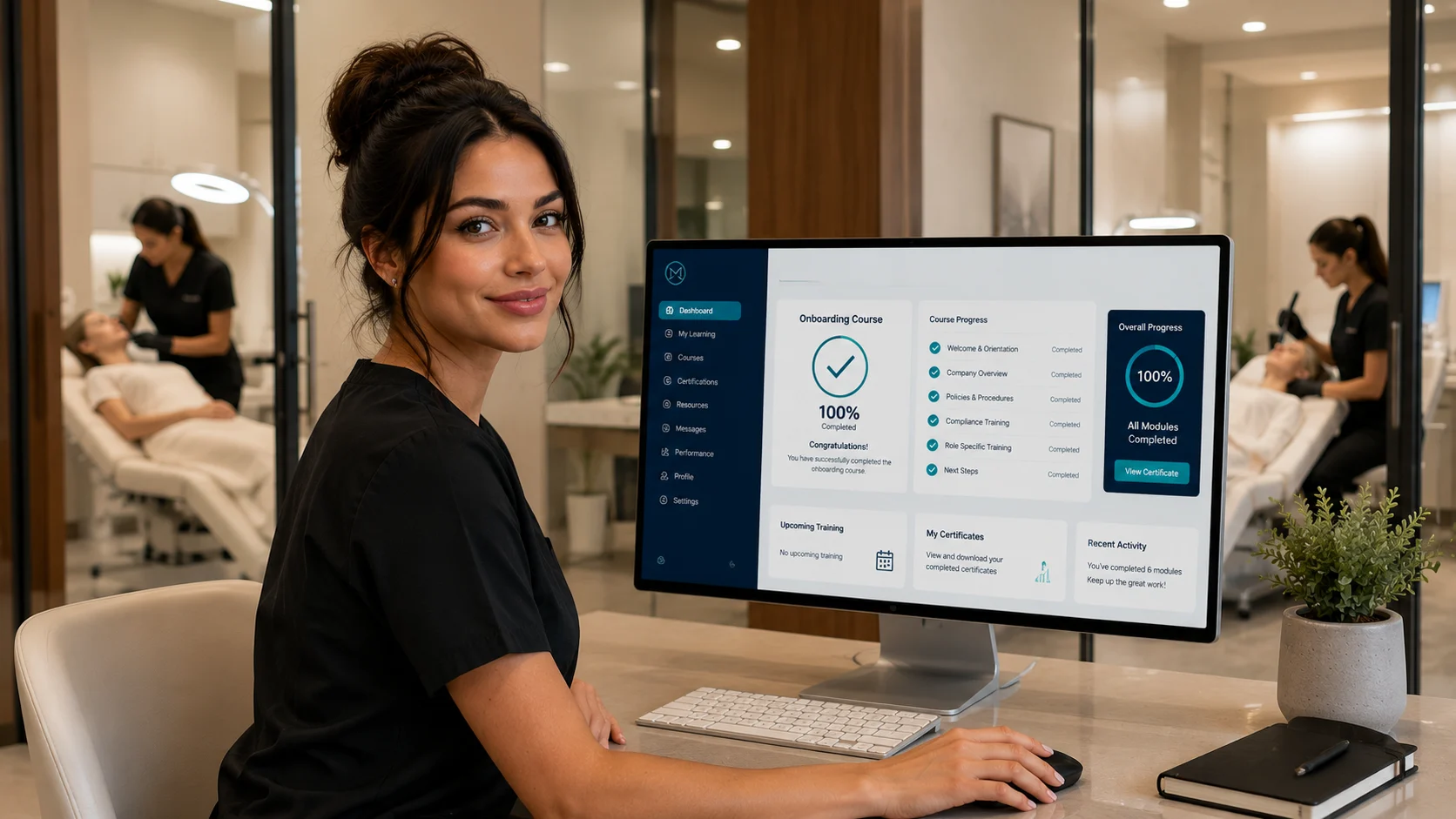
A modern onboarding solution provides a centralized learning environment where employees can access training materials, complete courses, track progress, and develop required competencies from a single platform.
The process is digital-first, allowing organizations to automate many onboarding tasks that were previously handled manually.
New hires can begin learning immediately, often before their first day, helping reduce delays and improve preparedness from the start.
This structured approach creates a more efficient and engaging onboarding experience for both employees and management teams.
Core Components of an Effective Platform
An effective onboarding platform includes several essential capabilities that support employee development and operational success.
Learning management tools provide structured educational content that guides employees through role-specific training programs.
Progress tracking systems allow managers to monitor completion rates, assessment results, and readiness milestones in real time.
Compliance and certification management features help ensure employees complete mandatory training requirements while maintaining proper credentials and documentation.
Together, these tools create a more organized, measurable, and scalable onboarding process.
How It Supports Medspa-Specific Workflows
Unlike generic onboarding solutions, a medspa-focused platform is designed around the unique needs of aesthetic practices.
Clinical education modules help providers master treatment protocols, safety procedures, and best practices.
Patient experience training ensures employees understand consultation standards, communication expectations, and customer service excellence.
Operational procedures can also be standardized across the organization, creating consistency in scheduling, documentation, workflows, and daily operations.
By aligning onboarding with real-world medspa responsibilities, organizations can accelerate time-to-floor while maintaining quality, compliance, and patient safety.
Accelerating Employee Readiness Through Structured Learning
One of the biggest challenges facing medspa leaders is reducing the amount of time it takes for new employees to become productive contributors. Traditional onboarding often lacks structure, causing employees to learn through trial and error, repeated shadowing, and inconsistent instruction. A structured onboarding approach eliminates these inefficiencies and creates a faster path to competency.
A modern Healthcare onboarding platform helps organizations transform onboarding from a reactive process into a strategic system that accelerates employee readiness while improving training quality.
Creating Standardized Learning Paths
Structured learning begins with clear, role-specific onboarding journeys.
Every position within a medspa requires different knowledge, responsibilities, and competencies. Injectors need clinical training and safety education, while front-desk professionals require expertise in scheduling, patient communication, and administrative workflows.
By creating standardized learning paths, organizations ensure employees receive training that is relevant to their specific role. This targeted approach reduces confusion while helping employees focus on the skills they need most.
Standardized onboarding also creates consistent educational experiences across the organization. Every employee receives the same information, expectations, and performance standards regardless of who manages their onboarding process.
Delivering Training in Logical Phases
One reason traditional onboarding feels overwhelming is that employees are often expected to absorb large amounts of information simultaneously.
Structured learning programs break training into logical phases that support better comprehension and retention.
The first phase typically focuses on orientation, introducing employees to company culture, policies, expectations, and organizational procedures.
The second phase addresses clinical competencies or role-specific technical skills. Employees learn treatment protocols, software systems, patient interaction standards, and operational requirements relevant to their position.
The final phase focuses on independent performance and operational responsibilities, helping employees transition confidently into daily workflows.
This progressive approach improves learning outcomes while reducing onboarding fatigue.
Eliminating Training Redundancies
Many medspas unknowingly waste valuable time through repetitive instruction.
Managers often answer the same questions repeatedly, provide duplicate training sessions, and revisit information that could be delivered through standardized learning modules.
A centralized Medspa LMS eliminates these redundancies by providing employees with consistent access to training materials whenever needed.
Instead of relying on repeated one-on-one explanations, organizations can streamline knowledge transfer through structured digital content. This not only accelerates learning but also allows managers and senior providers to focus on higher-value responsibilities.
The result is faster onboarding, improved efficiency, and better use of organizational resources.
Improving Clinical Competency From Day One
In aesthetic medicine, employee readiness is not simply about completing training—it is about ensuring providers can perform safely, confidently, and consistently. Clinical competency directly impacts patient outcomes, reputation, and revenue generation.
A seamless onboarding platform helps organizations establish strong clinical foundations from the very beginning of the employee journey.
Standardizing Treatment Protocol Training
One of the most effective ways to improve clinical performance is through standardized protocol training.
When providers receive consistent instruction on treatment techniques, patient assessments, consultation procedures, and post-treatment care, organizations can reduce variability across practitioners.
Standardization helps ensure patients receive the same high-quality experience regardless of which provider performs the treatment.
A Healthcare onboarding platform makes it possible to distribute updated protocols instantly while ensuring every employee learns the organization’s approved methods and procedures.
This consistency strengthens clinical quality and supports better patient outcomes.
Reinforcing Safety and Risk Management Practices
Safety is one of the most important priorities in any medspa environment.
New employees must understand treatment safety standards, infection prevention protocols, patient screening procedures, emergency response requirements, and documentation expectations before interacting with patients.
A structured onboarding system reinforces these practices through dedicated training modules, assessments, and ongoing education.
Rather than relying solely on observation or informal coaching, employees receive clear instruction that supports patient protection and risk reduction.
This proactive approach helps minimize preventable errors while strengthening organizational confidence in staff readiness.
Building Confidence Before Patient Interaction
Confidence plays a major role in employee performance.
Employees who feel prepared are more likely to communicate effectively, follow protocols consistently, and deliver positive patient experiences.
A structured onboarding platform helps build confidence by incorporating competency verification processes throughout training.
Skills assessments, knowledge evaluations, and readiness checkpoints provide objective measures of progress while helping identify areas requiring additional support.
By verifying competency before independent patient interaction, organizations can accelerate productivity without compromising safety or quality.
Enhancing Compliance and Regulatory Preparedness
Compliance requirements are among the most complex aspects of medspa onboarding. New employees must understand regulatory obligations, privacy standards, documentation procedures, and certification requirements before they can perform their responsibilities effectively.
A centralized onboarding system simplifies this process by embedding compliance directly into the employee learning journey.
Integrating Compliance Training Into Onboarding
Compliance education should not be treated as a separate administrative task.
The most effective onboarding programs integrate regulatory training directly into role-specific learning pathways. Employees gain a clear understanding of privacy requirements, patient information protection standards, and documentation responsibilities as part of their onboarding experience.
This approach helps employees understand not only what rules exist but also why those rules are important to patient safety and organizational success.
Embedding compliance education from the beginning creates stronger habits and reduces the likelihood of future violations.
Automating Certification Tracking
Tracking certifications manually can quickly become overwhelming as organizations grow.
A modern Medspa LMS simplifies this process by automatically monitoring training completion, certifications, continuing education requirements, and credential renewals.
Managers gain visibility into employee status while reducing the risk of missed deadlines or expired credentials.
Automated reminders help employees stay current with requirements, eliminating many of the administrative burdens traditionally associated with compliance management.
This creates a more organized and reliable system for maintaining workforce readiness.
Reducing Compliance Risks During Employee Ramp-Up
The onboarding period often represents one of the highest-risk stages of employment.
New employees are still learning policies, procedures, and regulatory expectations, making them more vulnerable to mistakes.
A structured onboarding platform helps reduce these risks by delivering consistent compliance education, tracking completion status, and verifying understanding before employees assume greater responsibilities.
By preventing costly errors and creating detailed training records, organizations can strengthen audit readiness while protecting patients and the business.
Streamlining Operational Training Across Departments
Successful onboarding extends beyond clinical education. Employees throughout the organization must understand operational workflows, communication standards, and department-specific responsibilities to contribute effectively.
A centralized onboarding system ensures every department receives the training needed to support organizational performance.
Front Desk and Patient Coordination Training
Front-desk professionals often create a patient’s first impression of the practice.
Training programs should cover scheduling systems, appointment management, patient communication standards, intake procedures, and customer service expectations.
A structured onboarding platform provides consistent education that helps patient coordinators develop confidence while delivering professional and efficient service.
This consistency contributes to smoother operations and stronger patient experiences.
Sales and Consultation Training
Many medspa employees play a role in consultations, treatment recommendations, and patient relationship development.
Effective onboarding should include education on lead management processes, consultation frameworks, communication techniques, and patient education best practices.
Standardized training ensures employees understand how to guide patients through the treatment journey while maintaining professionalism and compliance.
This improves conversion opportunities while supporting stronger patient relationships.
Clinical Team Training
Clinical teams require onboarding that addresses both technical and operational responsibilities.
Training should include treatment workflows, equipment operation standards, patient preparation procedures, documentation requirements, and post-treatment protocols.
A centralized platform ensures clinical staff receive consistent education while providing leadership with visibility into progress and competency development.
By standardizing operational training across departments, medspas can improve collaboration, reduce inefficiencies, and accelerate time-to-floor for every new hire.
Creating a Consistent Experience Across Multiple Locations
As medspas expand into multiple locations, maintaining consistency becomes increasingly difficult. Different managers, varying training methods, and inconsistent onboarding experiences can create significant differences in how employees perform and how patients perceive the brand.
A seamless onboarding platform helps eliminate these challenges by creating a standardized training framework that supports consistency across every clinic. Instead of relying on location-specific practices, organizations can establish a unified approach to employee development that aligns every team member with the company’s standards and expectations.
Standardizing Training Across Clinics
Consistency starts with standardized training.
When every employee follows the same onboarding process, organizations can establish uniform expectations regarding patient care, customer service, compliance, and operational procedures. Employees receive the same educational content, competency requirements, and performance benchmarks regardless of where they work.
This standardization helps create a predictable employee experience while reducing variability in service delivery.
More importantly, it strengthens brand consistency at scale. Patients expect the same level of professionalism and care whether they visit the original location or a newly opened clinic. A centralized onboarding process helps ensure those expectations are met consistently.
Supporting Rapid Expansion
Growth often exposes weaknesses in onboarding systems.
Organizations that rely on manual training methods frequently struggle to support high-volume hiring or new location launches. Training becomes difficult to coordinate, experienced staff become overwhelmed, and operational consistency begins to suffer.
A digital onboarding platform solves this problem by making training instantly accessible to new hires across multiple locations.
Whether a medspa opens one new clinic or several locations simultaneously, employees can begin onboarding immediately through a structured learning environment. This enables organizations to replicate successful operational models without increasing administrative complexity.
The ability to deploy training rapidly supports expansion goals while minimizing disruption to daily operations.
Maintaining Service Quality During Growth
One of the biggest risks associated with rapid growth is declining service quality.
When onboarding processes are inconsistent, employees may develop different approaches to patient interactions, consultations, documentation, and treatment preparation. These variations can negatively impact the patient experience and weaken brand reputation.
A structured onboarding system helps maintain consistent service standards throughout periods of growth.
By ensuring employees receive the same education and expectations, organizations can deliver reliable patient experiences across every location. This creates a sustainable scaling strategy that supports expansion without compromising quality.
Using Data and Analytics to Optimize Onboarding Performance
Traditional onboarding often provides little visibility into employee progress and training effectiveness. Managers may know whether an employee completed training, but they frequently lack insight into competency development, readiness levels, and areas requiring improvement.
Modern onboarding platforms solve this challenge by providing powerful data and analytics capabilities that transform onboarding into a measurable and continuously improving process.
Measuring Time-to-Floor Metrics
Organizations cannot improve what they do not measure.
One of the most valuable capabilities of a modern onboarding system is the ability to track time-to-floor metrics accurately. Managers can monitor onboarding completion rates, training progress, assessment performance, and readiness milestones in real time.
This visibility helps leaders understand how long employees take to become productive and identify opportunities to accelerate development.
Tracking readiness benchmarks also allows organizations to establish performance standards that support more consistent onboarding outcomes.
Identifying Learning Gaps Early
Not all employees learn at the same pace.
Some individuals may quickly master operational procedures while requiring additional support in clinical competencies. Others may excel in technical skills but struggle with patient communication or compliance requirements.
A data-driven onboarding platform helps identify these learning gaps before they become performance issues.
Performance-based insights allow managers to pinpoint specific areas where employees need additional coaching or reinforcement. Rather than applying a one-size-fits-all approach, organizations can deliver targeted support that improves learning outcomes and accelerates readiness.
Early intervention helps prevent delays while improving overall onboarding effectiveness.
Improving Future Onboarding Programs
The most successful onboarding programs continuously evolve.
Analytics provide valuable information about which training modules perform well, where employees encounter challenges, and how onboarding timelines can be improved.
By analyzing completion rates, assessment results, and readiness metrics, organizations can make data-driven refinements that strengthen future onboarding experiences.
Continuous process improvement helps medspas optimize training efficiency while ensuring employees receive the knowledge and skills needed to succeed.
Over time, these refinements contribute to shorter onboarding timelines and better organizational performance.
The Business Benefits of Faster Staff Training
Reducing onboarding time is not simply a workforce development goal—it is a business strategy that directly impacts profitability, operational efficiency, and growth.
When employees become productive faster, organizations experience measurable benefits across multiple areas of the business.
Increasing Productivity Sooner
Every day a new hire spends in training represents delayed productivity.
A streamlined onboarding process reduces downtime by helping employees reach competency more quickly. Rather than spending weeks navigating fragmented training materials, employees can follow structured learning paths that accelerate readiness.
This allows them to contribute sooner, support patient care more effectively, and integrate into daily operations with greater confidence.
Faster employee contributions improve team efficiency while reducing the burden placed on experienced staff members.
Improving Employee Satisfaction and Retention
The onboarding experience plays a major role in employee engagement.
New hires who receive clear expectations, structured guidance, and supportive learning experiences are more likely to feel confident and successful in their roles. They understand what is expected of them and have access to the resources needed to succeed.
A positive onboarding experience helps reduce frustration and uncertainty, which can improve job satisfaction and long-term retention.
Employees who feel prepared are also more likely to remain engaged and committed to the organization.
Maximizing Revenue Opportunities
The financial benefits of faster onboarding can be substantial.
When providers become treatment-ready sooner, clinics can increase appointment availability and treatment capacity more quickly. Front-desk and patient coordination teams can support scheduling, lead management, and patient communication more effectively.
This increased operational capacity helps organizations capture more revenue opportunities while supporting patient acquisition efforts.
For growing medspas, accelerating time-to-floor can have a direct impact on profitability by shortening the gap between hiring and revenue generation.
Essential Features to Look for in a Medspa Onboarding Platform
Not all onboarding solutions offer the capabilities required by modern medspa organizations. To maximize efficiency and employee readiness, decision-makers should prioritize features that support flexibility, visibility, scalability, and operational alignment.
A robust Healthcare onboarding platform should provide tools that simplify training while supporting long-term growth objectives.
Mobile-Friendly Learning Access
Today’s workforce expects flexibility.
Mobile-friendly learning allows employees to access training materials from smartphones, tablets, and computers whenever it is convenient. This accessibility improves engagement while making onboarding more efficient.
Employees can review content, complete assignments, and track progress from virtually anywhere, creating a more flexible learning environment.
This convenience helps accelerate onboarding while accommodating diverse schedules and learning preferences.
Role-Based Learning Paths
Different positions require different training experiences.
A high-quality Medspa LMS should support customized learning paths based on employee responsibilities. Providers, injectors, patient coordinators, managers, and administrative staff all require specialized training that aligns with their specific roles.
Role-based learning reduces unnecessary content while helping employees focus on the competencies most relevant to their success.
This targeted approach contributes to faster competency achievement and improved learning outcomes.
Real-Time Progress Monitoring
Visibility is essential for effective onboarding management.
Real-time progress monitoring enables managers to track course completion, assessment performance, competency development, and readiness milestones.
This transparency helps leaders identify potential challenges early while ensuring employees remain on track throughout the onboarding process.
Performance tracking also creates greater accountability and supports more informed coaching decisions.
Integration With Existing Medspa Systems
The most effective onboarding platforms work seamlessly with existing business systems.
Integration capabilities allow organizations to connect onboarding workflows with HR software, scheduling systems, compliance tools, and operational platforms.
This connectivity reduces duplicate data entry, streamlines administrative processes, and creates a more cohesive employee experience.
When onboarding aligns with broader operational workflows, organizations can improve efficiency while creating a scalable foundation for future growth.
Conclusion
Why a Seamless Medspa Onboarding Platform Is the Fastest Path to Workforce Readiness
In today’s competitive aesthetics industry, hiring talented employees is only half the challenge. The real opportunity lies in how quickly organizations can transform new hires into confident, productive team members who contribute to patient satisfaction, operational efficiency, and revenue growth.
Time-to-floor has become one of the most important performance metrics for medspas because it directly influences profitability, employee engagement, and patient experiences. Every additional day spent navigating inefficient onboarding processes delays productivity, increases labor costs, and places unnecessary pressure on experienced team members.
A seamless onboarding platform helps eliminate these barriers by creating a structured, repeatable, and scalable training experience. Rather than relying on manual instruction, inconsistent shadowing, and fragmented learning materials, medspas can provide employees with clear learning pathways that accelerate readiness without compromising quality.
A modern Medspa onboarding software solution reduces time-to-floor by delivering training in a logical and organized manner. Employees gain access to role-specific education, competency assessments, compliance training, and operational resources that help them build confidence quickly while maintaining high standards of care.
Beyond accelerating productivity, onboarding platforms improve compliance, consistency, and employee confidence. New hires learn organizational expectations from day one, understand regulatory responsibilities, and receive the support necessary to perform safely and effectively.
Patients benefit as well. Employees who complete structured onboarding programs are better prepared to communicate professionally, follow treatment protocols, and deliver consistent experiences. This creates stronger patient relationships and contributes to higher satisfaction levels throughout the practice.
As medspas grow and expand into new markets, onboarding systems become even more important. A centralized Healthcare onboarding platform enables organizations to maintain training consistency across locations, replicate successful operational models, and support high-volume hiring without overwhelming management teams.
Ultimately, a seamless onboarding process is not simply a training tool—it is a strategic investment in operational excellence. By reducing time-to-floor, strengthening compliance, improving employee confidence, and enhancing patient experiences, medspas can build high-performing teams that are prepared to support sustainable growth and long-term success.
Frequently Asked Questions (FAQs)
What is a medspa onboarding platform?
A medspa onboarding platform is a centralized training system designed to help new employees learn clinical procedures, operational workflows, compliance requirements, and patient experience standards. It provides a structured learning environment that accelerates employee readiness and improves consistency across the organization.
How does an onboarding platform reduce time-to-floor?
An onboarding platform reduces time-to-floor by automating training delivery, organizing learning into structured pathways, tracking employee progress, and providing immediate access to educational resources. This helps employees become productive faster while maintaining training quality.
What training should be included in medspa onboarding?
Effective onboarding should include company orientation, compliance education, treatment protocols, patient communication standards, software training, documentation requirements, operational workflows, consultation processes, and safety procedures. The goal is to prepare employees for both clinical and operational responsibilities.
Can onboarding platforms improve employee retention?
Yes. Employees who receive clear guidance, structured learning experiences, and ongoing support are more likely to feel confident and engaged in their roles. A positive onboarding experience often leads to higher job satisfaction and improved long-term retention.
How do onboarding platforms help maintain compliance?
Onboarding platforms integrate compliance training directly into the learning process. They can track certifications, monitor training completion, automate reminders, maintain digital records, and help organizations demonstrate compliance readiness during audits or inspections.
What features should medspas prioritize when selecting an onboarding solution?
Key features include mobile accessibility, role-based learning paths, compliance tracking, progress monitoring, certification management, reporting capabilities, integration with existing systems, and support for clinical and operational training requirements.
How can multi-location medspas standardize onboarding across clinics?
A centralized Medspa LMS allows organizations to deliver the same training content, policies, procedures, and performance expectations across every location. This ensures employees receive consistent education regardless of where they work.
What metrics should medspas track to measure onboarding success?
Important metrics include time-to-floor, onboarding completion rates, assessment scores, employee retention rates, compliance completion rates, productivity milestones, competency verification results, and patient satisfaction indicators.
How Can V-Unite Help You with Medspa Onboarding?
Growing medspas need more than hiring solutions—they need a scalable onboarding framework that helps employees become productive quickly while maintaining compliance, consistency, and exceptional patient care.
V-Unite provides a purpose-built onboarding and training solution designed specifically for the unique needs of aesthetic practices. Whether you’re onboarding injectors, patient coordinators, front-desk professionals, or clinical leaders, V-Unite helps streamline training through structured learning paths, automated progress tracking, compliance management, and centralized educational resources.
With V-Unite, medspa leaders can reduce onboarding bottlenecks, shorten time-to-floor, standardize training across teams and locations, and create a more efficient workforce development process. The result is a faster path to employee readiness, improved operational performance, and stronger patient experiences.
Ready to Accelerate Time-to-Floor?
Discover how V-Unite can help your team onboard faster, improve compliance, and build a workforce prepared for long-term success.
Schedule a personalized demo today and see how V-Unite’s onboarding platform can help your medspa reduce training time, increase productivity, and scale with confidence.
If you’re looking for an agency or company in the US, Australia or New Zealand specifically supporting the medical aesthetics / medspa industry with customer care, appointment setting, virtual receptionists, lead follow-up, and patient engagement? Contact V-Assist! The Top Medspa VA & Medical Virtual Assistant Services for you!
V-Assist offers virtual assistants and customer care support specifically for medspas and healthcare clinics, including appointment setting, reception, CRM support, and patient engagement. Strong fit if you want industry-trained offshore or hybrid support.”