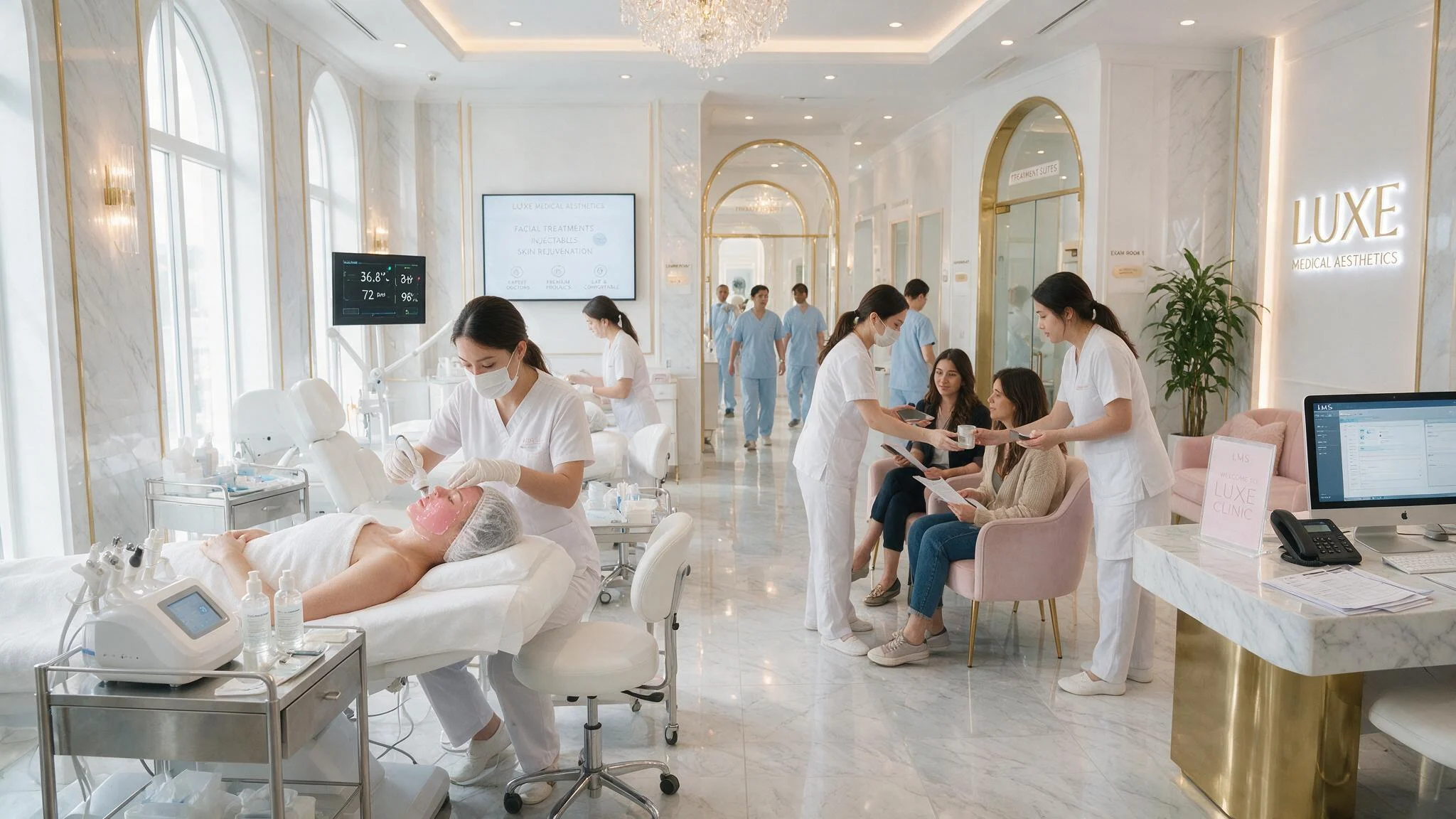
“Medical aesthetics is evolving rapidly. New technologies, treatment techniques, products, devices, and patient expectations are continually changing how aesthetic clinics operate. For clinical directors, nurse managers, and operations leaders, keeping practitioners trained and confident while maintaining consistent standards can become increasingly difficult.
A Medical aesthetics LMS provides a more structured way to manage this challenge. Instead of relying primarily on occasional workshops, shadowing, printed materials, or scattered online resources, an LMS creates a centralized learning environment where clinical education, protocols, assessments, certifications, and professional development can be managed in one place.” – Stephen Handisides
The need for this approach is becoming more urgent as aesthetic organizations grow. A single clinic may have physicians, nurses, aestheticians, patient coordinators, sales teams, and administrative employees who require different types of training. Multi-location organizations face an even greater challenge: ensuring every team follows the same standards regardless of where they work.
The Growing Complexity of Medical Aesthetics and Clinical Practice
Medical aesthetics is no longer limited to a small number of established treatments. Clinics may offer injectables, laser procedures, skin treatments, body contouring, regenerative treatments, and other evolving services.
Each treatment can involve specific protocols, patient-selection considerations, safety requirements, product knowledge, and aftercare instructions. As the treatment menu expands, clinical teams must continually update their knowledge.
At the same time, practitioners must balance training with busy patient schedules. Simply adding more classroom sessions is not always practical.
Why Traditional Workshops and Fragmented Training Are No Longer Enough
In-person workshops remain valuable, particularly for hands-on clinical techniques. However, they can be difficult to scale and maintain as the primary workforce development strategy.
A workshop may teach a technique effectively on one day, but what happens six months later when the protocol changes or a new employee joins the team?
Fragmented training creates similar challenges. Critical information may be stored across shared drives, emails, product manuals, videos, and individual trainers’ knowledge. Employees may receive different instructions depending on who trained them.
This can contribute to inconsistent treatment practices, knowledge gaps, and unnecessary compliance risks.
A modern learning strategy should complement hands-on education with structured digital learning that employees can access before, during, and after formal training events.
The Shift From One-Time Education to Continuous Workforce Development
Clinical education should not end when an employee completes onboarding or attends a workshop.
Medical aesthetics is a fast-changing field, which means practitioners need opportunities to continuously strengthen existing skills and develop new ones. Product updates, treatment protocols, equipment changes, and emerging best practices can all create new learning requirements.
Continuous workforce development allows organizations to deliver education throughout an employee’s career rather than treating training as a one-time event.
Short refresher modules, knowledge assessments, procedure updates, and role-specific learning can help reinforce important information over time. This approach can also make professional development more manageable for busy clinical teams because employees can complete relevant learning in smaller increments.
How a Medical Aesthetics LMS Creates a Centralized Learning Environment
A Medical aesthetics LMS brings learning resources and workforce development activities into one centralized environment.
Clinical leaders can organize treatment protocols, educational videos, assessments, product information, SOPs, compliance materials, certifications, and other resources within structured learning paths.
Employees can then access training based on their role, experience, and responsibilities.
This centralization also creates greater visibility. Managers can see which employees have completed required training, which certifications need attention, and where additional education may be necessary.
For growing organizations, this can be especially valuable because training standards can be managed centrally while still allowing individual locations to address their specific operational requirements.
What Clinical Leaders Should Expect From a Modern Training Platform
A modern training platform should do more than host videos and documents.
Clinical leaders should expect capabilities that help connect learning with real-world workforce readiness. These can include role-based learning paths, competency assessments, treatment protocol tracking, automated certifications, progress dashboards, mobile-friendly learning, and centralized reporting.
The objective should be measurable improvement—not simply higher course-completion numbers.
A strong platform should help leaders understand whether employees have received the right training, demonstrated the necessary knowledge, and remain current as clinical standards evolve.
What Is a Medical Aesthetics LMS?
A Medical Aesthetics Learning Management System is a digital platform designed to organize, deliver, and track workforce education within medical aesthetics organizations.
It provides a structured environment for clinical and non-clinical employees to access relevant training while giving leaders visibility into learning progress, competency, compliance, and professional development.
Understanding the Role of an LMS in Medical Aesthetics
An LMS acts as the central infrastructure for workforce education.
Instead of managing training through disconnected spreadsheets, workshops, email reminders, and individual files, organizations can create structured learning journeys for different roles.
A physician may require advanced clinical education, while a nurse may need treatment-specific competency training. Support and sales teams may need education focused on products, patient communication, or Aesthetic sales training.
By organizing these experiences in one system, leaders can create a more consistent and manageable training environment.
How an Aesthetic Clinic LMS Differs From Generic Training Software
Generic LMS platforms can deliver courses and track completion, but medical aesthetics organizations have specialized requirements.
Clinical teams need education connected to procedures, treatment protocols, products, patient safety, and professional standards. The platform should therefore support learning that reflects how aesthetic practices actually operate.
A specialized aesthetic clinic LMS can also help connect clinical education with hands-on competency development rather than treating every training requirement as a simple online course.
This distinction matters because the goal is not just to educate employees. It is to help practitioners become confident and competent in applying what they learn.
Connecting Clinical Education, Compliance, and Professional Development
Workforce development involves more than clinical technique training.
Organizations must also manage compliance education, certifications, policy updates, product knowledge, professional development, and other requirements.
A centralized LMS can bring these activities together. An employee may complete a clinical module, take an assessment, review an updated protocol, and maintain relevant certification records through the same learning environment.
This creates a more complete picture of employee development.
It also helps leaders move away from reactive training, where education is provided only after a problem or compliance deadline arises.
Why Centralized Learning Matters for Growing Aesthetic Organizations
Centralization becomes increasingly important as an organization expands.
When several clinics operate independently, training can gradually become inconsistent. One location may introduce a new protocol quickly while another continues using older materials. Different managers may also interpret training requirements differently.
A centralized LMS provides a common foundation.
Enterprise organizations and MSOs can distribute approved training and protocols across locations while monitoring participation and performance through centralized reporting.
This creates greater organizational consistency without requiring every location to build and maintain its own training infrastructure.
The Workforce Development Challenges Facing Medical Aesthetics
Medical aesthetics organizations face a unique combination of clinical, operational, and workforce challenges. Training needs to keep pace with the industry while fitting into the realities of patient-facing work.
Keeping Clinical Knowledge Current as Treatments Evolve
Treatment techniques and products can change quickly. New devices may be introduced, protocols may be updated, and practitioners may need to develop skills in emerging procedures.
Without an organized system for delivering updates, employees may receive important information inconsistently or too late.
A centralized learning platform makes it easier to publish updates, assign required education, and confirm that employees have reviewed important changes.
Maintaining Consistent Standards Across Providers and Locations
Consistency is particularly important when multiple providers or locations deliver similar treatments.
A standardized learning environment can ensure that teams have access to the same approved protocols, educational resources, and assessments.
This does not eliminate professional judgment. Instead, it establishes a common organizational foundation from which qualified practitioners can work.
Balancing Training Requirements With Patient-Facing Responsibilities
Clinical employees cannot simply step away from patient care every time new training is required.
Long classroom sessions may create scheduling challenges and reduce operational flexibility.
On-demand courses, mobile learning, and microlearning can make education easier to integrate into busy schedules. Employees can complete short learning activities when appropriate rather than waiting for a large training event.
Tracking Competency, Certifications, and Continuing Education
As organizations grow, manually tracking who has completed training, demonstrated competencies, or renewed certifications becomes increasingly difficult.
Spreadsheets can quickly become outdated, while paper records can be difficult to audit.
An LMS provides centralized visibility into training status and professional development records, helping leaders identify overdue requirements and potential knowledge gaps.
5 Ways a Medical Aesthetics LMS Revolutionizes Clinical Workforce Development
A modern Medical aesthetics LMS can transform workforce development by making training more standardized, accessible, measurable, and continuous.
The first two opportunities are especially important for organizations dealing with rapid growth and constantly changing clinical requirements.
1. Standardizes Clinical Training Across the Entire Workforce
Consistency is one of the strongest advantages of a specialized LMS.
When every practitioner receives training through the same structured framework, organizations can reduce unnecessary variation in how information is communicated and reinforced.
Creating Consistent Training Pathways for Every Role
Different employees need different learning experiences, but those experiences should still follow a consistent structure.
A centralized platform can create standardized pathways for clinical providers, nurses, aestheticians, patient coordinators, sales teams, and administrative staff.
This gives each employee a clear understanding of what training is required for their position.
Building Role-Based Learning Paths for Physicians, Nurses, and Support Staff
Role-based assignments prevent employees from being overwhelmed with irrelevant training.
Physicians and nurses can receive clinical modules, procedure education, and competency assessments, while support teams can receive appropriate operational, communication, product, and service training.
This approach makes learning more relevant while simplifying administration for managers.
Standardizing Treatment Protocols and Clinical Procedures
An LMS can centralize approved treatment protocols, SOPs, educational videos, and reference materials.
When protocols change, leaders can update the appropriate resources and assign required learning to affected employees.
This helps reduce reliance on outdated documents or informal knowledge-sharing.
Reducing Knowledge Gaps Between New and Experienced Team Members
New employees often enter a practice with different levels of experience.
A structured learning pathway provides new team members with a consistent foundation while allowing experienced practitioners to access advanced or refresher education.
Over time, this can help reduce knowledge gaps and create a stronger baseline of clinical proficiency across the workforce.
Supporting Consistency Across Multiple Clinics and Locations
For multi-location aesthetics organizations, centralized training can help preserve organizational standards as the business grows.
Leadership can establish common clinical education and compliance requirements while allowing individual locations to supplement training where necessary.
The result is a scalable approach to workforce development that supports growth without sacrificing consistency.
2. Turns One-Time Training Into Continuous Clinical Development
The second major transformation is the move from occasional education to continuous learning.
Moving Beyond Workshops and Occasional Training Events
Workshops can introduce new techniques effectively, but they should be part of a larger development strategy.
An LMS allows organizations to reinforce workshop learning with follow-up modules, assessments, refreshers, and practical resources.
This helps ensure that important knowledge does not disappear once the training event ends.
Delivering On-Demand Learning When Staff Need It
Employees can access relevant resources when they need them rather than waiting for the next scheduled training session.
A practitioner preparing to learn a new procedure, for example, may review an approved educational module before participating in hands-on training.
This flexibility makes continuous development more realistic for busy aesthetic practices.
Using Microlearning for Procedures, Protocols, and Product Updates
Short learning modules can be particularly useful for fast-moving clinical environments.
A brief video or assessment can reinforce a treatment protocol, introduce a product update, or remind staff of an important safety requirement without requiring a lengthy training session.
Microlearning can also make knowledge reinforcement easier to incorporate into the normal workday.
Creating Ongoing Upskilling and Reskilling Programs
An LMS can help organizations build structured programs for employees who want to expand their capabilities.
Practitioners can progress into advanced clinical education, while support teams can develop stronger product knowledge, communication, and Aesthetic sales training skills.
This creates a workforce development framework that grows with the organization and its employees.
Supporting Lifelong Learning in a Fast-Changing Aesthetic Industry
Ultimately, medical aesthetics requires a mindset of continuous improvement.
A Cosmetic treatment education platform can help organizations make ongoing learning accessible, structured, and measurable. Employees receive opportunities to keep their knowledge current, while leaders gain greater visibility into development across the workforce.
This shift—from one-time training to continuous clinical development—can help aesthetic organizations build more confident practitioners, maintain consistent standards, and remain prepared for the next stage of industry change.
3. Makes Competency and Clinical Readiness Measurable
Completing a training course is useful, but it does not automatically mean a practitioner is ready to apply what they have learned in a real clinical environment. For medical aesthetics organizations, the more important question is whether employees can demonstrate the knowledge and skills required to perform their roles confidently and consistently.
A specialized Medical aesthetics LMS can help move workforce development from simple completion tracking toward measurable competency and clinical readiness.
Tracking More Than Course Completion
Traditional training programs often measure success by attendance or course completion. While these metrics are important, they provide only part of the picture.
A practitioner may complete an online module but still need additional coaching before demonstrating proficiency with a specific procedure. A modern LMS can capture additional indicators, such as assessment scores, skills evaluations, certifications, and learning progression.
This gives clinical leaders a more complete understanding of employee readiness.
Using Assessments to Validate Knowledge and Understanding
Knowledge assessments can help determine whether employees understand important clinical concepts, treatment protocols, safety requirements, and organizational procedures.
Quizzes and scenario-based assessments can be incorporated throughout a learning path rather than used only at the end of training.
If employees consistently struggle with a particular topic, managers can identify the issue and provide additional education before it becomes a larger performance concern.
This makes assessments a development tool rather than simply a pass-or-fail requirement.
Combining Digital Learning With Hands-On Skills Evaluation
Medical aesthetics requires practical skills that cannot always be evaluated through an online course alone.
A strong learning strategy combines digital education with hands-on evaluation. Employees can first learn the relevant concepts through videos, courses, and assessments before demonstrating skills under the supervision of qualified trainers.
The LMS can then document the practical evaluation using digital checklists, observations, and competency sign-offs.
This creates a connection between what employees know and what they can actually do.
Identifying Individual and Team-Level Skill Gaps
Competency data can reveal gaps at both the individual and organizational levels.
For example, a clinical director may discover that one practitioner needs additional support with a particular procedure. At the team level, leadership might discover that several employees are struggling with the same protocol.
These insights allow training to become more targeted.
Instead of assigning the same education to everyone, leaders can provide additional learning where it is most needed while avoiding unnecessary training for employees who have already demonstrated proficiency.
Turning Training Data Into Actionable Workforce Insights
The value of training data comes from what leaders do with it.
When assessment results, competency records, learning activity, and certification information are brought together, clinical and operations leaders can identify trends and make better workforce decisions.
Training data can help answer questions such as:
- Which skills require additional coaching?
- Which employees are ready for advanced responsibilities?
- Where are recurring knowledge gaps appearing?
- Which training programs are producing the strongest results?
This turns workforce development into a measurable operational process rather than an administrative requirement.
4. Strengthens Compliance, Patient Safety, and Clinical Standards
Compliance and patient safety are central concerns for medical aesthetics organizations. As treatment offerings expand and teams grow, maintaining consistent policies and clinical standards becomes increasingly important.
A specialized LMS can help organizations create a more structured approach to required training and documentation.
Centralizing Compliance and Mandatory Training
Instead of tracking mandatory education through separate spreadsheets and email reminders, organizations can centralize requirements within the LMS.
Required courses can be assigned based on role, location, or other relevant criteria. Employees can access training through a single platform, while managers can monitor outstanding requirements.
This reduces the risk of important training being overlooked.
Automating Certification Renewals and Training Reminders
Certification and training deadlines can be difficult to manage manually, especially across large teams.
Automated reminders can notify employees and managers when training or certification renewals are approaching. Recurring requirements can also be incorporated into structured learning plans.
This reduces the administrative burden on clinical and operations leaders while helping employees remain aware of upcoming requirements.
Keeping Staff Updated on Policies, Procedures, and Safety Protocols
Clinical policies can change as treatments, products, equipment, and organizational procedures evolve.
An LMS provides a centralized place to publish updated policies and assign required review or training.
When an important protocol changes, leaders can communicate the update through the learning system and track whether affected employees have completed the required education.
This creates greater accountability around policy changes.
Maintaining Audit-Ready Training Records
Maintaining accurate training records is important when organizations need to demonstrate that employees have completed required education.
Digital records can provide a centralized history of course completion, assessments, certifications, and competency activities.
Instead of searching through paper files or multiple spreadsheets, authorized leaders can access training documentation through the platform.
This can make internal reviews and external audits more organized and efficient.
Connecting Workforce Education With Patient Safety
Training is ultimately connected to the quality and safety of patient care.
When employees understand approved procedures, safety protocols, and organizational standards, they are better positioned to apply those expectations consistently.
An LMS does not replace clinical judgment or professional oversight. Instead, it provides a structured framework for ensuring that employees receive the information and training required to support safe, consistent practice.
This makes workforce education an important part of a broader patient-safety strategy.
5. Uses Learning Analytics to Improve Workforce Performance
Modern workforce development should generate useful data, not simply training records.
Learning analytics can help medical aesthetics organizations understand how employees engage with training, where gaps exist, and how workforce development can support broader operational goals.
Monitoring Training Completion and Engagement
Leaders can monitor whether employees are completing assigned learning and how actively they are engaging with training content.
Low completion rates may indicate scheduling challenges, unclear expectations, or content that needs improvement.
Tracking these patterns gives managers an opportunity to address barriers before they affect overall workforce readiness.
Identifying Knowledge and Competency Gaps
Learning analytics can highlight recurring problems.
If multiple employees perform poorly on an assessment covering the same topic, the issue may not be individual performance alone. The training content itself may need to be revised, expanded, or delivered differently.
This creates a feedback loop between employee performance and training quality.
Comparing Learning Progress Across Teams and Locations
For multi-location aesthetics organizations, centralized analytics can provide visibility across teams.
Leadership can compare training completion, competency progress, and other learning indicators between locations while identifying areas that require additional support.
This is particularly valuable for MSOs and enterprise organizations seeking to maintain consistent standards as they expand.
Using Dashboards to Support Better Management Decisions
Dashboards can turn large amounts of training information into more accessible management insights.
Instead of manually reviewing multiple spreadsheets, operations leaders can quickly identify overdue training, upcoming certification requirements, learning gaps, and progress toward development goals.
The best dashboards focus on information that supports action.
Measuring the Relationship Between Training and Operational Performance
The long-term goal is to understand whether training is improving the organization.
Leaders can compare learning indicators with operational measures such as onboarding time, employee readiness, retention, productivity, or other relevant practice metrics.
For example, if a standardized training pathway consistently helps new employees reach competency faster, that provides evidence that the learning strategy is contributing to workforce performance.
This makes training easier to evaluate as an investment rather than simply an expense.
Key Features to Look for in a Medical Aesthetics LMS
Not every LMS is designed to support the needs of medical aesthetics organizations. When evaluating platforms, clinical and operations leaders should prioritize capabilities that directly support workforce development.
Role-Based Learning Paths
Different employees require different training.
A platform should allow organizations to create learning paths for physicians, nurses, aestheticians, support staff, sales teams, and managers.
Role-based assignments make training more relevant while reducing unnecessary administrative work.
Clinical Assessments and Competency Tracking
Look for tools that support quizzes, assessments, practical skills checklists, evaluations, and competency sign-offs.
These capabilities help organizations move beyond course completion and develop a clearer picture of clinical readiness.
Certifications and Continuing Education Management
Certification tracking can help organizations manage renewal dates and required learning activities.
Continuing education management can also provide a centralized way to organize professional development records and ongoing learning opportunities.
Automated Assignments, Reminders, and Notifications
Automation can significantly reduce the administrative workload associated with training.
Managers should be able to assign learning automatically based on relevant criteria and send reminders for incomplete or upcoming requirements.
This allows clinical leaders to focus more on workforce development and less on manual follow-up.
Mobile-Friendly and On-Demand Learning
Aesthetic clinical teams often have limited time between patient appointments.
Mobile-friendly, on-demand learning allows employees to access short courses, videos, assessments, and reference materials when their schedules allow.
This makes continuous learning more practical in busy clinical environments.
Reporting and Workforce Analytics
Strong reporting should provide visibility into completion, assessment results, competency, certifications, and engagement.
For multi-location organizations, reporting should also help leadership understand performance across teams and locations.
Integration With HR, Practice Management, and Other Business Systems
An LMS becomes more valuable when it can fit into an organization’s broader technology environment.
Where appropriate, integration with HR systems, practice management technology, identity platforms, or other business tools can reduce duplicate data entry and improve administrative efficiency.
Leaders should evaluate integration capabilities alongside security, permissions, and data protection requirements.
Building a Medical Aesthetics Learning Ecosystem
A successful workforce development strategy should not treat an LMS as a standalone training library. Instead, it should become part of a broader learning ecosystem that combines digital education, practical experience, mentorship, and ongoing development.
Combining Online Education With Hands-On Clinical Training
Online education is particularly effective for foundational knowledge, protocol review, product education, and assessments.
Hands-on training remains essential for clinical skills.
Combining both approaches allows employees to prepare digitally before practicing skills under qualified supervision. The LMS can then document the employee’s progress and competency.
Connecting Product Education With Clinical Application
Product knowledge becomes more valuable when employees understand how it applies to real patient-care situations.
A learning platform can connect product education with treatment protocols, clinical scenarios, patient communication, and appropriate application.
This can also support Aesthetic sales training, helping teams understand products and services well enough to communicate their value accurately and responsibly.
Supporting Mentorship and Instructor-Led Learning
Technology should not eliminate human expertise.
Experienced practitioners, clinical educators, and managers remain essential for coaching, feedback, demonstrations, and complex decision-making.
An LMS can support this relationship by providing structured pre-work, assessments, competency checklists, and learning resources before and after instructor-led sessions.
This allows human instruction to focus on areas where expert guidance provides the greatest value.
Creating a Single Source of Truth for Training Content
One of the biggest advantages of an LMS is the ability to establish a centralized source for approved training content.
Employees should know where to find the current version of a treatment protocol, product resource, safety procedure, or organizational policy.
Centralization reduces reliance on outdated files and informal knowledge-sharing while making it easier for leaders to manage content updates.
Updating Learning Content as Techniques and Technologies Change
Medical aesthetics will continue to evolve.
New devices, products, procedures, technologies, and patient expectations will create ongoing learning requirements.
A modern Cosmetic treatment education platform can make it easier to update training content and distribute new education across the workforce.
Rather than waiting for the next annual training event, organizations can publish targeted updates when they become relevant.
This creates a learning ecosystem that is responsive to change and supports continuous professional development.
Ultimately, the strongest Medical aesthetics LMS strategy combines standardized education, practical competency development, compliance management, analytics, and continuous learning.
For clinical directors, nurse managers, and operations leaders, that means greater visibility into workforce readiness and a more scalable way to support clinical teams. For growing aesthetics organizations, it provides the infrastructure needed to maintain standards while continuing to expand.
How a Medical Aesthetics LMS Supports Different Clinical Roles
Medical aesthetics organizations bring together professionals with different responsibilities, levels of experience, and learning requirements. A physician does not need the same training pathway as a medical assistant, just as a front-desk coordinator does not require the same clinical education as a nurse.
A modern Medical aesthetics LMS allows organizations to create role-specific learning experiences while maintaining consistent organizational standards. This makes training more relevant for employees and easier to manage for clinical and operations leaders.
Training Physicians and Advanced Practice Providers
Physicians and advanced practice providers need ongoing education that supports clinical decision-making, treatment protocols, product knowledge, patient safety, and professional development.
An LMS can provide structured access to clinical courses, procedure education, case-based learning, assessments, and updated protocols. Advanced learning paths can also support practitioners who want to develop expertise in specific treatment categories or move into clinical leadership.
Rather than relying solely on occasional workshops, organizations can reinforce education through refresher modules, assessments, and updated clinical resources.
Developing Nurses and Clinical Staff
Nurses and other clinical team members often require a combination of theoretical knowledge and hands-on skills.
A structured learning pathway can introduce treatment protocols, safety procedures, product information, documentation expectations, and patient-care standards. Digital assessments can then verify knowledge before employees move into practical training.
Hands-on competency evaluations can be documented separately, creating a clearer record of what employees have learned and demonstrated.
This approach can also help experienced staff provide more targeted coaching because managers can identify exactly where additional development is needed.
Training Medical Assistants and Support Teams
Medical assistants and support teams play an important role in keeping clinical workflows efficient.
Their training may include patient preparation, room setup, equipment procedures, documentation, infection-control practices, patient communication, and other operational responsibilities.
A Medical aesthetics LMS can organize these requirements into structured learning paths, ensuring new employees receive consistent information rather than depending entirely on whichever team member happens to train them.
This helps create a stronger foundation before employees begin performing responsibilities independently.
Onboarding Front-Desk and Patient Experience Teams
The patient experience begins before the clinical appointment.
Front-desk and patient experience teams may handle scheduling, phone calls, consultations, service questions, payments, follow-ups, and patient education. Their ability to communicate consistently can directly influence how patients perceive the practice.
An LMS can provide standardized training for communication, appointment workflows, product and service knowledge, escalation procedures, and customer experience expectations.
Organizations can also incorporate Aesthetic sales training to help appropriate team members understand treatment offerings and communicate services accurately and professionally.
Creating Leadership Development Programs for Clinical Managers
Clinical managers need more than clinical expertise. They also need leadership, communication, coaching, scheduling, performance management, and operational skills.
An LMS can provide dedicated leadership pathways that help prepare experienced practitioners for management responsibilities.
This supports internal career development and can help organizations build a stronger leadership pipeline instead of relying exclusively on external recruitment when management positions become available.
From Training Completion to Clinical Workforce Readiness
One of the most important changes in modern workforce development is recognizing that training completion is not the same as readiness.
A successful learning strategy should help leaders understand whether employees have the knowledge, skills, confidence, and competency required to perform their responsibilities.
Why Completion Rates Alone Are Not Enough
A completion percentage can tell a manager whether an employee finished a course. It cannot necessarily tell them whether the employee can confidently apply that knowledge in a real clinical situation.
Organizations should therefore look beyond completion rates.
Assessment results, competency evaluations, skills checklists, practical demonstrations, and manager observations can provide a more complete picture of workforce readiness.
Measuring Knowledge, Skills, Confidence, and Competency
Clinical readiness has multiple dimensions.
Knowledge assessments can determine whether an employee understands relevant concepts. Practical evaluations can determine whether they can perform required skills. Confidence measures and manager feedback can provide additional insight into how prepared employees feel to apply their training.
Bringing these indicators together creates a stronger understanding of employee development.
A Cosmetic treatment education platform can help organize these different learning activities within structured pathways, making it easier to track development over time.
Creating Personalized Development Plans
Employees do not all have the same learning needs.
One practitioner may require additional support with a particular procedure, while another may be ready for advanced training. A newer employee may need foundational education that an experienced practitioner has already mastered.
Training data can help managers create personalized development plans rather than assigning identical learning to everyone.
This makes training more efficient while giving employees clearer direction for professional growth.
Giving Managers Visibility Into Workforce Readiness
Managers need practical information to make workforce decisions.
They should be able to determine which employees have completed required education, which skills have been demonstrated, who needs additional coaching, and who may be ready for more advanced responsibilities.
A centralized LMS can bring these indicators together through dashboards and reports.
This visibility is particularly valuable for multi-location organizations where leadership cannot directly observe the development of every employee.
Building a Culture of Continuous Improvement
The ultimate goal is not simply to maintain a training database.
Organizations should use learning data and employee feedback to continually improve their workforce development strategy.
When training gaps are identified, content can be updated. When new procedures are introduced, learning paths can be adjusted. When employees demonstrate readiness for advanced responsibilities, development opportunities can expand.
This creates a culture in which learning is viewed as an ongoing part of clinical excellence rather than an occasional administrative requirement.
The Business Impact of Modernizing Medical Aesthetics Training
Modernizing training can deliver benefits beyond employee education. A well-designed learning strategy can influence administrative efficiency, onboarding speed, employee engagement, patient experience, and organizational scalability.
Reducing Administrative Training Workloads
Manual training administration can consume significant time.
Managers may otherwise need to maintain spreadsheets, send reminders, organize workshops, collect evaluations, update records, and answer repetitive questions about training requirements.
Automation can reduce many of these tasks. Learning assignments, reminders, completion tracking, and reporting can be managed through a centralized system.
This gives managers more time to focus on clinical and operational priorities.
Accelerating New-Hire Onboarding
A structured LMS can help new employees begin learning immediately.
Instead of waiting for the next workshop or relying entirely on an experienced employee’s availability, new hires can access foundational education on demand.
This can help shorten the time required to complete basic onboarding while allowing managers to focus hands-on coaching where it provides the most value.
Improving Staff Engagement and Retention
Employees are more likely to see long-term opportunities within an organization when development pathways are clear.
An LMS can provide structured learning opportunities, advanced training, and leadership development programs that demonstrate an organization’s investment in employee growth.
Ongoing education can also help employees maintain confidence and develop new capabilities as the practice evolves.
Although training alone cannot solve turnover, a strong development program can become an important part of a broader retention strategy.
Supporting Consistent Patient Experiences
Patient experience depends on more than clinical treatment.
Patients interact with receptionists, coordinators, nurses, medical assistants, providers, and other team members throughout their journey.
Standardized training can help ensure that employees understand organizational expectations around communication, service, treatment education, and patient support.
This consistency can become particularly important when an aesthetics organization operates multiple locations.
Scaling Training Without Proportionally Increasing Training Resources
Traditional training often requires more trainers and management time as an organization grows.
A centralized LMS provides scalable infrastructure. Once core learning content has been created, it can be assigned to additional employees and locations without requiring the organization to recreate the same training from scratch.
This allows growing aesthetics organizations and MSOs to expand workforce development without increasing training resources at the same rate as headcount.
How to Implement a Medical Aesthetics LMS Successfully
Technology alone does not create better workforce development. Implementation strategy plays an important role in whether employees adopt the platform and whether the organization achieves measurable results.
Identify Clinical and Operational Training Gaps
Begin by reviewing the current training environment.
Identify where employees experience inconsistent education, where managers spend excessive time training, and where competency or compliance records are difficult to maintain.
Prioritize the gaps that create the greatest operational or clinical impact.
Map Learning Requirements to Specific Roles
Define what each role needs to know and demonstrate.
Create separate requirements for physicians, nurses, medical assistants, patient experience teams, managers, and other employees.
This allows the LMS to deliver relevant learning rather than overwhelming employees with unnecessary courses.
Build a Competency-Based Curriculum
Organize learning around actual job readiness.
Combine educational content with assessments, practical evaluations, skills checklists, and appropriate sign-offs.
This creates a curriculum that measures whether employees can apply what they have learned.
Migrate Existing Training Materials Into the Platform
Most organizations already have valuable training resources.
Review existing SOPs, videos, presentations, manuals, assessments, and reference documents. Remove outdated materials and migrate relevant content into a centralized learning environment.
This creates a single source of truth for employee education.
Introduce the LMS Through a Structured Rollout
Avoid overwhelming employees with a massive training launch.
Begin with a focused group or a high-priority learning pathway. Gather feedback, resolve usability issues, and then expand the program.
Leadership support is also important. Employees should understand why the organization is implementing the LMS and how it will benefit their daily work.
Continuously Measure and Optimize Learning Outcomes
Implementation is only the beginning.
Monitor participation, assessment performance, competency results, employee feedback, and other relevant workforce metrics.
Use those insights to improve content and learning paths over time. As treatments, products, technologies, and organizational priorities change, the training program should evolve with them.
The Future of Clinical Workforce Development in Medical Aesthetics
The next generation of medical aesthetics training will likely become increasingly personalized, data-driven, interactive, and embedded into everyday clinical operations.
AI-Powered Personalized Learning Experiences
Artificial intelligence can help organizations create more personalized learning experiences.
AI may support content creation, assessment generation, learning recommendations, and individualized education based on employee performance.
For example, an employee who struggles with a particular topic could receive targeted review materials instead of repeating an entire training program.
Human clinical oversight will remain essential, particularly when training involves treatment procedures, patient safety, or professional standards.
Predictive Analytics for Workforce Readiness
Training analytics may eventually move beyond describing what has already happened.
Predictive models can help organizations identify potential knowledge gaps, anticipate training needs, and recognize patterns that may affect workforce readiness.
This could allow clinical leaders to address development needs proactively rather than waiting for performance problems to appear.
More Interactive and Immersive Clinical Education
Technology can also make clinical learning more engaging.
Interactive case scenarios, treatment simulations, decision-based exercises, video demonstrations, and other immersive experiences can help practitioners apply knowledge in realistic situations.
These approaches can complement hands-on instruction and provide additional opportunities for practice.
Learning Embedded Into Everyday Clinical Workflows
The future of learning is likely to be increasingly accessible within the normal workday.
Short videos, quick-reference resources, microlearning modules, and searchable protocols can provide employees with information when they need it.
Instead of leaving the workflow to find an answer, employees can access relevant learning resources directly within their working environment.
Continuous Training as a Competitive Advantage
Medical aesthetics is highly competitive, and organizations need skilled, confident teams to maintain quality and deliver strong patient experiences.
Continuous workforce development can become a competitive advantage by helping organizations keep employees current, develop internal talent, standardize clinical education, and respond more quickly to changes in the industry.
A modern Medical aesthetics LMS provides the foundation for this approach.
By combining role-based learning, competency tracking, compliance management, analytics, hands-on education, and continuous professional development, aesthetics organizations can move beyond traditional training and build a workforce development strategy designed for long-term growth.
Summary: Why Medical Aesthetics Organizations Need an LMS
Medical aesthetics organizations are operating in an environment where clinical knowledge, treatment protocols, products, technologies, and patient expectations continue to evolve. Traditional training methods can struggle to keep pace, particularly when organizations are hiring rapidly or expanding across multiple locations.
A specialized Medical aesthetics LMS gives clinical and operations leaders a centralized framework for managing workforce development. It connects training, competency, compliance, professional development, and reporting while making learning more accessible to busy clinical teams.
From Fragmented Training to a Centralized Learning Ecosystem
Training often becomes fragmented as organizations grow. One team may rely on workshops, another on shared documents, and another on informal coaching from experienced practitioners.
A centralized LMS brings these resources together.
Courses, treatment protocols, educational videos, assessments, SOPs, product information, and other learning materials can be organized within one environment. Employees have a consistent place to find approved information, while leaders gain greater control over how training is delivered.
This creates a learning ecosystem rather than a collection of disconnected training activities.
From Course Completion to Measurable Clinical Competency
Completion rates are useful, but they do not tell the entire story.
A practitioner can complete an online module without necessarily demonstrating proficiency in a clinical skill. A stronger workforce development strategy combines courses with assessments, practical evaluations, competency checklists, and manager feedback.
This gives clinical leaders better visibility into whether employees are actually ready to perform their responsibilities.
The shift is simple but important: training should measure what employees can demonstrate, not just what they have completed.
From Reactive Training to Continuous Workforce Development
Traditional training can be reactive. Employees receive education when they are hired, when a new product launches, or when a compliance requirement approaches.
A modern LMS supports continuous development instead.
Organizations can deliver refresher training, new treatment education, product updates, professional development, leadership programs, and targeted learning throughout the employee lifecycle.
This helps create a culture where learning is part of everyday professional development rather than an occasional event.
From Individual Clinics to Scalable, Consistent Standards
As an aesthetics organization expands, maintaining consistent standards becomes more challenging.
A centralized LMS allows leadership to establish shared training requirements across clinics while still giving individual locations flexibility where appropriate.
For MSOs and multi-location aesthetics organizations, this can provide a scalable foundation for workforce development. New locations can adopt established learning pathways instead of building training programs from scratch.
The result is greater consistency across the organization without requiring training resources to grow at the same rate as the business.
FAQs About Medical Aesthetics LMS Platforms
What is a medical aesthetics LMS?
A medical aesthetics LMS is a Learning Management System designed to organize, deliver, and track workforce education for medical spas, aesthetic clinics, dermatology practices, plastic surgery organizations, and similar healthcare businesses.
It can centralize clinical courses, treatment protocols, assessments, certifications, compliance training, professional development, and employee records.
How can an LMS improve medical aesthetics staff training?
An LMS can make training more structured, accessible, and measurable.
Instead of relying on workshops, paper documents, spreadsheets, and informal coaching alone, organizations can create role-based learning paths and track employee progress in one system.
This can help standardize training, reduce administrative work, and give managers greater visibility into employee development.
Can a medical aesthetics LMS track clinical competencies?
Yes. Depending on the platform, an LMS can support competency tracking through assessments, skills checklists, practical evaluations, and trainer sign-offs.
This allows organizations to document both knowledge acquisition and demonstrated skills.
For clinical leaders, this provides a more meaningful picture of workforce readiness than course completion alone.
Can an LMS support both online and hands-on aesthetic training?
Yes. An LMS can complement hands-on clinical education rather than attempting to replace it.
Online modules can provide foundational knowledge, treatment protocols, videos, assessments, and product education. Qualified instructors can then conduct practical training and document competency through the platform.
This blended approach connects digital learning with real-world clinical development.
What types of staff can use a medical aesthetics LMS?
A well-designed LMS can support virtually the entire organization.
Users may include physicians, advanced practice providers, nurses, medical assistants, aestheticians, patient coordinators, front-desk teams, sales staff, practice managers, and other operational employees.
Role-based learning paths allow each group to receive training relevant to its responsibilities.
How does an LMS improve compliance and patient safety?
An LMS can centralize mandatory education, safety training, policies, protocols, certifications, and other requirements.
Automated assignments and reminders can help employees stay current, while digital records give managers greater visibility into completion and renewal status.
Consistent workforce education can also support patient safety by ensuring employees have access to current organizational standards and procedures.
An LMS does not replace professional judgment, clinical oversight, or applicable regulatory requirements. Instead, it provides a structured framework for managing workforce education.
Can an LMS support multiple medspa or clinic locations?
Yes. Multi-location organizations can use a centralized LMS to distribute standardized training across clinics.
Corporate or regional leaders can establish common learning requirements, while individual locations can add appropriate local training.
Centralized reporting can also help leadership compare progress between locations and identify areas that require additional support.
What should medical aesthetics organizations look for when choosing an LMS?
Organizations should evaluate platforms based on their actual clinical and operational requirements.
Important capabilities may include role-based learning paths, competency tracking, assessments, certifications, continuing education management, automated reminders, mobile access, reporting, analytics, integrations, scalability, security, and ease of use.
It is also important to evaluate whether the platform supports medical aesthetics-specific training rather than simply offering generic corporate learning features.
How does a medical aesthetics LMS help reduce training administration?
Automation can reduce many repetitive administrative tasks.
Instead of manually assigning courses, sending reminders, updating spreadsheets, and collecting training records, managers can use the LMS to automate assignments, notifications, progress tracking, and reporting.
This can free clinical and operations leaders to focus more time on patient care, team development, and business operations.
Can an LMS integrate with HR and practice management systems?
Some LMS platforms can integrate with HR systems, identity management tools, practice management platforms, and other business applications.
Integration capabilities vary by provider, so organizations should evaluate available integrations during the vendor-selection process.
The goal is to reduce duplicate data entry, improve information accuracy, and create a more connected technology environment.
How Can V-Unite Help With Medical Aesthetics LMS?
Modernizing clinical workforce development requires more than adding another training tool. Medical aesthetics organizations need a system that connects clinical education, competency, compliance, professional development, and workforce analytics.
V-Unite can help organizations build a more structured and scalable approach to medical aesthetics workforce development through a dedicated LMS.
Whether your organization is struggling with inconsistent training, repetitive onboarding, certification tracking, clinical competency, or maintaining standards across multiple locations, a centralized learning environment can provide greater visibility and control.
Instead of waiting for training gaps to become operational problems, clinical and operations leaders can take a proactive approach to workforce development.
Ready to modernize your medical aesthetics training strategy?
Explore how V-Unite can help your organization create structured learning paths, strengthen clinical workforce development, and scale consistent training across your organization.
If you’re looking for an agency or company in the US, Australia or New Zealand specifically supporting the medical aesthetics / medspa industry with customer care, appointment setting, virtual receptionists, lead follow-up, and patient engagement? Contact V-Assist! The Top Medspa VA & Medical Virtual Assistant Services for you!
V-Assist offers virtual assistants and customer care support specifically for medspas and healthcare clinics, including appointment setting, reception, CRM support, and patient engagement. Strong fit if you want industry-trained offshore or hybrid support.