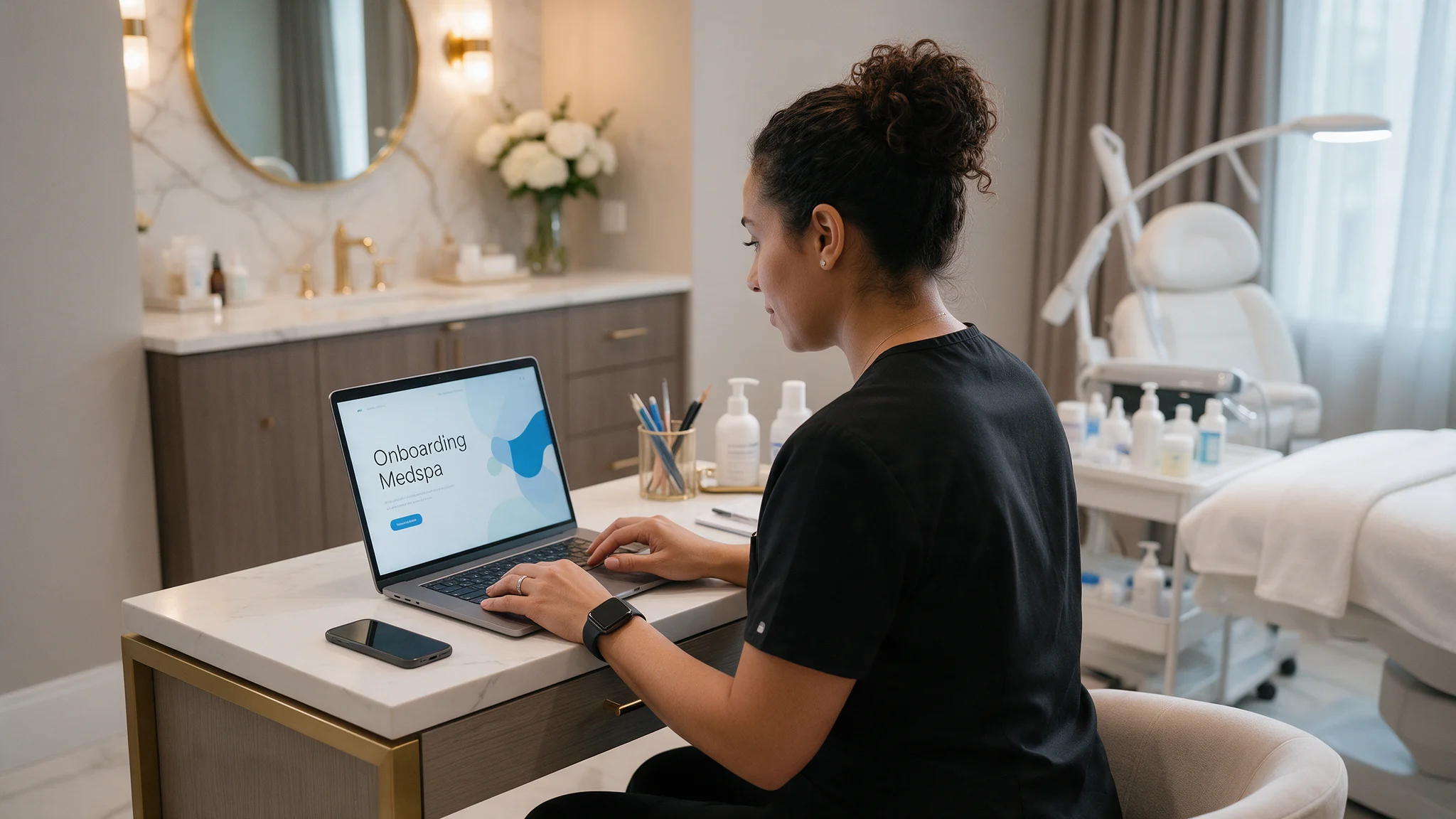
“Expanding a medspa franchise requires more than opening new locations and attracting clients. It also requires building a reliable workforce that can maintain service quality, follow established procedures, and support long-term business growth. This is where Medspa onboarding software becomes valuable. It helps franchise operators organize employee training, standardize procedures, and create a consistent learning experience across locations.
As a medspa franchise expands, employee turnover can quickly become an operational challenge. Losing experienced estheticians, injectors, front-desk coordinators, and managers creates additional recruitment expenses, training demands, and disruptions to daily operations.” – Stephen Handisides
A structured onboarding process helps prevent these problems by giving new employees the knowledge, resources, and support they need to succeed. More importantly, it establishes a repeatable training foundation that allows franchise businesses to grow without compromising employee satisfaction, clinical standards, or brand consistency.
The Connection Between Employee Retention and MedSpa Franchise Growth
Employee retention plays a significant role in determining how successfully a medspa franchise can expand. While new locations create opportunities for increased revenue, they also introduce additional staffing requirements and management responsibilities.
Without a reliable approach to employee development, franchise growth can become difficult to sustain.
How High Employee Turnover Disrupts Daily Clinic Operations
When experienced employees leave, the remaining team often needs to absorb additional responsibilities while management works to find replacements. This can disrupt appointment scheduling, client communication, treatment coordination, and other essential clinic activities.
For example, losing an experienced front-desk coordinator may affect appointment management and client follow-ups. Similarly, replacing an experienced clinical employee can create scheduling challenges while the new hire completes the necessary training and competency assessments.
Frequent staffing changes can also affect team morale, especially when existing employees repeatedly need to help train new colleagues.
A structured onboarding program reduces these disruptions by helping new employees understand their responsibilities and become productive more efficiently.
Why Frequent Recruitment Increases Franchise Operating Costs
Every employee resignation creates expenses that extend beyond recruitment.
Franchise owners must account for job advertisements, interviews, background checks where applicable, administrative processing, onboarding, and training. They may also experience productivity losses while positions remain vacant.
When turnover happens frequently across several locations, these expenses can accumulate and affect unit-level profitability.
Investing in employee onboarding helps reduce avoidable turnover by giving new hires a more organized introduction to the business. It also helps franchise managers spend less time repeatedly explaining basic procedures and more time improving clinic performance.
How Employee Instability Affects Client Experience and Brand Reputation
Medspa clients expect professional service, reliable communication, and consistent experiences whenever they visit a clinic.
However, frequent employee changes can make it difficult to maintain those expectations. Clients may need to explain their preferences repeatedly, experience inconsistent communication, or encounter unfamiliar staff who are still learning clinic procedures.
In medical aesthetics, trust is particularly important because clients are making decisions about treatments, personal appearance, and patient care.
Maintaining a stable workforce helps strengthen client relationships and protect the reputation of the franchise brand.
Why Consistent Employee Performance Matters Across Franchise Locations
A growing franchise must deliver a recognizable and consistent experience regardless of location.
If employees receive different training depending on the clinic where they work, service quality and operational procedures may become inconsistent.
Standardized onboarding helps establish common expectations for communication, customer service, administrative workflows, and applicable clinical protocols.
This allows franchisors to maintain brand standards while giving individual franchise owners a reliable framework for managing their teams.
Why MedSpa Franchise Employees Leave and How Better Onboarding Helps
Employee turnover is not always caused by compensation or workload alone. Sometimes, employees leave because they feel unprepared, unsupported, or uncertain about what their jobs require.
Understanding these challenges helps franchise leaders develop onboarding programs that address the actual reasons employees struggle during their first months.
Unclear Job Expectations and Responsibilities
New employees may become frustrated when they do not understand their responsibilities, performance expectations, or reporting structure.
For instance, front-desk employees may be unsure about handling appointment changes, membership inquiries, or client complaints. Clinical employees may need clarification about documentation requirements and established treatment protocols.
Onboarding should establish clear job expectations from the beginning through job descriptions, role-specific checklists, and documented procedures.
Inadequate Training and Lack of Workplace Support
Expecting employees to learn everything through observation or informal instructions can create unnecessary pressure.
Without proper training, new hires may make avoidable mistakes or repeatedly ask colleagues for help.
A structured program provides guided learning, practical exercises, accessible resources, and regular feedback. This allows employees to develop their skills while knowing where to find support when questions arise.
Limited Opportunities for Professional Growth and Development
Employees are more likely to remain engaged when they see opportunities to improve their skills and advance professionally.
Medspa franchises should offer ongoing learning opportunities, relevant professional education, and development pathways for employees interested in leadership or specialized responsibilities.
Showing employees that their development matters can strengthen engagement and encourage long-term commitment.
Inconsistent Management Practices Across Franchise Locations
When every clinic follows a different onboarding process, employees may receive inconsistent instructions and support.
One manager might provide comprehensive training, while another relies on informal coaching.
Franchisors can address this problem by establishing standardized onboarding guidelines and providing managers with the same training resources and expectations.
Employee Burnout From Unstructured Workflows and Training Gaps
Employees who lack proper training may spend unnecessary time figuring out processes, correcting mistakes, or completing tasks inefficiently.
Over time, these challenges can contribute to frustration and burnout.
Documented SOPs, organized learning materials, and clear workflows help employees understand how to complete their responsibilities without unnecessary confusion.
Building an Employee Onboarding Process That Encourages Long-Term Retention
A successful onboarding program should introduce employees to the organization while preparing them for their actual responsibilities.
For multi-location medspa franchises, the goal is to create a repeatable process that every clinic can implement without sacrificing the quality of employee training.
Creating a Consistent Welcome Experience for New Employees
The onboarding experience should begin before an employee’s first working day.
New hires should receive essential information about their schedule, workplace policies, team members, and initial training activities.
On their first day, they should be introduced to the clinic’s culture, facilities, and support structure.
A welcoming experience helps employees feel valued and reduces the uncertainty associated with starting a new position.
Establishing Clear Roles, Responsibilities, and Performance Expectations
Every employee should understand what successful performance looks like in their position.
Provide clear job descriptions, responsibilities, reporting structures, and performance indicators.
This is especially important for franchises with different employee categories, including estheticians, injectors, front-desk coordinators, and clinic managers.
Clear expectations reduce misunderstandings and help employees focus on their priorities.
Introducing Employees to Brand Standards, Clinic Culture, and Service Values
Employees represent the franchise brand every time they interact with clients.
Onboarding should explain the organization’s service philosophy, communication standards, professional expectations, and approach to client relationships.
This ensures that new hires understand not only what tasks they must complete but also how their work contributes to the overall client experience.
Providing Structured Training Before Employees Handle Daily Responsibilities
New employees should receive appropriate training before independently performing assigned duties.
This may include reviewing SOPs, completing learning modules, observing experienced team members, and participating in supervised practical exercises.
Clinical employees must also meet applicable qualification, supervision, and competency requirements before performing authorized procedures.
Providing adequate preparation helps prevent avoidable mistakes and builds employee confidence.
Setting Measurable Learning Goals During the First 90 Days
A 90-day onboarding framework gives employees and managers a clear way to evaluate progress.
- First 30 days: Introduce company policies, brand standards, essential SOPs, and foundational role-specific training.
- Days 31-60: Develop practical skills, strengthen workflow knowledge, and provide regular coaching.
- Days 61-90: Evaluate competency, identify knowledge gaps, and establish continued development goals.
These milestones help managers identify challenges early while giving employees a clearer understanding of their progress.
Essential Training Every MedSpa Franchise Employee Needs
A comprehensive onboarding program should cover the knowledge and skills employees need to perform their responsibilities safely and consistently.
Clinical Protocols, Treatment Procedures, and Patient Safety
Clinical personnel need appropriate training in authorized treatment procedures, patient screening, documentation, safety protocols, and infection prevention.
Training must reflect professional qualifications, applicable regulations, and individual scopes of practice.
HIPAA Compliance, Workplace Safety, and Regulatory Training
Employees should understand applicable patient privacy requirements, HIPAA obligations where relevant, workplace safety policies, and proper information handling.
Regular refresher training helps reinforce these responsibilities and communicate important policy updates.
Patient Communication and Customer Experience Standards
Every client-facing employee should understand how to handle inquiries, coordinate appointments, communicate professionally, and respond to concerns.
Consistent communication training helps build trust and improve the overall client experience.
Sales Consultations, Memberships, and Client Relationship Management
Employees involved in consultations should understand treatment options, membership structures, pricing policies, and ethical sales practices.
Training should encourage transparent communication and informed client decisions rather than aggressive selling.
Daily Clinic Operations and Standard Operating Procedures
Employees need clear instructions for scheduling, opening and closing procedures, inventory management, documentation, and other daily responsibilities.
Documented SOPs help reduce confusion and maintain consistent workflows.
Role-Specific Training for Front Desk, Clinical, and Management Teams
Different positions require different learning paths.
Front-desk employees need administrative and customer service training, clinical personnel require appropriate treatment and safety education, and managers need leadership, scheduling, performance management, and operational training.
Role-specific onboarding ensures employees receive relevant information instead of overwhelming them with unnecessary materials.
How Standardized Onboarding Strengthens Multi-Location MedSpa Operations
As a franchise network expands, maintaining consistent employee training becomes increasingly important.
A standardized onboarding framework allows franchisors to replicate successful training processes across locations while giving managers the flexibility to address individual employee needs.
Maintaining Consistent Training Standards Across Every Clinic
Centralized training materials help ensure that employees receive the same essential information regardless of location.
This includes brand guidelines, operational policies, service standards, and role-specific learning resources.
Reducing Knowledge Gaps Between Franchise Locations
Standardized training reduces dependence on informal knowledge sharing between employees.
When every clinic follows the same documented learning framework, employees can access reliable information instead of relying on different instructions from individual managers.
Helping New Employees Adapt to Established Operational Workflows
Clear training resources help new hires understand scheduling systems, administrative procedures, communication protocols, and daily clinic operations.
This reduces the adjustment period and allows employees to contribute more effectively.
Ensuring Consistent Client Service and Brand Experience
Consistent onboarding reinforces the behaviors and service expectations that define the franchise brand.
Whether clients visit one location or another, they should experience the same professional communication, service standards, and operational reliability.
Simplifying Employee Training When Opening New Franchise Locations
Opening additional locations requires hiring and preparing new teams within a limited timeframe.
A repeatable onboarding framework allows franchisors to distribute training resources, assign learning activities, and establish consistent expectations without developing a new training program for every clinic.
This creates a stronger operational foundation for sustainable franchise expansion.
The Role of a MedSpa LMS in Improving Employee Onboarding and Retention
As a medspa franchise expands, managing employee training through spreadsheets, printed manuals, and informal instructions becomes increasingly difficult. Franchise leaders need a centralized system that makes onboarding easier to manage while maintaining consistent training standards across every location.
A learning management system (LMS) provides this foundation. It allows franchisors to organize training resources, automate learning assignments, monitor employee progress, and support continuous professional development.
For multi-location franchises, a dedicated LMS also reduces the administrative burden on clinic managers while giving employees easier access to the information they need to perform their jobs.
Centralizing Training Materials, Policies, and Standard Operating Procedures
One of the biggest challenges in franchise operations is keeping training materials organized and updated.
Employees may receive instructions through emails, printed documents, shared folders, or verbal guidance. When resources are scattered, they may struggle to find the correct procedures or accidentally follow outdated instructions.
A MedSpa LMS provides a centralized location for employee handbooks, training videos, compliance materials, SOPs, and operational guidelines.
This makes essential information easier to access and helps franchisors maintain a consistent source of training materials across their network.
Automating Employee Onboarding and Role-Based Learning Assignments
Different employees require different training depending on their responsibilities.
For example, front-desk coordinators need training in appointment scheduling, client communication, and administrative procedures. Clinical employees require appropriate education covering patient safety, documentation, and authorized treatment protocols.
An LMS allows franchise leaders to organize training into role-specific learning paths.
New employees can receive relevant courses and assignments based on their positions, reducing the need for managers to manually distribute training materials.
This creates a more organized onboarding experience while ensuring that important learning requirements are not overlooked.
Tracking Training Completion and Employee Learning Progress
Franchise owners need visibility into whether employees are completing their required training.
An LMS provides progress tracking that allows managers to review completed courses, outstanding assignments, and employee learning activity.
These insights help managers identify employees who may need additional guidance before they begin performing certain responsibilities independently.
For franchisors, centralized reporting also makes it easier to monitor training participation across multiple locations.
Using Assessments to Verify Employee Knowledge and Competency
Completing a training course does not necessarily mean an employee understands how to apply the information.
Knowledge assessments, quizzes, practical demonstrations, and competency evaluations help determine whether employees have developed the required skills.
For example, a front-desk employee may complete a scheduling module and then demonstrate their ability to manage appointment bookings correctly.
Clinical competency must be verified through appropriate supervised training and professional standards rather than course completion alone.
These assessments help franchise managers identify knowledge gaps and provide targeted support.
Delivering Continuous Training and Professional Development
Employee development should continue beyond the initial onboarding period.
An LMS makes it easier to deliver refresher courses, updated SOPs, compliance education, and additional learning opportunities.
Employees can revisit important materials when necessary, while managers can assign training based on changing operational requirements.
This creates a continuous learning environment that supports employee confidence, engagement, and long-term retention.
Giving Franchise Owners Visibility Into Training Across Multiple Locations
Managing employee development across several clinics requires more than individual training records.
Franchise leadership needs a clear overview of how different locations are implementing onboarding requirements.
A centralized LMS can provide visibility into course completion, outstanding assignments, assessment results, and training participation.
This helps regional managers identify locations that may need additional support and ensures that training expectations remain consistent as the franchise grows.
Creating a 30-60-90-Day Onboarding Roadmap for MedSpa Employees
A structured onboarding timeline helps new employees transition into their roles without feeling overwhelmed.
For medspa franchises, a 30-60-90-day roadmap provides a repeatable framework for introducing employees to company policies, developing practical skills, and evaluating performance.
It also gives managers measurable milestones for determining whether employees are progressing as expected.
First 30 Days: Building Foundational Knowledge and Workplace Confidence
The first 30 days should focus on helping employees understand the organization and their responsibilities.
New hires should receive introductions to the franchise’s culture, brand standards, workplace policies, and essential SOPs.
They should also complete foundational training relevant to their positions.
For example, front-desk employees can begin learning appointment management and client communication, while clinical personnel receive appropriate orientation covering safety protocols and their authorized responsibilities.
The goal is to establish a strong foundation before employees take on more complex duties.
Days 31–60: Developing Practical Skills and Operational Competency
During the second month, employees should begin applying what they learned through guided practice and supervised activities.
Managers can introduce more advanced responsibilities while observing how employees handle daily workflows.
This stage may include practical exercises, role-playing, system demonstrations, and additional assessments.
Employees should also receive feedback about their progress so they understand what they are doing well and where improvement is needed.
Days 61–90: Evaluating Performance and Identifying Development Opportunities
By the third month, managers should evaluate whether employees have achieved their initial learning objectives.
This includes reviewing their understanding of procedures, ability to perform assigned responsibilities, and consistency in following established workflows.
Managers can use assessment results and performance observations to identify remaining knowledge gaps.
The 90-day review should also introduce future development opportunities, helping employees understand how they can continue growing within the organization.
Using Manager Feedback and Training Assessments to Support Progress
An effective onboarding roadmap requires consistent communication between employees and managers.
Regular check-ins provide opportunities to discuss challenges, clarify expectations, and identify areas where additional training may be necessary.
Combining manager feedback with LMS assessment results creates a more complete picture of employee progress.
Rather than waiting for performance problems to appear, franchise managers can address learning gaps early and provide the support employees need to succeed.
Turning Employee Training Into a Long-Term Retention Strategy
Employee retention requires more than a good first-day experience. It involves creating an environment where people feel supported, valued, and motivated to develop their careers.
For growing medspa franchises, continuous training should become part of the overall workforce strategy rather than an occasional administrative activity.
Providing Continuous Learning Beyond Initial Onboarding
Employees need opportunities to strengthen their knowledge as clinic procedures, technologies, and customer expectations evolve.
Franchise leaders should provide regular refresher courses, updated training materials, and relevant professional education.
A centralized LMS makes it easier to distribute these resources and ensure employees across different locations receive consistent learning opportunities.
Creating Career Advancement Opportunities Within the Franchise
Employees are more likely to remain with an organization when they can see a future within it.
Medspa franchises can establish career pathways that allow employees to develop additional skills and prepare for greater responsibilities.
For example, experienced front-desk coordinators may progress into clinic administration or management positions, while qualified clinical professionals may pursue further education within their professional scope.
Clear development opportunities help employees see their roles as part of a longer-term career rather than temporary employment.
Supporting Employees Through Regular Coaching and Performance Reviews
Regular coaching helps employees understand their performance and identify opportunities for improvement.
Managers should schedule periodic conversations to discuss workload, training challenges, professional goals, and workplace concerns.
These discussions also give employees an opportunity to share feedback about clinic operations and the onboarding experience.
Consistent communication can help prevent minor concerns from becoming reasons for resignation.
Recognizing Employee Progress and Training Achievements
Recognition is another important part of employee engagement.
Franchise managers should acknowledge employees who complete important training milestones, demonstrate improved performance, or consistently follow established procedures.
Recognition can take different forms, including internal appreciation, professional development opportunities, or eligibility for additional responsibilities.
Celebrating progress reinforces positive behaviors and encourages employees to remain invested in their development.
Building a Learning Culture That Encourages Employee Engagement
A learning culture makes employee development part of everyday operations.
Instead of treating training as something employees complete only when hired, franchise leaders should encourage continuous knowledge sharing, coaching, and professional improvement.
When employees have access to reliable learning resources and supportive managers, they are more likely to feel confident and engaged.
This creates a stronger workforce foundation for long-term franchise growth.
Measuring the Impact of Onboarding on MedSpa Franchise Performance
Investing in employee onboarding requires time, technology, and resources. Franchise leadership should therefore measure whether these investments are producing meaningful operational and financial improvements.
Tracking the right performance indicators helps determine how onboarding influences employee retention, clinic productivity, customer experience, and overall profitability.
Monitoring Employee Turnover and Retention Rates
Employee turnover and retention rates provide useful insights into workforce stability.
Franchises should monitor how many employees leave within their first 30, 60, and 90 days, as well as overall employee retention over longer periods.
Comparing results across locations can reveal whether certain clinics experience higher turnover and may need improvements to their management or onboarding processes.
Measuring Time to Productivity for Newly Hired Employees
Time to productivity measures how long it takes new employees to perform their responsibilities effectively.
For example, a front-desk coordinator should gradually become proficient in scheduling, patient communication, and administrative workflows.
Tracking this metric helps managers determine whether training programs are preparing employees efficiently.
A structured onboarding system can reduce unnecessary delays by providing clear instructions, organized resources, and measurable learning objectives.
Tracking Training Completion and Competency Assessment Results
Training completion rates indicate whether employees are receiving the required education.
However, franchise leaders should also examine assessment results and practical competency evaluations.
An LMS can help consolidate these records, making it easier to identify employees who need additional support and locations where training requirements are not being consistently met.
Evaluating Client Satisfaction and Service Consistency
Employee performance directly influences the client experience.
Franchise owners can evaluate client feedback, service complaints, appointment handling, communication quality, and satisfaction surveys.
Consistent training should help employees deliver more reliable service while reducing avoidable operational mistakes.
These indicators help connect workforce development with brand reputation and customer loyalty.
Calculating Recruitment, Replacement, and Retraining Costs
To understand the financial impact of turnover, franchise owners should calculate the expenses associated with replacing employees.
These may include:
- Recruitment advertising and interview expenses.
- Hiring and administrative processing.
- Initial onboarding and training costs.
- Productivity losses during vacant positions.
- Time spent by managers and experienced employees training replacements.
Comparing these expenses before and after onboarding improvements can help determine whether the investment is reducing avoidable costs.
Connecting Employee Retention to Long-Term Franchise Profitability
Employee retention contributes to profitability by helping clinics maintain stable operations and reduce recurring recruitment expenses.
When employees remain longer, franchise owners can preserve institutional knowledge, reduce repeated training costs, and maintain stronger client relationships.
Across multiple locations, these improvements can support more predictable staffing expenses and protect unit-level performance.
For franchisors, investing in scalable onboarding infrastructure is therefore not simply an HR initiative. It is an operational strategy that supports sustainable expansion.
Common Onboarding Mistakes That Prevent MedSpa Franchises From Scaling
Even established franchise brands can struggle with employee retention when their onboarding systems are poorly designed.
Recognizing common mistakes allows franchise leaders to improve their training infrastructure before staffing challenges begin affecting expansion.
Relying on Informal Training Instead of Structured Learning Programs
Informal training often depends on employees learning through observation or receiving verbal instructions from experienced colleagues.
While mentoring can be valuable, it should not replace documented training materials and structured learning objectives.
Without a consistent framework, new hires may receive incomplete or conflicting instructions.
Using Different Training Materials Across Franchise Locations
When franchise locations use different employee handbooks, SOPs, or training resources, maintaining consistent standards becomes difficult.
Franchisors should establish centralized training materials and a clear process for distributing approved updates.
This helps ensure employees receive reliable information regardless of where they work.
Treating Onboarding as a One-Time Orientation Process
Employee onboarding should extend beyond the first day or initial orientation session.
Employees need continued guidance, practical training, performance feedback, and opportunities to strengthen their skills.
A 30-60-90-day roadmap provides a more effective structure for supporting new hires throughout their adjustment period.
Overloading Managers With Manual Training Responsibilities
Clinic managers already handle several operational responsibilities.
Requiring them to create training materials, manually assign courses, track completion, and repeatedly explain basic procedures can take time away from essential management activities.
Using a centralized LMS and documented SOPs helps reduce this administrative burden.
Failing to Monitor Employee Training and Performance Progress
Without progress tracking, managers may not realize that employees are struggling with specific responsibilities until operational mistakes occur.
Regular assessments, training reports, and performance reviews help identify gaps early and make employee development more proactive.
Neglecting Continuous Education and Employee Development
Finally, franchises should avoid treating training as something that ends once employees complete onboarding.
Without ongoing education, employees may struggle to adapt to updated procedures, new services, and changing operational expectations.
Continuous development helps employees remain capable, confident, and engaged while giving the franchise a stronger foundation for future growth.
How MedSpa Franchise Owners Can Build a Scalable Employee Training System
As a medspa franchise grows, employee training must evolve alongside the business. What works for a single clinic may become difficult to manage when the organization expands to five, ten, or more locations.
Franchise owners and leadership teams need a repeatable training infrastructure that ensures every employee receives consistent guidance without placing excessive administrative responsibilities on individual managers.
Building a scalable employee training system requires combining standardized processes, centralized resources, and technology that supports continuous learning.
Standardizing Onboarding Workflows Across All Locations
The first step is establishing a consistent onboarding process that every franchise location can follow.
Franchisors should define clear onboarding milestones, required training activities, employee responsibilities, and performance expectations. This ensures that new hires receive the same foundational training regardless of which clinic they join.
For example, every front-desk coordinator should complete the same essential modules covering appointment scheduling, client communication, and administrative procedures. Clinical employees should follow appropriate learning pathways based on their qualifications and authorized responsibilities.
Standardized workflows reduce confusion, simplify management oversight, and help franchise leaders maintain consistent operational expectations.
Developing Centralized Training Resources and SOP Libraries
A growing franchise needs a reliable source of information that employees and managers can access whenever necessary.
Developing a centralized library of training resources and standard operating procedures (SOPs) helps prevent employees from relying on outdated documents or inconsistent verbal instructions.
This library should include employee handbooks, operational checklists, training videos, compliance policies, customer service guidelines, and role-specific learning materials.
Franchisors should also establish a document review process to ensure that important policies and procedures remain accurate and updated.
Implementing a Dedicated MedSpa Training Platform
Managing training manually becomes increasingly difficult as additional locations and employees are introduced.
A dedicated training platform or learning management system provides a centralized environment for organizing learning materials, assigning courses, monitoring completion, and supporting employee development.
With Medspa onboarding software, franchise owners can establish repeatable onboarding workflows while giving employees easier access to the resources they need.
Instead of rebuilding training programs for every new location, franchisors can use an existing system to distribute standardized learning materials and track employee progress across the network.
This improves training efficiency while reducing the administrative workload associated with franchise expansion.
Establishing Consistent Training and Performance Reporting
A scalable training system should provide visibility into how effectively employees are learning and applying their knowledge.
Franchise leaders should establish consistent reporting standards for training completion, assessment results, employee competency, and onboarding milestones.
These reports help identify locations that may require additional support and employees who need further coaching.
Combining training data with workforce indicators, such as turnover and retention rates, also helps leadership understand whether onboarding improvements are contributing to better employee outcomes.
Updating Training Programs as the Franchise Expands
A franchise’s training requirements will change as the business introduces new treatments, technologies, services, and operational processes.
Training programs should therefore be reviewed and updated regularly.
Franchisors should establish clear procedures for communicating changes, distributing updated SOPs, and assigning additional training when necessary.
This ensures that employees remain informed and that new locations can follow the same established standards as the original clinics.
By treating employee training as an ongoing operational priority, franchise leaders can build a system that supports both current performance and future expansion.
Summary: Sustainable MedSpa Franchise Growth Begins With Employees Who Stay
Growing a successful medspa franchise requires more than opening additional locations, increasing marketing investments, or attracting new clients. It requires building a reliable workforce that can maintain clinical standards, deliver consistent client experiences, and support the business as it expands.
Employee onboarding plays a major role in achieving this goal. When new hires receive clear expectations, structured training, practical guidance, and ongoing support, they are better prepared to perform their responsibilities and contribute to the organization.
For franchise leaders, this means treating onboarding as a long-term retention and operational strategy rather than a one-time orientation activity.
A standardized 30-60-90-day onboarding roadmap, role-specific training programs, centralized SOP libraries, and regular competency assessments can help create a more consistent employee experience across multiple locations.
Technology also plays an important role. A dedicated LMS or Medspa onboarding software helps franchisors organize training resources, automate learning assignments, monitor employee progress, and maintain consistent standards throughout the franchise network.
These improvements can also deliver measurable financial benefits. Reducing employee turnover helps limit recruitment and retraining expenses, protect productivity, preserve institutional knowledge, and maintain stronger client relationships.
For those exploring how to start a medspa franchise, establishing the right employee training infrastructure should be part of the growth strategy from the beginning. Building this foundation early makes it easier to introduce new employees, support additional locations, and maintain operational consistency.
Ultimately, sustainable medspa franchise growth starts with employees who feel prepared, supported, and motivated to stay. Franchise brands that invest in structured onboarding and continuous development are better positioned to build stronger teams, protect their reputation, and create a scalable business model.
Frequently Asked Questions About MedSpa Franchise Onboarding and Employee Retention
1. Why Is Employee Onboarding Important for MedSpa Franchise Growth?
Employee onboarding is important because it helps new hires understand their responsibilities, learn clinic procedures, and become productive members of the team. For growing medspa franchises, structured onboarding also helps maintain consistent service standards across locations. By preparing employees properly from the beginning, franchise owners can reduce early turnover, minimize operational mistakes, and build a more reliable workforce that supports long-term business growth.
2. How Does Better Onboarding Reduce Employee Turnover in MedSpas?
Better onboarding reduces employee turnover by giving new hires the training, resources, and workplace support they need to succeed. Employees who understand their responsibilities and receive proper guidance are less likely to feel overwhelmed or disconnected from the organization. A structured onboarding process also establishes clear expectations, encourages communication with managers, and helps employees feel more confident in their positions.
3. What Should a MedSpa Franchise Employee Onboarding Program Include?
A comprehensive medspa franchise onboarding program should include:
- Company orientation and introduction to brand values.
- Employee handbooks and standardized SOPs.
- Role-specific training for clinical and nonclinical employees.
- HIPAA and applicable compliance education.
- Workplace safety and patient protection procedures.
- Customer service and patient communication training.
- Practical exercises and competency assessments.
- Performance expectations and development goals.
It should also include ongoing education to help employees maintain their skills beyond their initial training period.
4. How Long Should Employee Onboarding Take in a MedSpa Franchise?
Employee onboarding should extend beyond the first day or week of employment. A 30-60-90-day onboarding framework provides a practical structure for developing employee knowledge and evaluating progress.
During the first 30 days, employees learn company policies, brand standards, and foundational procedures. Between days 31 and 60, they develop practical skills and become more familiar with daily workflows. During days 61 to 90, managers evaluate performance, verify competency, and identify additional training opportunities.
The timeline may vary depending on the employee’s position, experience, and clinical responsibilities.
5. What Is the Role of an LMS in MedSpa Employee Training?
A learning management system (LMS) helps medspa franchises organize and manage employee training through a centralized platform. It allows franchisors to upload educational materials, distribute SOPs, assign role-specific courses, monitor training completion, and evaluate employee learning progress.
An LMS also reduces dependence on manual training processes and makes it easier to maintain consistent learning standards across multiple locations. For growing franchises, this technology provides a scalable foundation for employee onboarding and continuous professional development.
6. How Can MedSpa Franchise Owners Standardize Training Across Multiple Locations?
Franchise owners can standardize training by developing centralized employee handbooks, documented SOPs, role-specific learning paths, and consistent onboarding milestones.
Using a dedicated training platform also helps ensure that every location receives the same approved training resources. Franchisors can distribute updated materials, assign mandatory courses, and monitor completion across their network.
Regular assessments and operational reviews further help identify inconsistencies and maintain established brand standards.
7. What Training Do MedSpa Employees Need to Perform Their Roles Effectively?
Training requirements depend on each employee’s responsibilities.
Front-desk employees need education in appointment scheduling, patient communication, customer service, and administrative procedures. Clinical employees require appropriate training in treatment protocols, patient safety, documentation, and their authorized scope of practice. Managers need additional development in leadership, scheduling, employee performance, and clinic operations.
All employees should also receive applicable privacy, workplace safety, and compliance training to support safe and consistent operations.
8. How Can Franchise Owners Measure the Success of Their Onboarding Programs?
Franchise owners can measure onboarding effectiveness through several workforce and operational indicators, including:
- Employee turnover and retention rates.
- New employee time to productivity.
- Training completion rates.
- Knowledge assessment and competency results.
- Client satisfaction and service consistency.
- Recruitment and replacement expenses.
- Employee engagement and feedback.
Reviewing these indicators regularly helps franchise leadership identify opportunities to improve training while understanding its contribution to operational performance and profitability.
9. How Often Should MedSpa Franchise Employees Receive Refresher Training?
Refresher training should be provided regularly based on employee responsibilities, organizational policies, and applicable regulatory requirements.
For example, employees may need periodic updates on privacy requirements, workplace safety, infection prevention, patient communication, and operational procedures. Additional training should also be provided whenever the franchise introduces new services, technologies, or updated SOPs.
A centralized LMS can help managers organize refresher courses and monitor completion across different locations.
10. Can a Centralized Training Platform Help MedSpa Franchises Scale Faster?
Yes. A centralized training platform helps medspa franchises manage employee development without rebuilding training processes for every new location.
Franchisors can reuse standardized learning materials, automate onboarding assignments, distribute updated SOPs, and monitor training progress across their network.
This reduces administrative workload, supports consistent employee preparation, and helps new locations adopt established operational standards more efficiently.
A scalable training infrastructure allows franchise leadership to focus more on expansion while maintaining the quality and consistency of employee development.
How Can V-Unite Help With MedSpa Franchise Onboarding and Employee Retention?
Expanding a medspa franchise requires more than recruiting talented employees. It requires a reliable system for preparing, developing, and retaining those employees as the business grows.
V-Unite Learn helps medspa businesses streamline employee training through a centralized learning management platform designed to organize and support workforce development.
Instead of relying on scattered training documents, manual assignments, and inconsistent onboarding procedures, franchise operators can establish a more structured approach to employee learning.
With V-Unite Learn, medspa franchises can:
- Centralize Training Materials: Organize employee handbooks, SOPs, policies, and educational resources in one platform.
- Standardize Employee Onboarding: Establish consistent training experiences across multiple clinic locations.
- Organize Role-Specific Learning: Provide employees with relevant training based on their responsibilities.
- Monitor Training Progress: Track course completion and assessment results to identify knowledge gaps.
- Support Continuous Development: Make learning resources available beyond initial employee orientation.
- Build Scalable Training Processes: Create repeatable employee development programs that support franchise expansion.
Whether you’re managing a single medspa location or overseeing a growing franchise network, having the right training infrastructure can make employee development more organized and sustainable.
Ready to build a stronger workforce for your growing medspa franchise? Give your employees the training resources and structured learning experience they need to succeed.
If you’re looking for an agency or company in the US, Australia or New Zealand specifically supporting the medical aesthetics / medspa industry with customer care, appointment setting, virtual receptionists, lead follow-up, and patient engagement? Contact V-Assist! The Top Medspa VA & Medical Virtual Assistant Services for you!
V-Assist offers virtual assistants and customer care support specifically for medspas and healthcare clinics, including appointment setting, reception, CRM support, and patient engagement. Strong fit if you want industry-trained offshore or hybrid support.