“The medical aesthetics industry is evolving rapidly as brands expand through direct partnerships, franchise networks, and third-party distributors. As these external relationships grow, maintaining consistent education becomes increasingly challenging. A Distributor training platform helps brands educate distributor sales teams while ensuring product knowledge, compliance, and messaging remain consistent across every market. At the same time, organizations are investing in specialized learning solutions that improve operational efficiency, strengthen clinical standards, and support long-term business growth without sacrificing quality or patient safety.” – Stephen Handisides
Today’s medspa ecosystem extends well beyond a single clinic. Manufacturers, skincare companies, injectable brands, laser device developers, distributors, and partner clinics all play a role in delivering exceptional patient outcomes. Without a structured approach to external education, organizations risk inconsistent product knowledge, varying clinical protocols, and fragmented customer experiences.
Training is no longer simply an educational initiative—it has become a strategic business function that directly influences revenue growth, brand reputation, regulatory compliance, and customer loyalty.
The Rise of Collaborative Healthcare and Aesthetic Business Models
Unlike traditional healthcare organizations, modern medical aesthetics brands rarely operate through a single sales channel.
Many companies now support:
- Direct medspa partners
- Franchise clinics
- Independent healthcare providers
- Regional distributors
- National distribution networks
- Clinical educators
- Sales representatives
Each audience has different responsibilities, learning objectives, and business priorities.
For example, a medspa owner may require in-depth clinical protocols, patient consultation techniques, and treatment workflows, while a distributor’s sales representative needs comprehensive product knowledge, competitive positioning, and regulatory guidance before introducing products to healthcare professionals.
As brands continue expanding internationally or across multiple regions, coordinating education across these diverse audiences becomes significantly more complex.
This growing complexity is driving organizations toward centralized digital learning platforms capable of supporting multiple external learner groups while maintaining consistent educational quality.
Why Consistent Training Impacts Patient Experience and Business Growth
Training directly influences every stage of the customer journey.
Well-trained clinicians deliver safer procedures, more consistent treatment outcomes, and stronger patient confidence. Likewise, knowledgeable distributor representatives communicate product value more accurately, helping healthcare providers adopt new technologies and treatments with greater confidence.
Conversely, inconsistent training can result in:
- Mixed product messaging
- Incorrect treatment protocols
- Lower clinician confidence
- Reduced customer satisfaction
- Compliance concerns
- Lost sales opportunities
- Brand inconsistency
Every inconsistency affects not only business performance but also patient trust.
As competition within the medical aesthetics industry intensifies, delivering standardized education across every external relationship becomes a competitive advantage rather than simply a best practice.
Understanding the Need for Specialized Training Platforms
General-purpose learning systems often struggle to meet the unique demands of medical aesthetics organizations.
External learners require different learning paths, permissions, certifications, reporting structures, and communication workflows than internal employees.
A specialized Partner training platform enables organizations to deliver customized learning experiences for external clinics, physicians, aesthetic practitioners, and strategic business partners while maintaining centralized oversight.
Likewise, a modern Medspa LMS allows organizations to automate learning assignments, monitor certification completion, measure learner engagement, and scale education across growing partner networks.
Instead of managing multiple disconnected learning tools, organizations gain a single ecosystem capable of supporting expansion while protecting brand integrity and clinical excellence.
What Is a Partner Training Platform?
As medical aesthetics brands continue expanding through strategic partnerships, educating external clinics has become just as important as training internal employees. A partner training platform is specifically designed to help organizations deliver structured education to business partners who represent, recommend, or use their products and services.
Rather than simply providing online courses, these platforms create a centralized learning environment where partners can access educational resources, complete certifications, receive product updates, and stay aligned with evolving clinical and operational standards.
This structured approach ensures every partner receives a consistent educational experience regardless of location, helping organizations maintain brand consistency while supporting scalable growth.
Definition and Primary Purpose
A partner training platform is a learning system designed to educate external business partners instead of internal staff.
Its primary objectives include:
- Standardizing product education
- Supporting clinical competency
- Reinforcing brand standards
- Delivering certification programs
- Improving partner engagement
- Accelerating partner success
The platform enables organizations to build stronger business relationships while ensuring partners have the knowledge needed to represent the brand effectively.
Who Uses a Partner Training Platform?
Partner learning platforms typically support:
- Medspa owners
- Physicians
- Nurse injectors
- Aesthetic practitioners
- Franchise operators
- Clinical educators
- Strategic business partners
- Enterprise clinic networks
Each audience receives learning experiences tailored to their responsibilities and clinical expertise.
Common Training Objectives for Medspa Partners
Partner education often focuses on helping clinics achieve both clinical excellence and commercial success.
Typical learning programs include:
- Product application protocols
- Patient consultation best practices
- Treatment planning
- Clinical safety guidelines
- Brand standards
- Marketing support
- Business development strategies
- Certification programs
These educational initiatives help partners deliver consistent patient experiences while strengthening long-term brand loyalty.
What Is a Distributor Training Platform?
Although partner clinics and distributors both contribute to business growth, their responsibilities differ significantly. Distributors primarily focus on expanding market reach, introducing products to new accounts, supporting sales teams, and strengthening customer relationships across multiple territories.
A distributor training platform is specifically built to educate these external sales organizations while ensuring every representative accurately communicates product information, follows regulatory requirements, and consistently represents the manufacturer’s brand.
Because distributors often sell multiple product lines from different manufacturers, structured education becomes essential for maintaining product knowledge and reducing misinformation within competitive markets.
Definition and Core Functionality
A distributor training platform provides centralized learning resources specifically for distributor organizations and their sales representatives.
Key capabilities typically include:
- Product education
- Sales enablement
- Compliance training
- Certification management
- Product launch training
- Competitive positioning
- Performance reporting
These features help distributor teams confidently represent products while supporting consistent market messaging.
Who Benefits from Distributor Training?
Primary learners include:
- Distributor sales representatives
- Regional sales managers
- Territory managers
- Product specialists
- Clinical support representatives
- Distribution leadership teams
Manufacturers also benefit by gaining greater visibility into distributor readiness and learning progress.
Typical Training Programs for Product Distribution Teams
Distributor education commonly includes:
- Product features and benefits
- Clinical evidence
- Regulatory requirements
- Sales conversations
- Competitive differentiation
- Product updates
- Market positioning
- Certification assessments
These programs ensure distributors represent products accurately while strengthening customer confidence throughout the sales process.
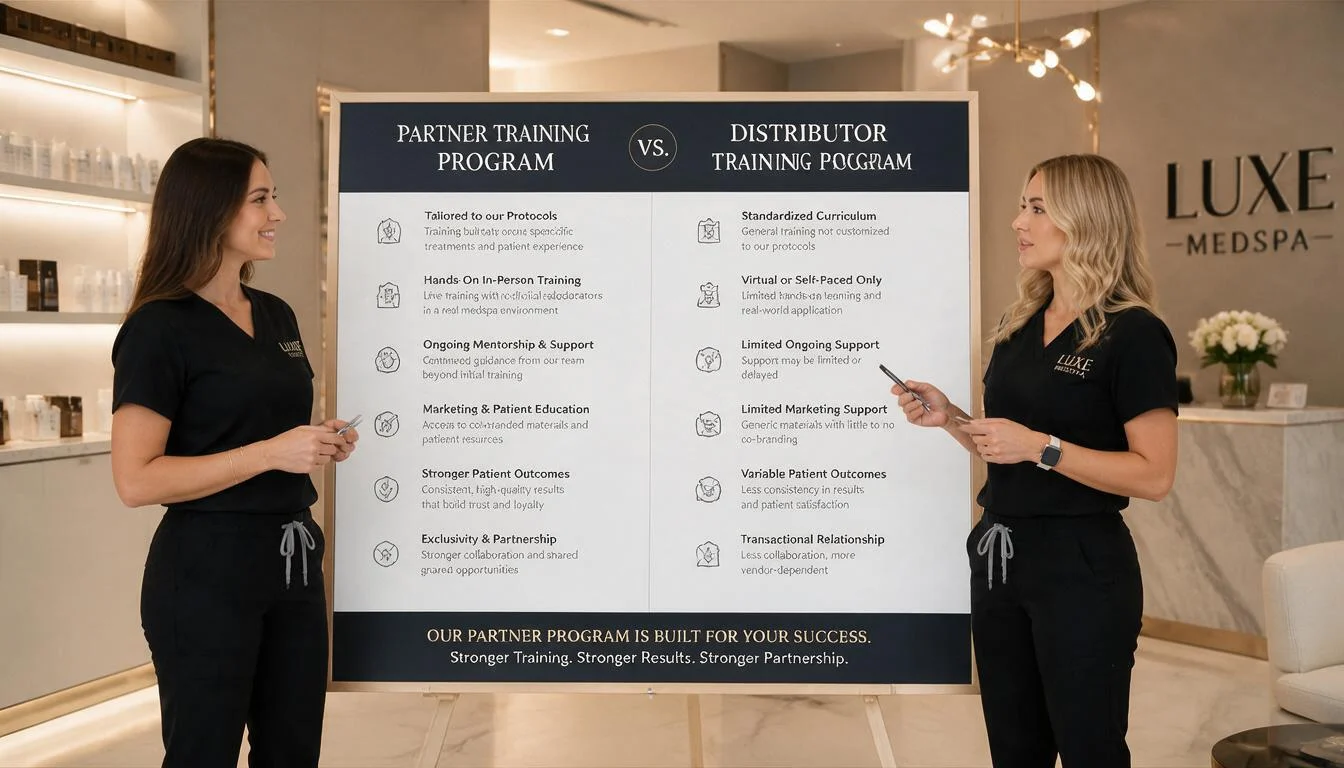
Partner Training Platform vs. Distributor Training Platform: Understanding the Differences
At first glance, partner training platforms and distributor training platforms may appear nearly identical because both educate external audiences. However, their goals, learner profiles, content strategies, and performance measurements differ considerably.
Understanding these differences is essential for medical aesthetics brands evaluating their learning technology. Choosing the wrong platform—or attempting to force every external learner into the same training experience—can create operational inefficiencies, inconsistent messaging, and channel conflict.
Rather than asking which platform is “better,” organizations should evaluate which business relationships they are supporting and whether one flexible learning ecosystem can effectively serve multiple external audiences.
For many growing aesthetics brands, a configurable Medspa LMS can support both partner and distributor learning through separate learning paths, permissions, certifications, and reporting dashboards, eliminating the need for disconnected training systems.
Primary Audience
A partner training platform primarily serves healthcare providers, medspa owners, clinicians, and franchise operators.
A distributor training platform focuses on distributor organizations, sales representatives, and commercial teams responsible for selling products across multiple customer accounts.
Business Objectives
Partner education emphasizes clinical competency, treatment consistency, and successful product implementation.
Distributor education prioritizes sales enablement, product knowledge, market expansion, and revenue generation.
Training Content and Curriculum
Partner programs generally include clinical protocols, patient safety, treatment workflows, and certification.
Distributor programs emphasize product positioning, competitive messaging, objection handling, and sales effectiveness.
Performance Measurement
Partner success is often measured through certification completion, clinical competency, treatment quality, and long-term product adoption.
Distributor performance focuses more heavily on sales readiness, product knowledge, market penetration, and revenue contribution.
Compliance and Certification Requirements
Both audiences require compliance education, but the emphasis differs.
Partner learners typically complete clinical certifications and treatment competencies, while distributors focus on product claims, regulatory guidance, ethical selling practices, and commercial compliance.
Why Medspas Need Structured External Training
As medical aesthetics businesses grow beyond a single location or sales channel, maintaining educational consistency becomes increasingly difficult. Every external learner—whether a clinician, franchise owner, distributor, or strategic partner—represents the brand in some capacity.
Without structured external training, organizations risk inconsistent treatment protocols, inaccurate product messaging, fragmented customer experiences, and unnecessary compliance exposure.
A centralized learning strategy enables organizations to educate every audience appropriately while maintaining visibility into learner progress, certifications, and performance.
Rather than creating separate manual training processes for each external relationship, organizations can build scalable education programs that evolve alongside business growth.
Maintaining Brand Consistency Across Networks
Standardized training ensures every partner and distributor communicates the same brand values, clinical guidance, and product information regardless of location.
This consistency strengthens customer trust while protecting long-term brand reputation.
Delivering Safe and Standardized Patient Care
Well-trained clinicians are better equipped to follow evidence-based treatment protocols, reducing variability in patient outcomes and improving overall quality of care.
Consistent education supports both patient safety and regulatory compliance.
Supporting Business Expansion Without Compromising Quality
As organizations expand into new markets, structured external training enables rapid growth without sacrificing educational quality.
Scalable learning platforms help brands onboard new partners and distributors efficiently while maintaining the high standards that drive long-term success.
The Business Benefits of a Partner Training Platform
For medical aesthetics brands that rely on long-term relationships with medspas, clinics, franchise operators, and strategic healthcare providers, education is about much more than sharing product information. A well-designed Partner training platform creates a structured learning environment that helps external partners operate more effectively while maintaining consistent clinical standards and delivering exceptional patient experiences.
Unlike traditional onboarding or one-time product training, a partner training platform supports continuous education throughout the relationship lifecycle. Partners can access updated clinical protocols, certification programs, treatment techniques, marketing resources, and operational best practices whenever they need them.
This ongoing access to learning helps organizations build stronger partnerships while reducing operational inconsistencies across growing clinic networks. As medical aesthetics brands expand into new territories, standardized partner education becomes one of the most effective ways to protect brand reputation and maintain high-quality patient care.
Rather than depending on in-person workshops alone, organizations can scale education digitally without increasing administrative overhead, making partner enablement both more efficient and more measurable.
Faster Partner Onboarding
New clinics and healthcare providers can begin learning immediately after joining the network.
Digital onboarding pathways provide step-by-step guidance through certifications, product education, compliance requirements, and operational procedures, allowing partners to become productive more quickly.
Standardized Operational Procedures
A centralized learning platform ensures every partner follows the same clinical protocols, treatment guidelines, customer service standards, and business processes.
Standardization minimizes variation while strengthening operational consistency across every location.
Improved Service Quality
Consistent education enables clinicians and practice teams to deliver safer treatments, more accurate consultations, and a more professional patient experience.
Higher service quality reinforces customer trust and strengthens long-term brand credibility.
Stronger Long-Term Business Relationships
Providing continuous education demonstrates an ongoing commitment to partner success.
When partners receive valuable learning resources beyond the initial onboarding period, they are more likely to remain engaged, loyal, and invested in the long-term relationship.
The Business Benefits of a Distributor Training Platform
While partner education focuses on strengthening clinical relationships, a Distributor training platform is designed to improve commercial performance across external sales networks. Distributors frequently represent multiple manufacturers, making it essential for medical aesthetics brands to ensure their products receive consistent, accurate, and compelling representation.
Without structured distributor education, sales teams may struggle to differentiate products, communicate clinical evidence, or explain treatment benefits with confidence. This can slow product adoption, reduce customer trust, and create inconsistent messaging across different territories.
A dedicated distributor training platform equips sales organizations with the knowledge, certifications, and resources they need to represent products effectively while remaining compliant with regulatory requirements.
As organizations continue expanding into regional and international markets, standardized distributor education becomes increasingly important for maintaining brand consistency and accelerating revenue growth.
Better Product Knowledge
Comprehensive product education helps distributor representatives understand indications, clinical evidence, treatment benefits, safety information, and product positioning.
Well-informed sales professionals communicate more effectively with healthcare providers.
Increased Sales Confidence
Confidence grows when distributor teams fully understand the products they represent.
Structured learning prepares representatives to answer questions accurately, overcome objections, and conduct more productive customer conversations.
Improved Product Adoption
Healthcare professionals are more likely to adopt products when distributor representatives provide consistent education, practical demonstrations, and evidence-based guidance.
Better-trained distributors contribute directly to stronger market adoption.
Reduced Support Requests and Product Misuse
Accurate education minimizes misunderstandings related to product use, storage requirements, ordering processes, and clinical expectations.
This reduces unnecessary support inquiries while helping protect brand reputation.
Where the Two Platforms Overlap
Although partner and distributor training platforms serve different audiences, they also share many common capabilities. Both aim to improve external education, increase learner engagement, and ensure individuals representing the brand possess accurate, up-to-date knowledge.
Because of these similarities, many growing medical aesthetics companies question whether they need two separate platforms or a single learning ecosystem capable of supporting multiple learner groups.
The answer depends largely on business complexity.
Organizations with relatively straightforward external education needs may successfully manage partners and distributors within one configurable Medspa LMS, using audience segmentation, customized learning paths, role-based permissions, and separate reporting dashboards.
Larger organizations with highly specialized channel strategies, however, may require more advanced learning architectures to accommodate distinct workflows while preventing channel conflict.
Understanding where these two platforms overlap helps decision-makers evaluate whether consolidation or specialization best supports their long-term growth strategy.
Shared Learning Resources
Both learner groups often require access to:
- Product documentation
- Clinical updates
- Marketing resources
- Product launch materials
- Educational videos
- Frequently asked questions
Centralized content management reduces duplication while ensuring information remains current.
Certification and Compliance Tracking
Whether training clinicians or distributors, organizations benefit from tracking certification completion, compliance requirements, continuing education, and learner progress through automated reporting.
Performance Analytics
Learning analytics provide valuable insights into course completion, assessment performance, learner engagement, certification status, and educational effectiveness.
These metrics help organizations continuously improve training programs.
Centralized Content Management
Managing educational content within one platform simplifies version control, content updates, and regulatory revisions.
This ensures every learner receives the latest approved information regardless of role or location.
Key Differences That Affect Business Strategy
Although partner and distributor education share foundational learning principles, they support very different business outcomes. Understanding these distinctions is critical when designing a scalable training strategy.
Partner education focuses on developing long-term clinical success, operational consistency, and strong business relationships. Distributor education, meanwhile, prioritizes product expertise, commercial execution, and market expansion.
Confusing these objectives can lead to ineffective learning experiences that fail to meet the needs of either audience.
Instead of delivering identical training to every external learner, organizations should align educational content with each group’s responsibilities, performance expectations, and contribution to overall business growth.
This strategic alignment improves learner engagement while maximizing the return on investment in external education.
Customer Experience vs. Product Expertise
Partner learning emphasizes delivering exceptional patient experiences through standardized clinical practices.
Distributor education focuses on building deep product knowledge that supports confident customer conversations and successful sales.
Operational Excellence vs. Sales Enablement
Partners require operational guidance, treatment workflows, compliance education, and practice success strategies.
Distributors need sales tools, competitive positioning, objection handling techniques, and product expertise that improve commercial performance.
Long-Term Relationship Building vs. Distribution Efficiency
Partner programs are designed to strengthen long-term collaboration and mutual business growth.
Distributor education seeks to improve sales efficiency, product adoption, and market coverage across multiple territories.
When a Partner Training Platform Is the Better Choice
Not every medical aesthetics organization requires separate learning systems for every external audience. Brands whose growth strategy centers on building lasting relationships with clinics, healthcare providers, and franchise operators often benefit most from investing in a robust Partner training platform.
These organizations typically prioritize clinical excellence, consistent patient experiences, standardized operations, and partner success over large-scale distributor management.
A dedicated partner platform allows brands to deliver personalized learning journeys, reinforce brand standards, and maintain continuous engagement long after onboarding is complete.
For businesses focused on strengthening healthcare partnerships rather than expanding distributor networks, partner education becomes a powerful driver of sustainable growth.
Multi-Location Medspa Networks
Organizations operating multiple clinics benefit from standardized education that ensures consistent treatment protocols, operational procedures, and patient experiences across every location.
Franchise and Affiliate Programs
Franchisees and affiliate clinics require ongoing education that supports both clinical excellence and business success.
Centralized learning helps maintain consistency while allowing organizations to scale efficiently.
Strategic Business Partnerships
Brands working closely with healthcare providers, enterprise clinic groups, and long-term clinical partners benefit from continuous education that strengthens collaboration, reinforces trust, and supports shared business objectives.
When a Distributor Training Platform Is the Better Choice
Not every medical aesthetics company builds its growth strategy around direct partnerships with clinics. Many manufacturers rely heavily on regional, national, or international distributors to expand market reach, introduce products to new customers, and drive sales across multiple territories. In these situations, investing in a dedicated Distributor training platform often delivers greater strategic value than focusing solely on partner education.
Distributor organizations operate differently from direct business partners. Their sales teams represent multiple brands, work across diverse customer segments, and require fast access to current product information, competitive positioning, compliance guidance, and sales resources. Without structured training, product messaging can become inconsistent, clinical claims may be communicated inaccurately, and opportunities to differentiate products can be lost.
A distributor training platform provides manufacturers with greater visibility into how effectively external sales teams understand their products while ensuring every representative receives standardized education regardless of geographic location.
For organizations experiencing rapid commercial growth, distributor education becomes a powerful tool for accelerating product adoption while protecting brand reputation across expanding markets.
Medical Device Manufacturers
Medical device companies often introduce complex technologies that require distributors to understand product functionality, clinical applications, safety guidance, and customer support procedures.
Structured distributor education improves confidence while helping sales representatives communicate technical information accurately.
Skincare Product Suppliers
Premium skincare brands depend on distributors to educate clinics about product ingredients, treatment protocols, retail recommendations, and proper product positioning.
Consistent training ensures customers receive reliable information regardless of where products are purchased.
Pharmaceutical and Aesthetic Product Distributors
Organizations distributing injectables, pharmaceuticals, and aesthetic products operate within highly regulated environments.
Comprehensive education helps distributor teams remain compliant while accurately representing products to healthcare professionals and business partners.
Do Medspas Need Both Platforms?
One of the most common questions growing aesthetics brands ask is whether they should invest in both a partner training platform and a distributor training platform—or whether one solution can effectively support both audiences.
The answer depends less on company size and more on the organization’s business model, channel strategy, and long-term growth objectives.
For brands that sell directly to clinics while simultaneously working through independent distributors, managing both learner groups within separate educational experiences is often essential. Although these audiences may require access to some of the same product resources, their learning objectives, performance expectations, certifications, and business responsibilities differ significantly.
Fortunately, many organizations no longer need completely separate software solutions.
A modern Medspa LMS can support multiple external audiences within one platform by using role-based permissions, customized learning paths, audience segmentation, and separate reporting dashboards. This approach enables organizations to simplify technology management while delivering highly personalized learning experiences.
Ultimately, the goal isn’t necessarily choosing one platform over another—it’s creating a training architecture that aligns with how your business grows.
Evaluating Your Business Model
Begin by identifying how products reach customers.
Organizations relying primarily on direct clinic relationships often prioritize partner education, while businesses operating through large distributor networks may benefit from stronger distributor-focused learning.
Hybrid organizations typically require both learning experiences.
Identifying Training Gaps
Review current onboarding processes, certification completion rates, learner engagement, product adoption, and customer feedback.
These insights help identify where educational improvements will generate the greatest business value.
Determining ROI Based on Organizational Goals
Technology decisions should support measurable business objectives.
Whether improving clinical consistency, increasing sales performance, accelerating onboarding, or expanding internationally, the chosen learning strategy should directly contribute to long-term organizational success.
Essential Features to Look for in Both Platforms
Regardless of whether an organization chooses a dedicated partner platform, a distributor-focused solution, or a unified learning ecosystem, certain capabilities are essential for supporting scalable external education.
The most effective learning platforms extend beyond simply hosting online courses. They automate administrative tasks, personalize learning experiences, monitor compliance, and provide meaningful analytics that help organizations continuously improve training performance.
When evaluating learning technology, decision-makers should prioritize platforms capable of evolving alongside business growth rather than solving only today’s training challenges.
Organizations implementing a Partner training platform should also consider whether the solution can support distributors, franchisees, healthcare providers, and future external audiences without requiring significant infrastructure changes.
Learning Paths and Role-Based Training
Customized learning journeys ensure every learner receives education relevant to their responsibilities.
Role-based learning reduces unnecessary content while improving engagement and knowledge retention.
Certification Management
Automated certification tracking simplifies learner verification, continuing education, and credential management while reducing administrative effort.
Compliance Tracking
Built-in compliance monitoring helps organizations verify completion of required regulatory training, product education, and policy acknowledgements.
This improves accountability while supporting audit readiness.
Mobile Learning Access
Today’s external learners expect flexible education they can access from virtually anywhere.
Mobile-friendly learning allows partners and distributors to complete courses, review resources, and monitor progress on their preferred devices.
Progress Reporting and Dashboards
Real-time analytics provide visibility into learner engagement, assessment scores, certification completion, and overall training performance.
These insights help leadership make informed business decisions.
AI-Powered Personalized Learning
Artificial intelligence is transforming external education by recommending personalized learning paths, identifying knowledge gaps, and adapting educational experiences based on learner behavior.
AI-driven learning improves efficiency while creating more engaging educational experiences.
Supporting Regulatory Compliance Through Structured Training
Compliance remains one of the most important considerations for every organization operating within the medical aesthetics industry. Whether educating clinicians, distributor representatives, or business partners, organizations must demonstrate that required training has been completed accurately, consistently, and within applicable regulatory guidelines.
Manual spreadsheets and paper documentation often make compliance management unnecessarily complicated, especially as external networks continue growing.
Structured digital learning simplifies compliance by creating centralized records, automated reminders, standardized certifications, and comprehensive reporting that supports both operational efficiency and regulatory confidence.
Rather than reacting to audits or documentation requests, organizations can maintain continuous compliance through automated learning management processes.
Documentation and Audit Readiness
Centralized digital records make training documentation easy to retrieve during regulatory reviews, internal audits, or accreditation processes.
Organizations spend less time gathering evidence and more time focusing on continuous improvement.
Training Records Management
Automated recordkeeping securely stores learner histories, certification status, assessment results, and completion dates within one centralized system.
This improves accuracy while reducing administrative workload.
Continuous Compliance Education
Healthcare regulations, clinical guidelines, and product information continue evolving.
Automated learning assignments help ensure partners and distributors remain informed through ongoing education instead of relying solely on initial onboarding.
Improving Collaboration Across the Medspa Ecosystem
Medical aesthetics organizations rarely operate independently. Manufacturers, distributors, clinical educators, medspa owners, franchise operators, physicians, and aesthetic providers all contribute to delivering exceptional patient outcomes and business success.
Because these groups frequently collaborate, effective education depends on sharing accurate information quickly and consistently across the entire ecosystem.
A centralized Medspa LMS strengthens collaboration by providing every external audience with access to approved educational content, product updates, clinical resources, and operational guidance from one trusted source.
Rather than distributing information through disconnected emails, printed manuals, or separate learning portals, organizations maintain consistency while reducing communication delays.
Better collaboration also helps minimize channel conflict by ensuring every stakeholder understands current products, expectations, and organizational priorities.
Aligning Manufacturers, Distributors, and Clinics
Centralized education creates alignment across every participant within the product lifecycle.
Manufacturers, distributors, and healthcare providers work from the same educational foundation, reducing misunderstandings and improving collaboration.
Sharing Updated Clinical and Product Information
Digital platforms allow organizations to distribute new product launches, updated treatment protocols, revised compliance guidance, and educational resources immediately.
This ensures every learner accesses the latest approved information.
Maintaining Consistent Messaging
Consistent education leads to consistent communication.
Whether customers interact with a distributor representative or a partner clinic, they receive accurate, standardized information that reinforces brand credibility and customer confidence.
Choosing the Right Training Strategy for Long-Term Growth
Selecting the right external learning strategy is about much more than purchasing software. It requires aligning education with business objectives, distribution models, growth plans, and long-term organizational priorities.
Some organizations will benefit from separate partner and distributor learning environments, while others can successfully support both audiences through one configurable learning ecosystem.
The key is understanding your external relationships and designing learning experiences that help each audience succeed without creating unnecessary operational complexity.
A scalable training strategy enables organizations to expand confidently while maintaining consistent education, protecting clinical standards, and strengthening business relationships.
Ultimately, the best solution is one that grows alongside your organization while supporting both operational excellence and commercial success.
Matching Technology to Business Goals
Learning technology should directly support organizational priorities such as market expansion, partner success, compliance, product adoption, or customer experience.
Technology is most valuable when it advances measurable business outcomes.
Balancing Operational Excellence with Sales Enablement
Successful organizations recognize that clinical quality and commercial performance are equally important.
Balancing partner education with distributor enablement helps organizations strengthen every stage of the customer journey.
Preparing for Sustainable Expansion
As medical aesthetics brands continue entering new markets, launching additional products, and growing external networks, scalable education becomes increasingly important.
Investing in flexible learning technology today helps organizations support future growth without continually rebuilding their training infrastructure.
Conclusion: Building Stronger Partnerships Through Smarter Training
As the medical aesthetics industry becomes increasingly interconnected, external education has evolved into a strategic business priority rather than a supporting function. Whether your organization works directly with medspas, franchise operators, healthcare providers, or independent distributors, the quality of your training directly influences clinical consistency, product adoption, customer satisfaction, and long-term business growth.
Choosing between a Partner training platform and a Distributor training platform is not simply a technology decision—it is a strategic investment that should align with your business model, distribution channels, and expansion goals. Organizations that clearly define the learning needs of each audience are better equipped to deliver targeted education, strengthen external relationships, and scale without sacrificing operational excellence.
For many growing medical aesthetics brands, a modern Medspa LMS offers the flexibility to support multiple external learner groups within one centralized ecosystem. With configurable learning paths, role-based permissions, compliance tracking, and robust reporting, organizations can simplify training management while providing personalized learning experiences for every audience.
Ultimately, the most successful brands recognize that investing in structured external education is an investment in stronger partnerships, safer patient care, and sustainable competitive advantage.
Why Specialized Training Platforms Drive Competitive Advantage
Specialized learning platforms address the unique educational needs of partners and distributors far more effectively than generic learning systems.
By delivering audience-specific content, certifications, and performance tracking, organizations improve learner engagement while ensuring every external stakeholder represents the brand accurately and confidently.
The Value of Standardized Learning Across External Teams
Consistent education creates consistent outcomes.
When partners, distributors, and healthcare providers receive standardized training, organizations benefit from aligned messaging, improved compliance, stronger clinical performance, and a more unified customer experience across every market.
Making the Right Investment for Future Business Success
The right training strategy should not only solve today’s learning challenges but also support tomorrow’s growth.
Whether your organization chooses one flexible platform or multiple specialized learning environments, investing in scalable education technology helps build stronger relationships, improve operational efficiency, and prepare your business for long-term expansion.
Summary
As external networks continue growing across the medical aesthetics industry, organizations must rethink how they educate partners and distributors. While both learning environments share common goals—such as improving knowledge, strengthening compliance, and supporting business growth—they serve different audiences with different responsibilities.
Understanding these distinctions enables organizations to make smarter technology investments that align with their commercial strategy while maximizing training effectiveness.
The right learning architecture empowers organizations to scale confidently, maintain clinical excellence, and strengthen every relationship across the medspa ecosystem.
Key Differences Between a Partner Training Platform and a Distributor Training Platform
A Partner training platform focuses on educating medspa owners, clinicians, franchise operators, and healthcare providers to ensure consistent treatment protocols, operational excellence, and high-quality patient care.
A Distributor training platform concentrates on preparing external sales organizations with the product knowledge, commercial resources, and compliance education needed to confidently represent your products in the marketplace.
Benefits of Each Platform for Medspas
Both platforms deliver measurable business value.
Partner learning improves clinical consistency, onboarding efficiency, partner engagement, and long-term relationship development.
Distributor education strengthens product knowledge, accelerates product adoption, improves sales confidence, and supports consistent market messaging.
How to Decide Whether Your Organization Needs One or Both
Evaluate your distribution strategy, growth objectives, learner audiences, and operational complexity.
Organizations working primarily with direct clinical partners may benefit from a dedicated partner learning solution, while businesses relying heavily on distributor networks may prioritize distributor education.
Brands operating hybrid distribution models often achieve the best results using a configurable Medspa LMS capable of supporting both audiences through customized learning paths and reporting.
Frequently Asked Questions (FAQs)
What is a partner training platform for medspas?
A partner training platform is a learning solution designed to educate external partners such as medspa owners, clinicians, franchisees, and healthcare providers. It helps standardize clinical education, operational procedures, certifications, and brand standards while strengthening long-term business relationships.
What is a distributor training platform?
A distributor training platform provides structured education for distributor organizations and external sales teams. It focuses on product knowledge, regulatory guidance, sales enablement, certifications, and commercial readiness to improve product adoption and market performance.
What is the main difference between partner and distributor training platforms?
The primary difference lies in the learner audience and business objectives.
Partner platforms support clinical excellence, operational consistency, and patient care, while distributor platforms emphasize product expertise, sales effectiveness, and commercial growth.
Can a single learning platform support both partner and distributor training?
Yes. Many organizations successfully use a configurable Medspa LMS that provides separate learning paths, role-based permissions, certifications, dashboards, and reporting for different external learner groups.
This approach reduces technology complexity while maintaining personalized learning experiences.
How do these platforms improve compliance and patient safety?
They automate certification tracking, document training completion, standardize educational content, maintain audit-ready records, and ensure learners complete required education before representing products or performing clinical procedures.
These capabilities strengthen regulatory compliance while promoting safer patient outcomes.
Which platform is best for a growing medspa franchise?
Organizations expanding through franchise or partner clinic networks often benefit most from a Partner training platform, as it emphasizes standardized operations, clinical education, brand consistency, and long-term partner success across multiple locations.
What features should I prioritize when selecting a training platform?
Look for features such as:
- Role-based learning paths
- Certification management
- Compliance tracking
- AI-powered personalized learning
- Mobile accessibility
- Automated workflows
- Reporting dashboards
- Integration capabilities
- Scalable content management
These features support both operational efficiency and future business growth.
How can I measure the ROI of a partner or distributor training platform?
Organizations commonly measure ROI through metrics such as:
- Faster onboarding completion
- Increased certification rates
- Improved learner engagement
- Higher product adoption
- Reduced support requests
- Stronger partner retention
- Increased sales performance
- Better compliance outcomes
- Reduced administrative workload
Tracking these key performance indicators helps demonstrate the long-term business value of structured external education.
How Can V-Unite Help with a Partner Training Platform for Medspas?
As your medical aesthetics brand grows, managing education across partner clinics, distributors, franchise locations, and healthcare providers becomes increasingly complex. V-Unite simplifies that challenge with a purpose-built learning platform designed to help aesthetics brands scale training without increasing administrative overhead.
Whether you need a dedicated Partner training platform, a Distributor training platform, or a flexible Medspa LMS capable of supporting both audiences, V-Unite provides the tools to centralize learning, automate certifications, monitor compliance, and deliver personalized educational experiences across your entire external network.
With configurable learning paths, role-based access, AI-powered recommendations, advanced analytics, and seamless content management, V-Unite empowers medical aesthetics organizations to maintain brand consistency, accelerate product adoption, strengthen clinical education, and build lasting business relationships.
Ready to Scale Your External Training Strategy?
If you’re evaluating how to educate partners, distributors, or both, V-Unite can help you build a scalable learning ecosystem that aligns with your business model and growth objectives.
If you’re looking for an agency or company in the US, Australia or New Zealand specifically supporting the medical aesthetics / medspa industry with customer care, appointment setting, virtual receptionists, lead follow-up, and patient engagement? Contact V-Assist! The Top Medspa VA & Medical Virtual Assistant Services for you!
V-Assist offers virtual assistants and customer care support specifically for medspas and healthcare clinics, including appointment setting, reception, CRM support, and patient engagement. Strong fit if you want industry-trained offshore or hybrid support.