
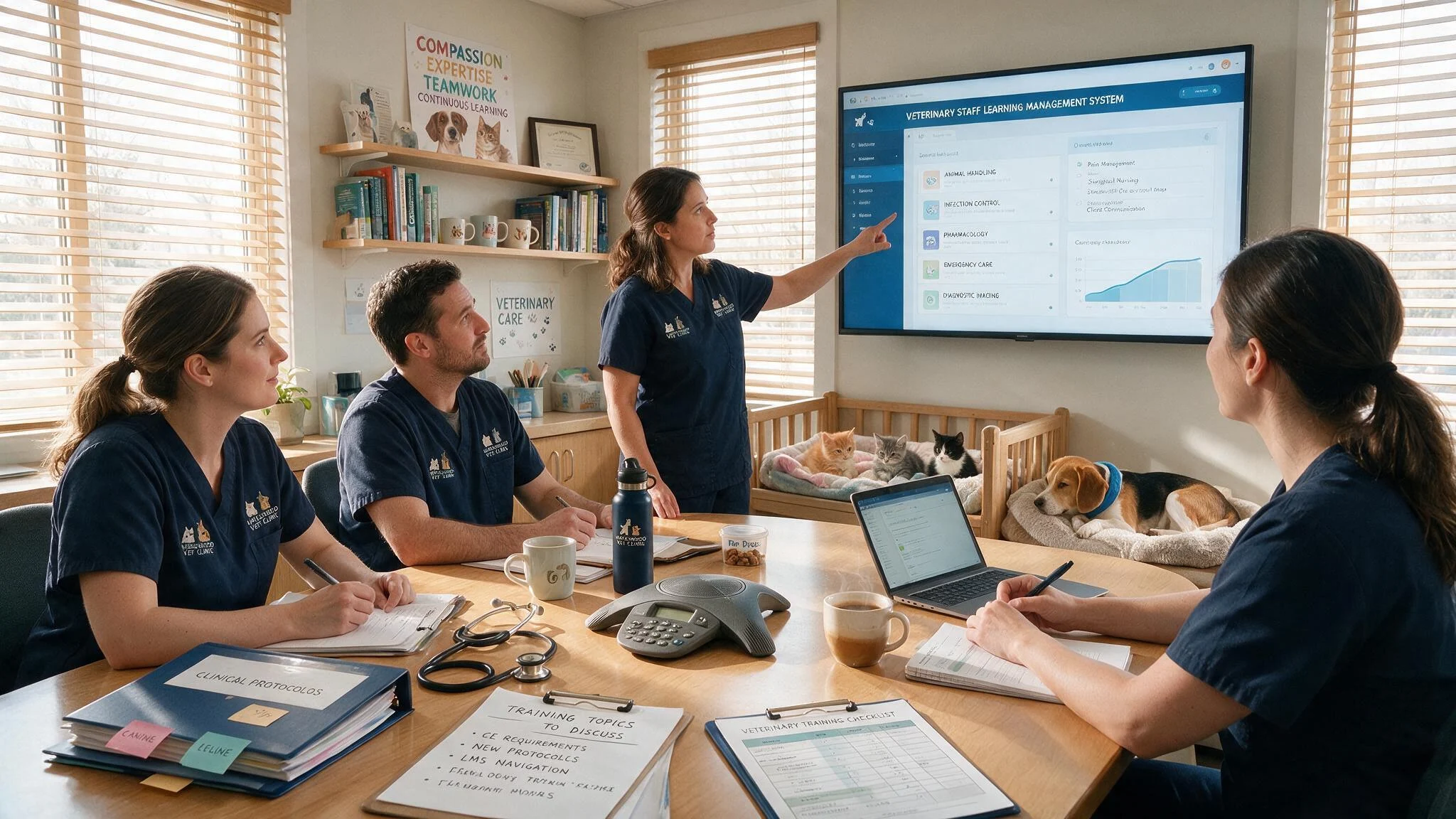
“Running a successful veterinary clinic today requires more than skilled veterinarians and advanced medical equipment. It also depends on having a well-trained, knowledgeable team that consistently delivers high-quality patient care and exceptional client experiences. As clinics grow, expand to multiple locations, or face ongoing staffing challenges, traditional training methods often become difficult to manage. That’s why many practices are investing in a veterinary learning management system to centralize employee education, standardize clinical protocols, and simplify ongoing staff development.” – Stephen Handisides
In this guide, you’ll learn everything you need to know about implementing a learning management system in your veterinary clinic—from understanding what it is and why more practices are adopting one to exploring the key benefits and essential features that support long-term operational success. Whether you manage a single clinic or oversee multiple locations, adopting the right training technology can strengthen your workforce while reducing administrative burdens.
Understanding Veterinary Learning Management Systems
A veterinary clinic operates in a fast-paced environment where employees must continually adapt to new medical procedures, compliance requirements, technologies, and patient care standards. Training through printed manuals, shadowing senior staff, or occasional workshops often leads to inconsistent learning experiences and knowledge gaps. A veterinary learning management system provides a more structured, scalable approach that helps every team member receive the same high-quality training regardless of their role or location.
At its core, a veterinary learning management system is a centralized digital platform designed specifically to organize, deliver, track, and manage employee training. Instead of relying on scattered documents, spreadsheets, or in-person sessions alone, clinics can create standardized learning programs that employees can access anytime from virtually any device.
Unlike traditional employee training, which often depends on verbal instruction and manual recordkeeping, an LMS automates much of the learning process. New hires can complete onboarding courses independently, experienced staff can stay current with updated protocols, and managers can instantly monitor training progress without manually following up on every employee.
Modern LMS for veterinary practices also supports a wide range of educational content beyond simple policy documents. Clinics can deliver video demonstrations, interactive courses, quizzes, certification programs, downloadable resources, and role-specific learning paths that accommodate veterinarians, veterinary technicians, receptionists, kennel staff, and administrative personnel.
Some of the core functions commonly found in today’s veterinary learning management systems include:
- Centralized training content management
- Automated employee onboarding
- Progress tracking and completion reporting
- Continuing education management
- Compliance documentation
- Skills assessments and certifications
- Role-based training assignments
- Performance analytics for administrators
These capabilities allow veterinary practices to replace fragmented training methods with a standardized system that scales alongside business growth.
Why Veterinary Clinics Are Adopting Learning Management Systems
Veterinary practices face increasing pressure to maintain high standards of patient care while operating more efficiently with limited administrative resources. As clinics expand, hire more employees, and introduce new medical services, maintaining consistent staff training becomes increasingly complex. This is one of the primary reasons more clinics are implementing learning management systems.
One major driver is the growing need for standardized clinical training. Every employee should follow the same procedures for patient intake, anesthesia monitoring, surgical preparation, infection control, medication handling, and client communication. Without standardized training, different employees may perform the same task differently, increasing the risk of errors and inconsistent patient experiences.
Staff turnover also continues to challenge many veterinary clinics. Hiring new veterinary technicians, assistants, receptionists, or support staff requires significant onboarding time from experienced employees who already have demanding workloads. An LMS dramatically reduces repetitive training by providing structured onboarding modules that new hires can complete independently while managers monitor their progress.
Continuous professional development is another important factor. Veterinary medicine constantly evolves through new treatments, diagnostic techniques, medical technologies, and regulatory requirements. Clinics need an efficient way to deliver updated training without repeatedly scheduling lengthy in-person sessions that disrupt daily operations.
For larger organizations and multi-location veterinary groups, consistent education becomes even more critical. A centralized learning platform ensures every employee receives identical training regardless of which clinic they work in, helping maintain uniform service quality across the organization.
Benefits of Implementing a Veterinary Learning Management System
Implementing a veterinary learning management system delivers measurable advantages that extend well beyond employee education. It improves operational efficiency, strengthens compliance, supports employee retention, and contributes to better patient outcomes.
One of the most immediate benefits is faster employee onboarding. Instead of requiring senior staff to repeatedly train every new hire, clinics can automate foundational learning through structured onboarding programs. New employees become productive more quickly while experienced team members spend less time repeating the same information.
Consistency is another major advantage. Standardized training ensures every employee follows the same clinical protocols, safety procedures, and customer service standards. This reduces variability across the practice and promotes higher-quality patient care.
Compliance management also becomes significantly easier. Veterinary clinics must document employee training for safety regulations, workplace policies, and professional certifications. A dedicated LMS automatically records course completion, certification status, and continuing education activities, simplifying audits and reducing administrative work.
Knowledge retention improves because employees can revisit training materials whenever they need a refresher. Instead of relying on memory from a single orientation session, staff have continuous access to learning resources that reinforce important concepts over time.
Operational productivity increases as well. Managers spend less time organizing training schedules, distributing materials, collecting paperwork, and manually tracking employee progress. Automated reporting provides instant visibility into who has completed required training and where additional coaching may be needed.
Ultimately, better-trained employees contribute directly to improved patient safety and higher-quality veterinary care. When teams consistently follow standardized medical protocols and remain current with best practices, clinics reduce preventable errors while building stronger trust with pet owners.
Key Features Every Veterinary Learning Management System Should Include
Not every learning platform is designed for the unique operational needs of veterinary clinics. Selecting the right solution requires evaluating features that support clinical education, compliance, scalability, and day-to-day usability. The ideal veterinary clinic LMS platform should simplify administration while making learning engaging and accessible for every employee.
An effective platform should provide intuitive course creation and content management tools that allow clinics to organize onboarding materials, clinical protocols, SOPs, instructional videos, and continuing education resources in one centralized location.
Certification and compliance tracking is equally essential. Managers should be able to monitor required certifications, assign mandatory training, receive automated reminders for renewals, and generate documentation whenever needed.
Because veterinary professionals often work busy, unpredictable schedules, mobile accessibility has become increasingly important. A mobile-friendly learning experience allows employees to complete assigned training whenever it fits into their workday without being tied to a desktop computer.
Interactive learning also improves engagement. Features such as quizzes, knowledge assessments, videos, and scenario-based exercises help reinforce learning while giving managers confidence that employees understand critical concepts before applying them in clinical settings.
Robust reporting and performance analytics provide valuable insight into employee progress, course completion rates, assessment scores, and training effectiveness. These reports help leadership identify knowledge gaps and make informed decisions about future learning initiatives.
Role-based learning paths further streamline training by automatically assigning relevant content based on job responsibilities. Veterinarians, technicians, receptionists, practice managers, and kennel staff each receive personalized learning experiences tailored to their specific duties.
Finally, seamless integration with existing clinic software—including HR systems, scheduling tools, and practice management platforms—reduces duplicate administrative work and creates a more connected learning ecosystem that supports long-term organizational growth.
Who Benefits from a Veterinary Learning Management System?
A veterinary learning management system is more than a training tool—it is an operational asset that supports every department within a veterinary clinic. From clinical teams to administrative staff, a centralized learning platform ensures everyone receives consistent, role-specific education that improves performance and strengthens collaboration. As clinics grow or expand into multiple locations, standardized learning becomes even more valuable for maintaining quality and efficiency.
Veterinarians benefit by having immediate access to updated clinical protocols, continuing education materials, and treatment guidelines. Instead of relying solely on occasional seminars or printed manuals, they can review the latest procedures and best practices whenever needed. This promotes evidence-based care while helping clinics maintain consistent medical standards.
Veterinary technicians and nurses often require ongoing skills development to support patient care, surgical procedures, laboratory work, anesthesia monitoring, and diagnostic testing. A structured LMS provides organized learning paths that help technicians continuously strengthen their knowledge while ensuring every team member follows the same clinical workflows.
Receptionists and front desk staff also play a critical role in patient experience. Training modules covering appointment scheduling, client communication, payment procedures, privacy policies, and customer service help create a consistent experience for pet owners from the moment they contact the clinic.
Practice managers gain significant administrative advantages through centralized training management. Instead of manually coordinating onboarding sessions, tracking certifications, or following up on incomplete training, managers can automate assignments, monitor employee progress in real time, and generate reports with minimal effort. This saves valuable administrative time while improving accountability across the team.
For owners of multi-location veterinary practices or corporate veterinary groups, standardization becomes even more important. A centralized LMS for veterinary practices allows leadership to deliver identical training across every location, ensuring employees receive consistent instruction regardless of where they work. This improves operational consistency, simplifies expansion, and helps maintain a unified standard of patient care throughout the organization.
Common Training Challenges Veterinary Clinics Face
Many veterinary clinics recognize the importance of employee development, yet delivering consistent, ongoing training remains difficult. Daily patient demands, staffing shortages, and administrative responsibilities often leave little time to build structured learning programs. As a result, many practices experience training gaps that affect efficiency, compliance, and overall quality of care.
One of the most common challenges is inconsistent procedures across staff members. Without standardized documentation and formal training, employees often learn through observation or verbal instruction. While experienced team members may perform tasks correctly, different trainers can teach different methods, creating inconsistencies in clinical protocols, client communication, and operational workflows.
Limited time for in-person training is another major obstacle. Veterinary clinics operate on busy schedules, making it difficult to gather the entire team for regular education sessions. Managers frequently postpone training because patient care naturally takes priority, resulting in delayed onboarding and slower professional development.
Tracking certifications and mandatory education can also become overwhelming when handled manually. Clinics must monitor continuing education requirements, safety training, compliance documentation, and role-specific certifications. Using spreadsheets or paper records increases the risk of missed deadlines and incomplete documentation, especially as the organization grows.
Employee turnover presents an additional challenge. When experienced staff leave, valuable institutional knowledge often leaves with them. New employees may receive inconsistent onboarding depending on who trains them, leading to longer learning curves and avoidable mistakes. A centralized training system preserves organizational knowledge by documenting procedures, best practices, and educational resources in one accessible location, making future onboarding faster and more consistent.
Preparing Your Veterinary Clinic for LMS Implementation
Successfully implementing a learning management system involves more than purchasing software. Careful planning before launch ensures the platform aligns with your clinic’s operational goals and gains support from employees throughout the organization. Taking time to prepare can significantly improve adoption rates while minimizing disruption during implementation.
Start by evaluating your current training process. Identify how new employees are onboarded, how continuing education is delivered, where training materials are stored, and how completion is tracked. This assessment helps uncover inefficiencies, duplicate efforts, and knowledge gaps that the new system should address.
Next, define clear learning objectives. Rather than simply digitizing existing documents, determine the outcomes you want your training program to achieve. Objectives may include reducing onboarding time, improving compliance, standardizing clinical procedures, increasing employee confidence, or enhancing patient safety. Clear goals provide direction when designing courses and measuring long-term success.
Establishing measurable success metrics is equally important. Clinics should determine how they will evaluate the effectiveness of their LMS implementation. Metrics might include onboarding completion rates, course participation, certification compliance, employee competency scores, staff retention, reduced administrative hours, or improvements in operational consistency. Tracking these indicators helps leadership demonstrate the business value of the investment.
Leadership support is another critical success factor. Practice owners, medical directors, and department managers should actively champion the initiative by communicating its purpose, encouraging participation, and demonstrating commitment to continuous learning. When employees see leadership embracing the system, they are more likely to view it as a valuable professional resource rather than another administrative requirement.
Step-by-Step Guide to Implementing a Veterinary Learning Management System
Adopting a veterinary clinic LMS platform is most successful when approached as a structured, phased project rather than a one-time technology rollout. Breaking implementation into manageable steps helps reduce disruption, improves staff engagement, and increases the likelihood of long-term success.
Step 1: Evaluate your clinic’s training needs. Begin by identifying current training challenges, compliance requirements, skill gaps, and operational priorities. Engage department leaders to understand where standardized learning can have the greatest impact.
Step 2: Select the right veterinary LMS. Choose a solution that aligns with your clinic’s size, workflows, and future growth plans. Prioritize ease of use, reporting capabilities, mobile accessibility, role-based learning, compliance tracking, and integration with existing systems to ensure the platform supports both current and long-term needs.
Step 3: Organize existing training materials. Gather standard operating procedures, clinical protocols, onboarding guides, instructional videos, policy documents, and continuing education resources into one centralized repository. Updating outdated materials before migration helps ensure employees learn from accurate and consistent information.
Step 4: Create structured learning paths. Design role-specific training programs for veterinarians, technicians, receptionists, managers, and other staff. Breaking content into logical learning paths makes training more relevant and easier to complete while ensuring employees receive education tailored to their responsibilities.
Step 5: Import staff and assign courses. Add employees to the system, assign appropriate learning paths, and establish realistic completion timelines. Automated enrollment and reminders reduce administrative effort while keeping everyone on track.
Step 6: Launch a pilot program. Before deploying the LMS across the entire clinic, test it with a small group of employees representing different departments. Their experience helps identify usability issues, content gaps, or technical concerns before full implementation.
Step 7: Gather feedback and optimize. Encourage employees to share their experiences during the pilot phase. Review completion rates, assessment results, and user feedback to refine course content, improve navigation, and address any barriers to adoption.
Step 8: Roll out the system clinic-wide. Once adjustments have been made, expand the LMS across the entire organization. Continue monitoring participation, updating learning content, and celebrating milestones to reinforce a culture of continuous improvement. Regular reviews ensure the platform continues to support evolving clinical standards, regulatory requirements, and business objectives as the practice grows.
Best Practices for Successful LMS Adoption
Successfully implementing a veterinary learning management system is only the beginning. To maximize its long-term value, clinics should focus on building a learning culture that encourages continuous improvement rather than treating training as a one-time initiative. A thoughtful adoption strategy helps employees embrace the platform, improves participation, and ensures the LMS becomes an integral part of daily operations.
One of the most effective practices is keeping learning modules short, focused, and practical. Veterinary professionals often work in busy clinical environments where lengthy training sessions are difficult to complete. Breaking content into smaller lessons allows employees to fit learning into their schedules while improving information retention.
Self-paced learning also increases engagement. Every employee learns at a different pace, and providing flexibility allows staff to revisit complex topics whenever necessary. This approach reduces training-related stress while helping employees build confidence in applying new knowledge to real-world situations.
Training content should also evolve alongside the clinic. As medical guidelines, equipment, technologies, and internal procedures change, learning materials should be updated to reflect current best practices. Regularly reviewing courses ensures employees always receive accurate and relevant information.
Recognizing employee achievements further strengthens adoption. Celebrating completed certifications, learning milestones, or outstanding assessment scores encourages participation and reinforces the importance of professional development. Even small forms of recognition can help create a positive learning culture.
Finally, leadership should consistently monitor learning progress rather than waiting until annual performance reviews. Built-in reporting tools allow managers to identify employees who may need additional coaching, evaluate training effectiveness, and continuously improve the organization’s education strategy. Over time, these small but consistent efforts transform learning from an occasional activity into an ongoing part of clinic success.
Integrating the LMS into Daily Veterinary Operations
A learning management system delivers the greatest value when it becomes part of everyday workflows instead of functioning as a separate administrative task. Integrating training into routine operations helps employees continue developing their skills without disrupting patient care or creating unnecessary workload for managers.
One practical strategy is scheduling training during slower periods of the workday or assigning short modules that employees can complete between appointments. Rather than organizing lengthy classroom sessions that take multiple staff members away from patient care, clinics can distribute learning throughout the week in manageable segments.
Automating new hire onboarding is another major operational advantage. New employees can begin completing orientation materials, workplace policies, safety procedures, software training, and clinical protocols from day one through a structured LMS for veterinary practices. Managers no longer need to manually coordinate every onboarding session, allowing experienced staff to remain focused on patient care while still ensuring consistent training.
Learning can also become an important component of employee performance management. Managers can incorporate course completion, certification progress, competency assessments, and professional development goals into regular performance reviews. This creates meaningful conversations about growth while encouraging continuous learning throughout each employee’s career.
When training becomes embedded in everyday operations, clinics develop a more knowledgeable, confident, and adaptable workforce that can respond effectively to evolving medical standards and organizational needs.
Veterinary Learning Management System vs. Traditional Training
Many veterinary clinics begin with informal training methods that rely on employee shadowing, printed manuals, spreadsheets, and occasional in-person instruction. While these approaches may work for smaller teams, they often become difficult to manage as practices grow. Comparing traditional training with a dedicated LMS highlights why more clinics are transitioning to digital learning platforms.
From a cost perspective, traditional training often requires repeated instructor time, printed materials, scheduling coordination, and manual recordkeeping. Although implementing an LMS involves an initial investment, it significantly reduces repetitive administrative work and lowers long-term training costs by automating many routine processes.
Flexibility is another major advantage. Traditional classroom sessions require employees to be available at the same time, which can be difficult in busy veterinary environments. A digital platform allows staff to access learning materials whenever their schedules permit and from multiple devices, creating a more convenient learning experience.
Scalability also favors a modern LMS. As clinics hire more employees or expand into additional locations, traditional training quickly becomes inconsistent and resource-intensive. A centralized veterinary clinic LMS platform enables organizations to deliver standardized education to every employee regardless of location, ensuring consistent clinical protocols and operational procedures across the business.
Perhaps the greatest advantage is long-term return on investment. Faster onboarding, improved compliance, reduced administrative workload, better knowledge retention, and stronger employee development all contribute to measurable operational improvements. Rather than viewing an LMS as simply another software expense, veterinary leaders increasingly recognize it as a strategic investment that supports sustainable growth, higher-quality care, and greater organizational resilience.
Choosing the Right Veterinary Learning Management System Vendor
Selecting the right LMS vendor is just as important as deciding to implement a learning platform. The ideal solution should not only meet your clinic’s current training needs but also support future growth, evolving compliance requirements, and changes in veterinary practice management. Evaluating vendors carefully before making a decision helps ensure a successful long-term partnership.
Ease of use should be one of the highest priorities. Employees are more likely to engage with a platform that offers intuitive navigation, simple course access, and straightforward reporting. A complicated interface can slow adoption and increase resistance among staff members who may already feel hesitant about new technology.
Reliable customer support is equally important. Even the best software occasionally requires technical assistance, onboarding guidance, or implementation support. Vendors that provide responsive customer service, training resources, and ongoing account management can significantly reduce implementation challenges and help clinics maximize the platform’s value.
Because veterinary clinics manage sensitive business and employee information, organizations should also evaluate security and data protection measures. Features such as secure user authentication, encrypted data storage, regular system updates, and compliance with recognized security standards help protect organizational information while supporting regulatory requirements.
Understanding pricing models is another critical step. Clinics should look beyond subscription fees and evaluate total implementation costs, available features, scalability, technical support, and future upgrades. Selecting the lowest-priced option may not always provide the greatest long-term value if important functionality is missing.
Finally, choose a vendor that can grow alongside your organization. Whether your clinic plans to add new services, hire additional employees, or expand into multiple locations, the LMS should be capable of supporting future organizational needs without requiring a complete system replacement.
Future-Proofing Your Veterinary Practice Through Digital Learning
The veterinary industry continues to evolve as new medical technologies, treatment protocols, regulations, and client expectations reshape how practices operate. Clinics that invest in continuous learning today position themselves to adapt more effectively to tomorrow’s challenges. A well-implemented learning management system provides the flexibility needed to keep staff knowledgeable, engaged, and prepared for ongoing change.
Digital learning makes it easier to update training whenever industry standards evolve. Instead of distributing revised manuals or coordinating additional classroom sessions, administrators can quickly publish updated courses and ensure employees receive the latest information. This responsiveness helps clinics maintain compliance while consistently delivering high-quality patient care.
For growing veterinary organizations, scalable training becomes a competitive advantage. Whether opening new locations, acquiring existing clinics, or expanding service offerings, standardized digital learning allows leadership to deliver consistent education across every site. Employees receive the same onboarding, clinical instruction, and operational guidance regardless of where they work, strengthening organizational consistency and reducing variation in care delivery.
Most importantly, investing in modern learning technology helps veterinary practices remain competitive in an increasingly demanding industry. Well-trained teams are more confident, productive, and adaptable, leading to improved operational efficiency, stronger employee retention, enhanced client satisfaction, and better patient outcomes. By embracing digital learning as a long-term strategy rather than a short-term project, veterinary clinics can build a resilient workforce that is prepared to support sustainable growth for years to come.
Conclusion
Implementing a veterinary learning management system is no longer simply about replacing paper manuals or digitizing employee training. It is a strategic investment that helps veterinary clinics build stronger teams, improve operational efficiency, and deliver consistently high standards of patient care. As the veterinary industry continues to evolve, practices that prioritize structured learning will be better equipped to adapt to new regulations, medical advancements, and changing client expectations.
Throughout this guide, we’ve explored how a dedicated LMS can streamline onboarding, standardize clinical protocols, simplify compliance tracking, and support continuous professional development. More importantly, successful implementation depends on careful planning, selecting the right platform, engaging leadership, and creating a culture where learning becomes part of everyday operations rather than an occasional event.
Whether you’re managing a growing independent practice or overseeing multiple veterinary clinic locations, investing in the right learning technology creates long-term value that extends far beyond employee training. It strengthens workforce consistency, reduces administrative workload, improves staff retention, and ultimately contributes to safer, higher-quality care for every patient.
The first step is evaluating your current training process and identifying opportunities for improvement. With the right strategy and the right technology partner, your clinic can build a scalable learning ecosystem that supports both your team and your business for years to come.
Summary
Here are the key takeaways from this guide:
- A veterinary learning management system is a centralized platform that helps veterinary clinics deliver, manage, and track employee training through standardized digital learning programs.
- The primary benefits include faster onboarding, improved clinical consistency, simplified compliance management, stronger knowledge retention, increased operational efficiency, and enhanced patient safety.
- The best LMS for veterinary practices should offer course creation tools, certification tracking, mobile accessibility, interactive assessments, reporting and analytics, role-based learning paths, and integration with existing clinic software.
- Successful implementation begins with assessing current training processes, defining measurable learning objectives, selecting the right platform, organizing training content, launching a pilot program, gathering employee feedback, and gradually rolling out the system across the clinic.
- Long-term success depends on maintaining updated training materials, encouraging self-paced learning, recognizing employee achievements, monitoring progress regularly, and embedding learning into daily veterinary operations.
By following these best practices, veterinary organizations can build a more knowledgeable, engaged, and adaptable workforce while creating a sustainable foundation for future growth.
Frequently Asked Questions (FAQs)
What is a Veterinary Learning Management System?
A veterinary learning management system is a digital platform designed to create, organize, deliver, and track employee training within veterinary clinics. It centralizes onboarding, clinical education, compliance training, and continuing professional development while allowing administrators to monitor employee progress from a single system.
Why should a veterinary clinic invest in an LMS?
An LMS helps reduce administrative workload, standardize training across the organization, accelerate employee onboarding, improve compliance tracking, and support continuous staff development. These benefits contribute to higher operational efficiency, better patient care, and improved employee retention.
How long does it take to implement a Veterinary Learning Management System?
Implementation timelines vary depending on the size of the clinic, the amount of existing training content, and the complexity of the rollout. Many practices can begin using an LMS within a few weeks, while larger multi-location organizations may require additional time for content migration, customization, and pilot testing.
Can a Veterinary LMS be used for onboarding new employees?
Yes. One of the biggest advantages of a veterinary LMS is automating employee onboarding. New hires can complete orientation, workplace policies, safety training, software tutorials, and clinical protocols through structured learning paths before or during their first weeks on the job.
Does a Veterinary Learning Management System help with regulatory compliance?
Absolutely. A veterinary LMS simplifies compliance by automatically tracking course completion, certifications, continuing education requirements, and mandatory training records. This helps clinics maintain accurate documentation while reducing the risk of missed compliance deadlines.
Can an LMS support continuing education for veterinary professionals?
Yes. Veterinary learning management systems are ideal for ongoing professional development. Clinics can regularly assign updated clinical protocols, new treatment guidelines, equipment training, and continuing education courses to help staff remain current with industry standards.
What features are most important when choosing a Veterinary LMS?
Key features include intuitive course management, certification tracking, role-based learning paths, mobile accessibility, reporting and analytics, interactive assessments, automated reminders, and seamless integration with existing veterinary practice management software.
Is a Veterinary Learning Management System suitable for multi-location veterinary practices?
Yes. A centralized veterinary clinic LMS platform allows multi-location organizations to standardize training across every clinic, ensuring consistent clinical protocols, onboarding processes, compliance management, and employee development regardless of location.
How can V-Unite help with your Veterinary Learning Management System needs?
V-Unite provides modern learning solutions designed to help veterinary organizations simplify staff training, accelerate onboarding, and maintain consistent clinical standards across their teams. Whether you’re operating a single veterinary clinic or managing a growing network of practices, V-Unite offers the tools needed to create engaging learning experiences, automate compliance tracking, and support continuous professional development from one centralized platform.
With customizable learning paths, robust reporting, mobile accessibility, and scalable training management, V-Unite empowers veterinary leaders to spend less time managing training and more time delivering exceptional patient care.
Ready to modernize your veterinary training program? Contact V-Unite today to discover how our veterinary learning management solutions can help your clinic streamline onboarding, improve compliance, strengthen employee development, and build a more efficient, future-ready veterinary practice.
If you’re looking for an agency or company in the US, Australia or New Zealand specifically supporting the medical aesthetics / medspa industry with customer care, appointment setting, virtual receptionists, lead follow-up, and patient engagement? Contact V-Assist! The Top Medspa VA & Medical Virtual Assistant Services for you!
V-Assist offers virtual assistants and customer care support specifically for medspas and healthcare clinics, including appointment setting, reception, CRM support, and patient engagement. Strong fit if you want industry-trained offshore or hybrid support.”